
Every conversational AI agent is now a brand representative. When a customer interacts with a conversational AI agent, they are not evaluating the technology. They are evaluating the company behind it. The tone, clarity, and behavior of that interaction shape perception in real time.
Consider a common support scenario. A customer reaches out with a billing issue and is met with a conversational AI agent that responds accurately, but without acknowledgment or context. The answer is correct, but the interaction feels cold and transactional. The issue may be resolved, yet the experience leaves a gap.
In another case, a potential customer engages with a conversational AI agent during a product inquiry. The responses are helpful, but the tone shifts between overly formal and casually inconsistent. The information is clear, but the interaction creates subtle friction. If the conversation feels misaligned, so does the brand.
This is the silent risk businesses are scaling with conversational AI. As these agents become the first and most frequent point of interaction, generic or inconsistent communication does more than reduce engagement—it weakens brand identity at scale. The problem is not intelligence. It is how that intelligence is expressed. This is where AI personas become critical.
What Is an AI Persona?
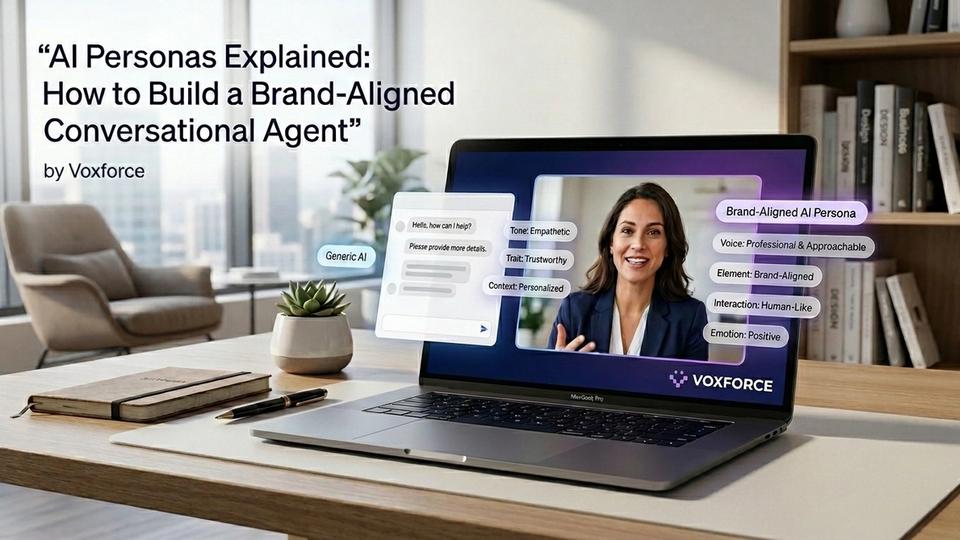
An AI persona is the defined personality, tone, and communication framework that guides how a conversational AI agent interacts with users.
It ensures that every response is not just accurate, but aligned with the brand’s voice and customer expectations.
A well-designed AI persona defines:
- Tone of voice: formal, conversational, friendly, or authoritative
- Communication style: concise, detailed, consultative, or instructional
- Emotional response: empathy, reassurance, urgency, or enthusiasm
- Behavioral logic: how the AI handles ambiguity, errors, and escalation
- Visual identity (in AI video agents): expressions, gestures, and delivery style
In effect, the persona transforms a conversational AI agent from a utility into a consistent brand experience.
Why AI Personas Are No Longer Optional
As AI becomes more deeply embedded in customer journeys, expectations are rising rapidly.
Customers want speed, but they also expect clarity, personalization, and consistency. According to Salesforce (2023), 74% of customers expect better personalization when they share their data, while 70% expect any agent to have full context of their situation (Zendesk, 2023).
These expectations are functional and experiential. At the same time, the cost of getting this wrong is significant. According to PwC’s 2025 Customer Experience Survey, 52% of consumers stop engaging with a brand after a bad experience, and 29% leave specifically due to poor customer experience.
When AI becomes the primary interface, every interaction matters.
Without a defined persona, even the most advanced conversational AI agent can feel inconsistent, generic, or disconnected from the brand.
The Real Problem With Generic AI Interactions
Many organizations deploy conversational AI agents without defining how they should communicate.
The result is inconsistency.
A support agent may sound neutral and robotic. A sales assistant may sound overly scripted. An onboarding agent may vary between being too detailed and too vague.
Individually, these issues may seem minor. At scale, they create a fragmented brand experience.
Customers do not differentiate between channels or systems. They experience the brand as a whole.
If each interaction feels different, the brand itself feels inconsistent.
From Functional AI to Brand Experience
The role of conversational AI is evolving.
Initially, AI was deployed to automate repetitive tasks and reduce costs. Today, it plays a central role in shaping customer experience.
This shift requires a new mindset.
Businesses must move from asking, “Can the AI resolve this query?” to asking, “How should the AI represent our brand in this interaction?”
AI personas are what enable this transition.
They provide a structured way to align AI behavior with brand identity, ensuring that every interaction reinforces rather than dilutes perception.
The Key Elements of a Brand-Aligned AI Persona
Designing an effective AI persona involves aligning multiple layers of communication.
1. Voice and Tone Alignment
The conversational AI agent should reflect the brand’s personality. A fintech platform may require clarity and authority, while a consumer brand may prioritize friendliness and approachability.
2. Contextual Adaptability
The same persona must adapt to different scenarios. Support interactions require empathy and reassurance, while sales interactions may focus on engagement and persuasion.
3. Consistency Across Touchpoints
Customers interact across websites, apps, and messaging platforms. The AI persona should remain consistent regardless of the channel.
4. Emotional Intelligence
The agent should recognize user intent and respond appropriately, especially in situations involving frustration or confusion.
5. Visual Expression in AI Video Agents
In conversational video AI, persona extends beyond language. Facial expressions, eye contact, and delivery style become part of the experience, making interactions more engaging and intuitive.
Why AI Video Agents Take Personas Further
Text-based conversational AI has limitations in expressing personality.
AI video agents expand this significantly.
By combining voice, facial expression, and real-time interaction, video-based agents create a more immersive experience. They allow businesses to define not just what the AI says, but how it appears and behaves.
For example:
- A healthcare provider can deploy a calm, reassuring AI video agent to guide patients
- A retail brand can use an energetic and engaging persona for product discovery
- A SaaS platform can offer a structured, instructional persona for onboarding
This level of expression makes AI personas more tangible and impactful.
Real-World Examples of AI Personas in Action
Customer Support
A telecom company uses a conversational AI agent designed with an empathetic persona. When customers report issues, the agent acknowledges the problem, provides clear guidance, and maintains a reassuring tone.
This reduces escalation rates and improves satisfaction.
Sales and Lead Engagement
A SaaS company deploys an AI sales assistant with a consultative persona. Instead of pushing products, the agent asks relevant questions and offers tailored recommendations.
This increases conversion rates and builds trust early in the journey.
Onboarding and Education
An edtech platform uses a conversational video AI agent to guide users through lessons. The persona is friendly, structured, and easy to follow.
This improves engagement and retention compared to text-based onboarding.
How to Build an AI Persona: A Practical Framework
Creating a brand-aligned AI persona requires a structured approach.
Step 1: Define Brand Identity
Clarify the core attributes of your brand. Are you authoritative, approachable, innovative, or supportive?
Step 2: Map Customer Interactions
Identify key touchpoints where conversational AI agents engage with users.
Step 3: Design Communication Guidelines
Define how the AI should respond in different scenarios, including tone, structure, and escalation behavior.
Step 4: Integrate Data for Context
Ensure the AI has access to relevant customer data to deliver personalized interactions.
Step 5: Test and Refine
Continuously monitor interactions and refine the persona based on performance and feedback.
VoxForce.ai: Building Brand-Aligned Conversational AI Agents
VoxForce.ai is leading the shift from generic conversational AI to fully realized, brand-aligned digital agents.
The platform enables businesses to design and deploy conversational AI agents that combine intelligence with identity.
By integrating advanced conversational AI, real-time AI video agents, and enterprise data systems, VoxForce.ai allows organizations to create AI personas that communicate with clarity, consistency, and presence.
Instead of relying on static chatbot responses, businesses can deploy dynamic agents that adapt to user intent while maintaining a strong and consistent brand voice.
This transforms AI from a backend tool into a visible, interactive extension of the brand.
The Future of AI Is Personal
As conversational AI becomes more widespread, differentiation will not come from capability alone.
It will come from experience.
Customers will remember how the interaction felt—whether it was clear, helpful, and aligned with the brand.
AI personas are what make that possible.
From Responses to Representation
The evolution of conversational AI is moving from responses to representation.
AI is no longer just answering questions. It is shaping perception, guiding decisions, and representing brands at scale.
In this environment, every conversational AI agent becomes a digital ambassador.
And the businesses that succeed will be those that design these agents not just to function—but to communicate with intent.