
Healthcare has witnessed extraordinary advances in medical science over the past few decades. Breakthroughs in diagnostics, treatment protocols, precision medicine, and digital health technologies have transformed the way diseases are identified and managed. Yet amid all this progress, one challenge continues to persist across healthcare systems worldwide. Communication remains one of the weakest links in the patient journey.
Patients today have access to more medical information than ever before, but access does not automatically translate into understanding. Many leave consultations feeling informed at the moment, only to become uncertain once they return home and attempt to apply medical advice in real life. Questions emerge, instructions are forgotten, and anxiety often fills the gaps between appointments. In many cases, the success of a treatment plan depends less on what happens inside a clinic and more on what happens after a patient walks out the door.
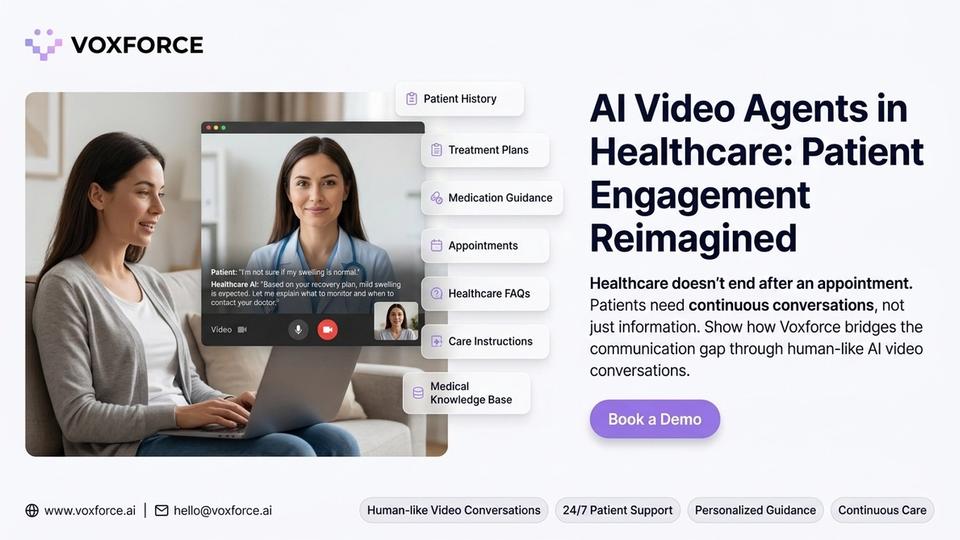
This is where a new generation of healthcare technology is beginning to make a meaningful impact. AI video agents combine conversational intelligence, voice interaction, and visual communication to create more engaging and accessible patient experiences. Rather than forcing patients to navigate portals, documents, and support channels independently, these systems create an ongoing dialogue that helps patients understand, remember, and act on healthcare guidance more effectively.
At VoxForce.ai, we believe this shift represents something much larger than automation. It reflects a fundamental rethinking of patient engagement itself.
Healthcare Has Traditionally Been Appointment Centric While Patients Experience Health Continuously
Most healthcare systems are designed around appointments. Patients meet physicians, receive diagnoses, discuss treatment plans, and return weeks or months later for follow up consultations. From an operational perspective, this model is logical and efficient.
Patients, however, do not experience their health in appointments.
A patient managing diabetes makes decisions every day about diet, medication, exercise, and monitoring. A cardiac patient recovering after surgery faces questions and concerns long after discharge. Someone beginning a new medication may encounter unexpected side effects or uncertainties that emerge outside clinical settings.
The reality is that health is continuous, while healthcare interactions are often intermittent.
This disconnect creates one of the largest gaps in modern healthcare. Medical expertise is concentrated within healthcare facilities, while patients spend the vast majority of their time managing health independently. When questions arise between appointments, many patients turn to internet searches, fragmented online resources, or delayed support channels that may not provide contextually relevant guidance.
Imagine a patient who has recently undergone knee replacement surgery. During discharge, the care team explains medication schedules, mobility precautions, rehabilitation exercises, and recovery milestones. The instructions are thorough and clinically accurate. Yet three days later, when the patient is uncertain about swelling, exercise intensity, or pain management, the discharge document may not feel like a practical source of reassurance.
A conversational video AI agent changes that dynamic. Instead of searching through paperwork or waiting for assistance, the patient can engage in a natural conversation, ask questions as they arise, and receive guidance in a format that feels immediate and easy to understand.
The interaction becomes less about accessing information and more about maintaining continuity of understanding.
Patients Do Not Need More Information They Need More Clarity
Healthcare organizations have historically responded to communication challenges by providing more information. Educational brochures, patient portals, discharge packets, and digital resources have expanded dramatically over the years.
The assumption is understandable. Better informed patients should theoretically make better decisions.
In practice, however, information overload often creates its own barriers. A patient discharged after a hospital stay may receive pages of instructions covering medications, dietary recommendations, follow up schedules, warning signs, and recovery expectations. While all of this information is valuable, absorbing and applying it can become overwhelming, particularly when patients are recovering from illness or coping with stress.
The challenge is rarely information availability. The challenge is delivering the right information at the moment it becomes relevant.
Consider a patient newly diagnosed with hypertension. During a consultation, the physician discusses lifestyle modifications, medication adherence, dietary considerations, and long term health risks. The patient understands the discussion at the time. Days later, however, practical questions begin to surface. Which foods should be avoided? What happens if medication is missed? How quickly should blood pressure readings improve?
An AI video agent can respond to these questions conversationally, transforming static information into an ongoing guidance experience. Rather than forcing patients to absorb everything at once, healthcare organizations can provide support in manageable and relevant moments throughout the patient journey.
This is a fundamentally different approach to patient engagement because it prioritizes understanding over information delivery.
Why Video Creates a More Effective Healthcare Experience
Human communication has always relied on more than words alone. Tone, pacing, facial expression, and visual cues play an important role in how people interpret information and build trust.
Healthcare is particularly dependent on these factors because patients are often dealing with uncertainty, stress, and emotional vulnerability. In these situations, communication quality becomes just as important as communication accuracy.
This is one reason video has become such a powerful medium for engagement across industries. Visual communication feels more intuitive because it aligns closely with how people naturally process information.
Imagine a patient beginning a complex medication regimen after cancer treatment. Written instructions can explain dosage schedules and side effects, but many patients still feel uncertain about what to expect. A conversational video AI agent can walk through the same information in a more accessible way, emphasizing key points through voice, pacing, and visual explanation. Questions can be addressed immediately rather than requiring another call or appointment.
The difference may seem subtle, but it changes the patient experience significantly. Information becomes guidance. Instructions become conversations.
For elderly patients, individuals with limited health literacy, or those managing chronic conditions, this distinction can have a meaningful impact on engagement and confidence.
The Future of Patient Engagement Is Continuous, Not Reactive
Much of healthcare communication today remains reactive. Support is often triggered when patients call with questions, miss appointments, or experience complications.
A more effective model focuses on proactive engagement.
AI video agents create opportunities for healthcare organizations to maintain meaningful communication throughout the patient journey rather than only at critical intervention points. A patient recovering from cardiac surgery, for example, can receive regular check ins, reminders, educational guidance, and encouragement during the recovery process. Questions can be addressed before they become sources of confusion or non adherence.
Similarly, patients managing chronic conditions can receive ongoing support that reinforces treatment plans and healthy behaviors. Instead of relying entirely on periodic appointments, healthcare organizations can establish a communication layer that remains present between clinical interactions.
This approach reflects a broader shift in healthcare philosophy. The focus moves from episodic care delivery toward continuous patient engagement.
As healthcare systems increasingly prioritize outcomes rather than activity, maintaining patient understanding between appointments becomes a strategic priority rather than a supplementary service.
Improving Access Without Increasing Administrative Burden
Healthcare providers face growing pressure to serve larger patient populations while maintaining high standards of care. At the same time, administrative workloads continue to consume significant portions of clinical resources.
Many patient inquiries involve important but routine topics such as appointment preparation, medication instructions, insurance processes, follow up requirements, or post treatment guidance. While these questions deserve attention, they often compete with more urgent clinical responsibilities.
AI powered digital agents can help healthcare organizations address this challenge more effectively.
Consider a patient preparing for an MRI scan who is uncertain about fasting requirements or arrival instructions. Another patient may need clarification regarding prescription refills or follow up scheduling. These interactions are important for patient satisfaction and care continuity, yet they do not always require direct clinician involvement.
Conversational video AI can provide immediate, accurate, and accessible guidance while allowing healthcare professionals to focus their time where clinical expertise creates the greatest value.
The objective is not replacing healthcare providers. It is extending their ability to communicate effectively at scale.
Why Trust Will Define the Next Era of Healthcare Communication
Trust remains the foundation of every successful healthcare relationship. Patients are more likely to follow treatment plans, attend follow up appointments, and engage proactively when communication feels clear, consistent, and reliable.
One of the challenges facing large healthcare organizations is maintaining that consistency across thousands or even millions of patient interactions. Information can vary across channels, departments, and support teams, creating unnecessary confusion.
AI video agents introduce a standardized communication layer that ensures patients receive accurate and approved information whenever they need it. More importantly, they make that information accessible through a conversational experience that feels approachable rather than transactional.
The future patient experience may increasingly resemble having a trusted healthcare guide rather than navigating a complex healthcare system. Patients will still rely on clinicians for diagnosis, treatment decisions, and medical expertise. However, they will also expect ongoing support that helps them understand and apply healthcare guidance in everyday life.
That expectation is already beginning to reshape how healthcare organizations think about engagement.
Why VoxForce.ai Is Building the Future of Patient Engagement
At VoxForce.ai, we believe the next chapter of healthcare innovation will be shaped not only by advances in medicine, but also by advances in communication.
Through conversational video AI, AI video avatars, and intelligent digital agents, healthcare organizations can create patient experiences that are more engaging, accessible, and scalable. These technologies help bridge the gap between clinical expertise and patient understanding by transforming healthcare communication into a continuous conversation rather than a series of isolated interactions.
The goal is not simply automation. It is helping patients feel informed, supported, and confident throughout their healthcare journey.
A New Model for Patient Engagement
For years, healthcare innovation has focused primarily on improving diagnosis and treatment. The next frontier may be helping patients engage more effectively with the care they already receive.
As healthcare becomes increasingly digital, success will depend on more than delivering information. It will depend on making that information understandable, accessible, and relevant at the moments when patients need it most.
AI video agents represent an important step toward that future. They transform communication from a static process into an interactive experience that supports patients long after appointments end.
The organizations that lead the next era of healthcare may not necessarily be those generating the most information. They may be the ones making healthcare easier to understand, easier to navigate, and ultimately easier for patients to act upon.