
A customer lands on a financial services website at 11:47 PM. She is comparing loan options, unsure about eligibility, and hesitant to proceed. There is no human agent available at that hour. A chatbot pops up - but instead of helping, it responds with rigid, templated answers. Within minutes, she leaves.
Now imagine the same scenario with a digital employee.
A lifelike AI video agent appears, greets her by context (“Looking at home loans?”), explains eligibility in simple terms, answers follow-up questions in real time, and even guides her through the application—all through natural conversation. No waiting. No friction. No drop-off.
This is not a future concept. It is the beginning of a structural shift—from human-led service models to AI-powered digital workforces.
The Workforce Is Changing, Not Just the Tools
For years, automation has been positioned as a way to assist human employees. But today, the narrative is evolving. AI is no longer just augmenting tasks—it is taking ownership of entire roles.
According to McKinsey’s “The State of AI in 2025: Agents, Innovation, and Transformationv” report, 88% of organizations report using AI in at least one business function, up from 78% the previous year, yet only about one-third have scaled it across the enterprise. This signals a clear transition phase: companies are moving from experimentation to workforce redesign.
At the same time, Gartner predicts that more than 80% of enterprises will have used generative AI APIs or deployed AI-enabled applications by the end of 2026. The implication is significant—AI is becoming embedded in the operational fabric of organizations.
This is where the concept of digital employees emerges.
What Are Digital Employees?
Digital employees are AI-powered agents capable of performing defined business functions autonomously. Unlike traditional bots that follow scripts, these systems can:
- Understand natural language (voice and text)
- Interpret intent and context
- Access enterprise systems (CRM, databases, workflows)
- Execute tasks end-to-end
- Communicate in human-like ways (voice or video)
They are not tools. They are operational entities.
A customer support digital employee, for instance, does not just answer FAQs. It resolves tickets, processes refunds, escalates intelligently, and learns from interactions.
A sales digital employee does not just capture leads. It qualifies prospects, explains products, handles objections, and moves deals forward.
Why Human-Only Workforces Are Reaching a Limit
The shift toward AI workforces is not driven by hype—it is driven by structural constraints in human-led models.
1. Scalability Challenges
Hiring, training, and managing large teams is expensive and time-consuming. Scaling customer support or sales operations requires linear increases in headcount.
2. Availability Gaps
Customers expect 24/7 engagement, but human teams operate in shifts. This creates gaps in responsiveness, especially in global markets.
3. Inconsistency in Experience
Human interactions vary. Tone, accuracy, and quality can differ across agents, leading to fragmented customer experiences.
4. Rising Cost Pressures
Operational costs continue to rise, especially in service-heavy industries like banking, telecom, and e-commerce.
Digital employees address all four challenges simultaneously. They scale instantly, operate continuously, deliver consistent interactions, and significantly reduce marginal costs.
The Evolution: From Automation to Autonomy
The journey toward digital employees can be understood in three stages:
Stage 1: Task Automation
Early chatbots and RPA systems automated repetitive tasks but lacked intelligence and adaptability.
Stage 2: Intelligent Assistance
AI copilots and assistants enhanced human productivity but still required human oversight.
Stage 3: Autonomous Digital Employees
Today’s AI agents combine reasoning, execution, and communication to operate independently within defined workflows.
This third stage is where the real transformation lies—not in efficiency gains, but in redefining how work gets done.
Real-World Examples of Digital Employees in Action
1. Customer Support Transformation
A global e-commerce company deploys AI video agents to handle post-purchase queries. Instead of waiting in queues, customers interact with a digital employee that visually demonstrates return processes, tracks orders, and resolves issues instantly.
Impact: Reduced ticket volume, faster resolution times, higher customer satisfaction.
2. AI Sales Development Representatives (SDRs)
A SaaS company replaces its first layer of sales outreach with AI-powered digital employees. These agents engage website visitors, qualify leads through conversation, and schedule demos.
Impact: Higher lead conversion rates, lower cost per acquisition, faster sales cycles.
3. Financial Services Advisory
Banks deploy conversational AI agents that explain complex financial products through video interactions. Customers receive personalized recommendations based on their profile and queries.
Impact: Improved trust, better understanding of products, increased conversions.
4. Employee Training and Onboarding
Enterprises use AI video agents as internal trainers. New employees interact with digital instructors that guide them through processes, policies, and tools.
Impact: Faster onboarding, consistent training quality, reduced HR workload.
Why Video-Led Digital Employees Are the Breakthrough
While AI adoption is accelerating, the interface layer is what determines effectiveness.
Text-based systems, even when intelligent, still limit engagement. Digital employees powered by conversational video AI unlock a new dimension:
- Human-like interaction: Voice, facial expressions, and visual cues
- Better comprehension: Complex ideas explained visually
- Stronger engagement: Users stay longer and interact more deeply
- Higher trust: Faces and voices build credibility
This is why the next generation of digital employees is not text-based—it is visual and conversational.
The Strategic Shift: Workforce as a Hybrid Model
The future is not about replacing humans entirely. It is about redefining roles.
Organizations are moving toward a hybrid workforce model:
- Digital employees handle high-volume, repetitive, and structured tasks
- Human employees focus on complex, emotional, and strategic work
This creates a more efficient system where each type of “worker” operates at its highest value.
In this model:
- A customer interacts first with a digital employee
- Complex cases are seamlessly handed over to humans
- Data and context flow continuously between both
The result is not just efficiency—it is a fundamentally better customer experience.
Turning AI Into a Scalable Workforce with voxforce.ai
As this shift accelerates, the need for robust infrastructure becomes critical. This is where voxforce.ai is defining the category.
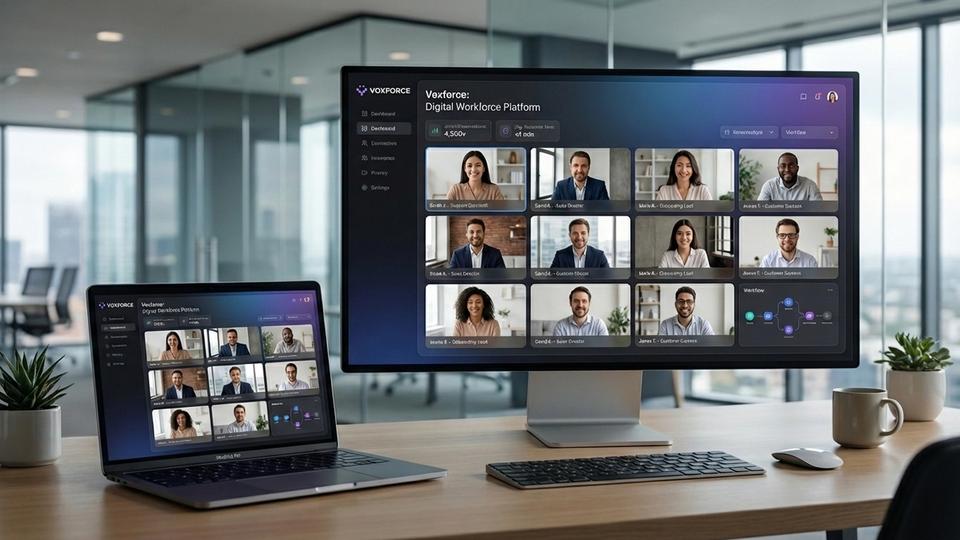
Voxforce is not building chatbots. It is building AI-powered digital employees designed for real-world business operations.
The platform integrates:
- Advanced conversational AI for reasoning and dialogue
- Real-time video avatar technology for human-like interaction
- Deep enterprise integrations for task execution
- Scalable architecture for deployment across channels
This enables businesses to deploy digital employees that are not just responsive, but proactive, contextual, and adaptive.
Unlike traditional solutions that rely on scripts or static workflows, Voxforce agents evolve with every interaction—learning, improving, and aligning with business goals.
In a market where most companies are still experimenting, Voxforce is enabling organizations to move directly toward scalable AI workforces.
The Economics of AI Workforces
Beyond experience, the shift to digital employees has strong economic implications.
AI-driven operations allow companies to:
- Reduce cost per interaction dramatically
- Increase revenue through better engagement and conversion
- Scale without proportional increases in cost
- Optimize workforce allocation
This aligns with broader economic projections. McKinsey estimates that AI-driven automation and intelligent systems could unlock trillions in value annually, particularly in service-driven sectors.
The organizations that operationalize AI early will not just save costs—they will gain a structural advantage.
The Road Ahead
We are at the beginning of a workforce transformation.
Just as industrial automation redefined manufacturing, AI is redefining knowledge work. The shift from human agents to digital employees is not a trend—it is a new operating model.
In the coming years:
- Every customer-facing function will have AI counterparts
- Digital employees will become the first point of interaction
- Interfaces will move from text to conversational video
- Organizations will compete on the intelligence and quality of their AI workforce
The question is no longer whether AI will be adopted. It is how quickly companies can integrate it into their core operations.
Conclusion
The transition from human agents to AI workforces marks one of the most significant shifts in modern business.
Digital employees are not just improving efficiency—they are redefining how organizations interact, operate, and scale.
For companies, this is a strategic inflection point. Those who continue relying solely on human-led systems will face limitations in scale, cost, and experience.
Those who embrace AI workforces—especially through conversational, video-driven interfaces—will set the new standard.
And as this transformation unfolds, platforms like voxforce.ai are not just participating in the shift—they are leading it.