
Most companies think they have a sales or support problem. In reality, they have an explanation problem.
Customers rarely drop off because a product is weak. They drop off because understanding takes too long. A feature that could have been explained in 20 seconds turns into a paragraph. A simple onboarding step becomes a support ticket. A high-intent lead leaves because no one was there to guide them at that moment.
For years, businesses tried to solve this by adding more content via FAQs, chatbots, help centers, and demo videos. But the format stayed static. Information was delivered, not experienced.
What is changing now is not just the intelligence behind these systems, but the way that intelligence is delivered.
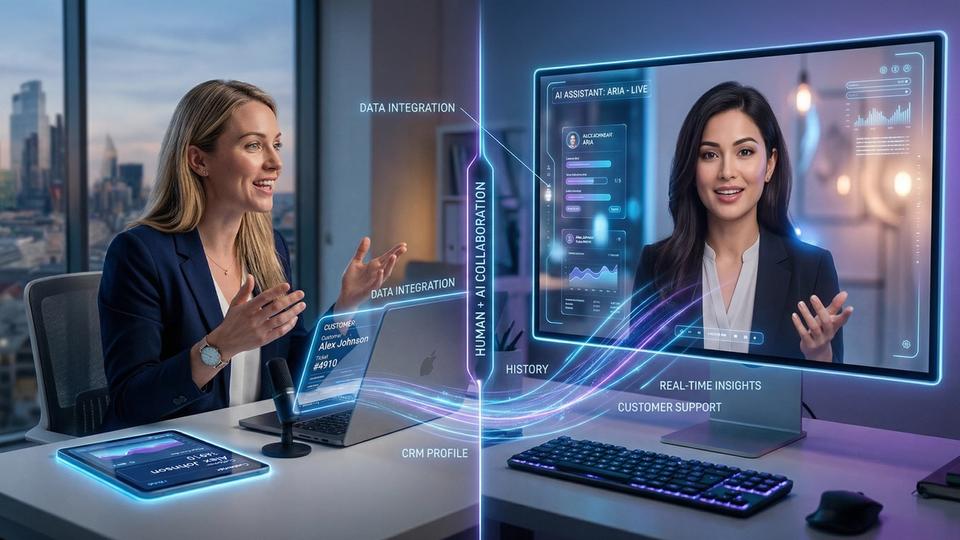
AI-powered video avatars are turning explanations into conversations.
Why This Shift Is Happening Now
This shift is being driven by a convergence of technologies. Advances in large language models, real-time speech processing, and video generation have made it possible for AI to communicate in a way that feels natural.
At the same time, user behavior has already moved ahead of most interfaces. As reported by The Leap 2023, 73% of consumers prefer to watch a short-form video when learning about a product or service. People lean toward formats that reduce effort and increase clarity.
The economics reinforce this shift. AI video tools can reduce production costs while enabling teams to produce significantly more content. What was once expensive and slow is now scalable and adaptive.
Video is no longer just a marketing format. It is becoming a core interface.
Sales Is Becoming Guided, Not Pushed
The biggest drop-off in most sales funnels does not happen at awareness or at checkout. It happens in the middle, when the customer is trying to understand.
This is where AI-powered video avatars are changing the equation.
Instead of static demos or delayed human calls, customers can interact with a video agent that explains the product, answers questions, and adapts in real time. The experience feels less like being sold to and more like being guided.
The impact is already visible as businesses have seen higher conversion rates after using video explainers. Engagement levels also rise sharply— personalized AI video content drives higher engagement compared to static formats.
This is not just better communication. It is a different kind of sales experience.
Customer Support Is Becoming More Human Without Humans
Customer support has always struggled with clarity.
Even when answers are correct, they are often difficult to follow. Long text instructions require effort, especially when the user is already frustrated. Most breakdowns happen not because the solution is missing, but because it is not easy to understand.
AI-powered video avatars change the format of resolution.
Instead of telling users what to do, they show them. They explain verbally, demonstrate visually, and adjust based on follow-up questions. The interaction becomes closer to real assistance rather than scripted support.
The broader impact of AI in support is already significant. Klarna, for instance, reduced response times by 82% after implementing AI-driven systems. More widely, AI customer engagement is reducing routine query handling costs by as much as 75%.
What video adds is comprehension. Issues get resolved faster because users understand the solution immediately.
The Business Case Is Getting Stronger
Adoption is accelerating not just because of experience improvements, but because of measurable returns.
As reported by Fullview, companies see an average return of $3.50 for every $1 invested in AI customer service, with leading organizations achieving significantly higher returns. At the same time, Nielsen reports that AI-driven video campaigns are increasing ROI by over 40% year over year.
On the cost side, the shift is equally compelling. As noted by Synthesia, companies using AI avatars reduce talent and production costs by up to 90%. Teams are also gaining time efficiency. SEMrush reports that marketing teams save an average of 80 hours per month using AI video tools.
This combination of higher conversion, lower cost, and faster execution is what makes the shift inevitable.
Where the Gap Still Exists
Despite strong momentum, execution remains uneven.
As reported by Zendesk, only 25% of call centers have successfully integrated AI automation. The challenge is not awareness—it is implementation.
Most companies struggle with connecting AI systems to real workflows. Without integration into CRM platforms, knowledge bases, and product systems, even advanced interfaces fail to deliver meaningful value.
This is where the difference between tools and platforms becomes critical.
Why voxforce.ai Is Defining the Category
voxforce.ai is not positioning itself as a feature within existing systems. It is building the infrastructure required for conversational video AI to work in real business environments.
The platform combines conversational intelligence, real-time video generation, and deep system integrations into a single layer. This allows businesses to deploy AI-powered video avatars that are not just interactive, but context-aware and actionable.
In practice, this means an AI agent can understand a customer query, access the right information, and deliver a clear, visual response in real time without breaking the flow of conversation.
More importantly, these interactions remain consistent with the company’s tone and positioning, which is critical for brand experience.
In a space where many solutions remain fragmented, voxforce.ai is shaping a unified approach to conversational video, positioning itself at the center of this emerging category.
The Interface Is the Real Shift
Every major technology shift has been defined by how humans interact with machines.
The move from command lines to graphical interfaces made computing accessible. The shift to mobile redefined convenience. Now, conversational AI is redefining interaction itself.
The next step in that evolution is visual and conversational.
AI-powered video avatars are not just improving communication. They are changing expectations. Customers will increasingly expect interactions that are immediate, clear, and human-like, even when powered entirely by AI.
Closing Thought
Every shift in technology eventually resets expectations.
What feels advanced today quickly becomes the baseline tomorrow. Text-based chat did that a decade ago. Conversational video is about to do it again.
As customers grow used to seeing, hearing, and interacting with AI in more natural ways, static interfaces will start to feel like friction. Not because they stopped working, but because something better replaced them.
This is the moment where that shift is taking shape.
Platforms like voxforce.ai are not just enabling AI-powered video avatars, they are helping define what modern customer interaction should look like. More immediate. More intuitive. Far easier to understand.
And once customers experience that level of clarity, there is no going back.