
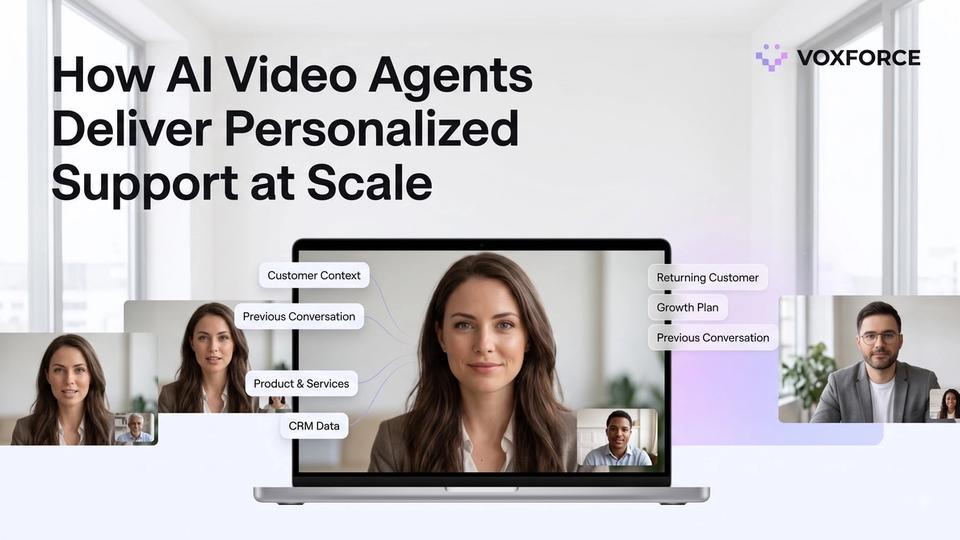
Personalization has become the metric that decides whether a customer stays or leaves. Not average handle time. Not first-response speed. Whether the business on the other end of the conversation actually knows who it is talking to.
Most enterprises have already invested heavily in trying to solve this. CRM platforms. Segmentation engines. Chatbots trained on product documentation. Despite that spend, a large share of customer interactions still feel generic. Deloitte's research on customer-centric companies found that businesses which genuinely prioritize the customer are 60 percent more profitable than those that do not, which means the gap between personalized and generic service is not a soft experience issue. It is a measurable earnings issue.
The reason the gap persists is structural. Legacy support systems were built to route and resolve, not to remember and understand. What enterprises need now is not another automation layer on top of the same architecture. It is a fundamentally different kind of agent: an AI-powered Human Agent, delivered through AI Video Agents, capable of holding a face-to-face, contextual conversation with a customer at the scale of an entire customer base, simultaneously.
Personalization Has Become the New Customer Expectation
Customers no longer evaluate service on resolution alone. They evaluate it on whether the business remembers the conversation they already had, the products they already own, and the way they prefer to communicate.
PwC's 2025 Customer Experience Survey captures how wide this expectation gap has become: 70 percent of executives believe customer expectations are now outpacing their organization's ability to adapt. That is a direct admission, from inside the enterprise, that personalization has become a capability gap rather than a strategic choice.
The cost of getting it wrong is severe and often silent. PwC found that 32 percent of customers will stop doing business with a company after a single bad interaction, regardless of prior loyalty. Separately, industry-compiled research puts that figure closer to half of all customers after repeated poor experiences. Most of that churn happens without complaint. Customers do not escalate. They simply do not come back.
The upside is just as measurable. Forrester's CX Index research has found that companies leading on customer experience achieve materially higher revenue growth than low-CX peers, and Qualtrics' XM Institute has estimated that a single point of improvement in CX score can be worth hundreds of millions of dollars in additional revenue for a large enterprise over a three-year period. Personalization is not a service nicety. It is one of the few levers left that reliably moves both retention and revenue at the same time.
Why Traditional Support Cannot Personalize at Scale
The infrastructure enterprises built for support was never designed to carry memory forward. It was designed to close cases.
A ticketing system stores a record of what happened, but does not carry the customer's context into the next interaction unless an agent manually reads the history first. An IVR routes by department, not by relationship. Email support depends on whichever agent picks up the thread, with no guarantee they have the full picture. Scripted chatbots typically start every session from zero, regardless of how many times the same customer has engaged before.
Human agents face a parallel limitation, just for different reasons. A skilled support representative can personalize one conversation exceptionally well. They cannot personalize five thousand conversations a day to the same standard, because attention, memory, and consistency all degrade with volume. Zendesk's 2026 CX Trends research, drawn from over 11,000 consumers and CX leaders globally, found that 74 percent of customers find it frustrating to repeat their story to different agents, and that 83 percent of CX leaders now say memory-rich AI agents are the key to delivering personalization that actually holds up across the full customer journey.
This is the core constraint enterprises have been unable to engineer around: personalization at the level customers now expect requires memory, context, and consistency applied uniformly across every single interaction. Ticket-based and human-only systems were never built to do that at scale.
The economics of the current model make the problem worse rather than better over time. Adding personalization capacity through headcount means adding training cycles, supervision layers, and quality assurance processes, each of which introduces its own variance. A newly hired agent personalizes less well than a five-year veteran, not through lack of effort, but because personalization depends on accumulated context that lives in individual memory rather than in any shared system. When that agent leaves, the context leaves with them. Enterprises have effectively been trying to scale a capability that resists scaling by its very nature, using an organizational structure that was designed to distribute workload, not preserve relationship history.
AI-powered Human Agents Understand Context, Not Just Questions
The distinction that matters is between answering a question and understanding a customer. A scripted chatbot answers the question in front of it. An AI-powered Human Agent understands who is asking, why they are likely asking it, what they have already tried, and what they own.
This is possible because an AI-powered Human Agent operates across several data layers at once: enterprise knowledge, CRM records, prior conversation history, and real-time intent recognition, combined through natural language understanding rather than keyword matching. The result is a system that does not wait passively for a query. It arrives at the conversation already holding the relevant context, the way a long-tenured account manager would.
Google Cloud–sourced benchmarking cited in industry compilations found that generative AI-powered agents reach roughly 92 percent accuracy in understanding customer intent, compared with 65 to 70 percent for keyword-based bots. That gap is the practical difference between a system that personalizes and one that merely responds.
Contextual understanding is becoming a genuine point of competitive separation. IDC-sourced research compiled by CX analysts found personalization to be one of the fastest-growing categories of CX investment, growing roughly 38 percent year over year, trailing only AI and automation spend itself. Enterprises are not investing in personalization because it is fashionable. They are investing because competitors who get it right are visibly pulling ahead on loyalty and revenue.
AI Video Agents Make Personalization Feel Human
Context alone does not guarantee trust. How that context is delivered matters just as much as whether it exists.
A written response, however accurate, is processed differently than a spoken, visual one. AI Video Agents close that gap by greeting a customer naturally, explaining a product visually where a screenshot or diagram would take too long to describe in text, and carrying tone and pacing that reassure a customer through a complex or sensitive issue rather than simply informing them of it.
Zendesk's research offers a directly relevant data point here: 76 percent of consumers say they would choose a company that let them move between text, images, and video within the same conversation thread, without having to restart. Customers are already telling researchers, in aggregate, that they want support to be multimodal and continuous. Conversational Video AI is the direct answer to that stated preference, not a speculative bet on where preferences might go.
Video also reduces a specific failure mode that has limited chatbots for years: misunderstanding. A customer describing a product issue through text alone often struggles to convey what they mean, and a chatbot without visual or vocal cues has no way to notice the confusion. An AI-powered Human Agent that can see context, hear tone, and respond with its own visual explanation closes that loop in a way plain text cannot.
Scaling Human Conversations Without Scaling Headcount
For as long as enterprise support has existed, scaling it has meant hiring. More customers meant more agents, more shifts, more training cycles, and more variance in quality as headcount grows faster than institutional knowledge can spread.
AI-powered Human Agents break that link. A single deployment can hold thousands of simultaneous, personalized conversations, each carrying the same depth of context and consistency, without the marginal cost of adding another trained employee for every additional customer served. Gartner's cost benchmarks illustrate the scale of the gap this closes: a self-service contact costs roughly $1.84, against roughly $13.50 for an agent-assisted interaction, and AI-native platforms are now operating in the $1 to $3 range per resolution while achieving first-contact resolution rates of 55 to 70 percent.
Availability compounds the effect. Zendesk found that 74 percent of customers now expect service around the clock, a standard that is prohibitively expensive to staff with human shifts alone but structurally native to an AI-powered agent. Multi-language coverage follows the same logic: adding a new language to a video-based conversational agent is a configuration decision, not a hiring campaign across new geographies.
The economics change because the constraint changes. Enterprises are no longer trading quality for scale, or scale for consistency. An AI-powered Human Agent, once built correctly, applies the same standard of personalized attention to the one-thousandth conversation of the day as it did to the first.
This also changes how enterprises should think about capacity planning. Under the old model, a demand spike, a product launch, a seasonal peak, a service outage, meant either accepting longer wait times or over-hiring for a surge that would not last. Under an AI-powered model, the marginal cost of an additional simultaneous conversation is close to zero, which means the capacity question shifts from "how many more agents do we need" to "is our knowledge base and integration layer current enough to support the answer." That is a fundamentally easier problem to solve, and one that does not require a hiring cycle to fix.
Every Customer Interaction Becomes Intelligent
Once an AI-powered Human Agent can carry memory and context forward, every interaction becomes an input the system can learn from, not just a case to be closed.
In SaaS, that means onboarding that adapts to what a specific customer is struggling with, rather than a static walkthrough. In banking and insurance, it means a claims or account conversation that opens with full history already understood, rather than requiring the customer to re-explain a dispute. In healthcare, it means guiding a patient through benefits or intake in a way that carries appropriate reassurance in tone, not just accurate information. In retail and hospitality, it means a return or booking change handled with the same attentiveness a trusted associate would bring. In manufacturing and telecommunications, it means field-level product or service questions answered with the same technical depth a specialist would provide, at any hour, in any region.
The common pattern across every one of these sectors is that the interaction stops being reactive. It becomes proactive, contextual, and conversational, because the system carries what it has learned about the customer into the next moment rather than resetting.
AI-powered Human Agents Strengthen Human Teams
None of this argues for removing people from customer support. It argues for changing what people spend their time on.
AI-powered Human Agents are well suited to FAQs, onboarding, product education, routine troubleshooting, order status, policy questions, and account guidance: high-volume, structured interactions where the correct answer is knowable and consistent. Human teams remain essential for complex cases, negotiations, escalations, emotionally difficult conversations, and strategic account relationships, where judgment and empathy are the scarce resource, not information retrieval.
Salesforce's State of Service: AI Agents Edition, based on a survey of 3,075 service professionals globally, found that after deploying AI agents, the top improved metric organizations report is customer satisfaction, ahead of agent productivity, average handle time, retention, and first-response time. That ordering matters. It indicates that well-deployed AI does not just cut cost. It measurably improves the experience customers report having, which is the outcome enterprises actually set out to achieve.
Gartner's own longer-range research anticipates that the workforce-reduction narrative many organizations expected has not held up as originally forecast: a substantial share of organizations that had planned significant headcount cuts are expected to reverse those plans, and the large majority of service leaders intend to retain human agents specifically to define where AI's role begins and ends. The pattern emerging across enterprise deployments is augmentation, with AI absorbing volume and structure so human teams can spend their attention on the accounts and moments that need it most.
How VoxForce.ai Is Redefining Personalized Customer Support
The organizations moving fastest on this shift are not replacing their support and sales teams with software. They are giving both functions a new front door: one that can see, remember, and reason with the customer directly, before a human ever needs to get involved.
VoxForce.ai is one example of this category in practice. Its AI Video Agents are built to function as an AI-powered Human Agent for the enterprise: combining Conversational AI, natural voice, and visual presence with memory and enterprise-specific knowledge, so a customer visiting a website or contacting support experiences something closer to a knowledgeable representative than a static form or chat widget. The platform extends the same architecture into AI Customer Engagement and AI Sales Assistants, supporting Human AI Conversations across both support and commercial interactions, and applying Multimodal AI so a customer can move between text, voice, and video without restarting the conversation.
The intent behind this kind of deployment is additive. VoxForce's approach is not to remove the human layer from customer support, but to make sure every customer, regardless of volume or hour, gets a conversation that carries real context and resolves cleanly, with a seamless handoff to a person when judgment or negotiation is required. For enterprises evaluating how to deliver Personalized Customer Support without proportionally scaling headcount, this is the practical shape the category is taking.
Conclusion
Customer support is no longer measured primarily by ticket closure rates or average handling time. Those metrics describe throughput, not relationship quality.
The metrics that will define enterprise support going forward are different: conversation quality, personalization, customer trust, relationship strength, first-contact resolution, and lifetime value. Each of these depends on the same underlying capability: whether the business remembers the customer and can act on that memory consistently, at any volume, at any hour.
AI-powered Human Agents, delivered through AI Video Agents, are the mechanism making that possible at enterprise scale. They do not just answer more questions faster. They make personalization, once the exclusive advantage of a small, highly trained team, available to every customer the enterprise serves, at the same time, without compromise on quality or consistency. That is the shift enterprise customer support is now moving through.