
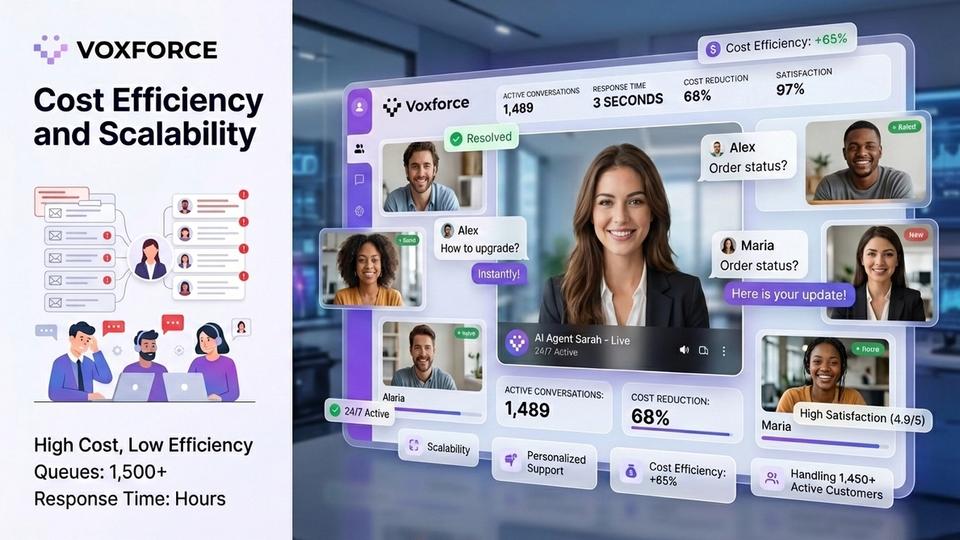
Customer support has become one of the most expensive operational functions for modern businesses. As customer expectations rise, companies are forced to scale support teams, extend service hours, and manage increasing volumes of queries across channels.
But the economics are breaking. Customers today expect immediacy, personalization, and consistency, requirements that are difficult to meet with human-only teams. According to Salesforce (2023), 83% of customers expect to interact with someone immediately when they contact a company, while 70% expect every agent to have full context of their situation (Zendesk, 2023). These expectations significantly increase the cost and complexity of service delivery.
At the same time, the cost of failure is rising. In PwC’s 2025 Customer Experience Survey, 52% of consumers say they stopped buying from a brand due to a bad experience, and 29% left due to poor customer experience specifically.
Support is no longer just a cost center. It is a revenue risk. The question for businesses is no longer whether to optimize support operations but how.
Why Traditional Support Models Don’t Scale
Most customer support systems are still built on a linear model:
- Customers raise queries
- Agents respond manually
- Complex issues are escalated
- Resolution times vary
This model worked when volumes were manageable. It fails when interactions scale into the thousands or millions.
Three structural limitations make traditional support expensive:
1. Human Dependency
Every additional query requires human intervention. Scaling support means hiring more agents, increasing training costs, and managing workforce variability.
2. Fragmented Context
Customers often have to repeat information across channels. This increases handling time and reduces satisfaction.
3. Inefficient Resolution
Simple queries consume the same resources as complex ones. Agents spend time on repetitive tasks instead of high-value problem-solving.
These inefficiencies directly impact cost per resolution, which continues to rise as customer expectations increase.
The Shift to AI-Powered Conversational Agents
AI-powered conversational agents fundamentally change how support operations function.
Instead of reacting to queries with human effort, businesses can deploy intelligent systems that handle conversations at scale.
These agents combine natural language understanding, real-time data access, and automated response generation to resolve customer issues efficiently.
More importantly, they operate continuously.
According to Zendesk (2025), 90% of leading CX organizations believe AI and automation will soon resolve up to 80% of customer issues without human intervention.
This is not an incremental improvement. It is a structural shift.
Where Cost Reduction Actually Happens
The value of AI in customer support is often misunderstood. It is not just about automation—it is about redesigning how work gets done.
1. Reducing First-Level Support Load
A large percentage of support queries are repetitive: password resets, order tracking, and basic troubleshooting.
AI agents can handle these instantly, reducing the volume of tickets reaching human agents.
2. Lowering Average Handling Time
AI systems provide instant, context-aware responses, eliminating delays caused by manual lookup and back-and-forth communication.
3. Improving First Contact Resolution
With access to integrated systems and knowledge bases, AI agents can resolve issues in a single interaction, reducing escalations.
4. Enabling 24/7 Support Without Incremental Cost
Unlike human teams, AI agents operate continuously without additional staffing costs.
5. Reducing Training and Onboarding Costs
AI agents do not require traditional training cycles. Once deployed, they can be updated centrally and scaled instantly.
These factors collectively reduce the cost per interaction while improving service quality.
The Role of Customer Expectations in Driving Change
Cost reduction alone is not driving AI adoption. Customer expectations are accelerating the shift.
- 74% of customers expect to complete any interaction digitally that they can do in person or over the phone (Salesforce, 2023)
- 74% expect personalized experiences when they share their data (Salesforce, 2023)
- Over 50% of consumers prioritize great service over price (Shep Hyken, 2023)
This creates a paradox.
Customers want better, faster, and more personalized service, but at scale, delivering this with human teams alone becomes economically unsustainable.
AI-powered conversational agents resolve this tension by delivering high-quality experiences at lower cost.
Beyond Text: The Role of AI Video Agents
While text-based AI agents have improved efficiency, they still face limitations in engagement and clarity.
This is where AI video agents represent the next evolution.
By combining conversational AI with visual interaction, businesses can:
- Explain complex issues more effectively
- Reduce misunderstandings in troubleshooting
- Improve customer confidence and satisfaction
- Deliver a more human-like experience
For example, instead of sending a long text explanation for a technical issue, a video AI agent can guide the user step-by-step with visual cues and voice interaction.
This reduces resolution time while improving outcomes, directly impacting cost efficiency.
Real-World Use Cases of Cost Reduction
SaaS and Technology Platforms
AI agents handle onboarding, feature guidance, and troubleshooting, reducing support tickets and improving user activation.
E-commerce and Retail
Conversational agents manage order queries, returns, and product recommendations, reducing reliance on large support teams.
Financial Services
AI agents assist with account queries, transaction support, and customer education, improving compliance and reducing manual workload.
Healthcare and Insurance
AI-powered systems guide users through claims, appointments, and documentation processes, reducing administrative overhead.
In each case, the impact is the same: lower operational costs and improved customer experience.
Investment Trends Signal Long-Term Shift
The move toward AI-powered support is backed by strong investment trends.
According to Deloitte (2025), 85% of organizations increased their AI investment in the past year, and 91% plan to increase it further.
At the same time, McKinsey (2024) reports that 37% of business leaders cite cost reduction as a top priority in customer service transformation.
This alignment between investment and operational goals indicates that AI-powered support is becoming a strategic priority, not just a technology upgrade.
voxforce.ai: Redefining Cost-Efficient Customer Engagement
voxforce.ai is leading this transformation by enabling businesses to deploy AI-powered conversational agents that operate across the entire customer journey.
What sets Voxforce apart is its ability to combine:
- Conversational AI for intelligent interactions
- Real-time video agents for human-like communication
- Enterprise integrations for context-aware responses
This creates a new category of support systems, one that moves beyond static chatbots to dynamic, adaptive digital agents.
Instead of relying on fragmented tools and manual workflows, businesses can deploy a unified AI workforce that handles customer interactions efficiently and consistently.
By reducing dependency on human-only support models, voxforce.ai helps organizations lower costs while improving service quality.
From Cost Center to Competitive Advantage
Customer support is no longer just an operational necessity. It is a key driver of customer loyalty and business growth.
Companies that continue to rely on traditional support models will face rising costs and declining customer satisfaction.
Those that adopt AI-powered conversational agents will gain a structural advantage:
- Lower cost per interaction
- Faster resolution times
- Higher customer satisfaction
- Scalable support operations
The shift is already underway.
The Future of Customer Support
The future of customer support will not be defined by larger teams, but by smarter systems.
AI-powered conversational agents will handle the majority of interactions, while human agents focus on complex and high-value tasks.
As this transition accelerates, the distinction between support and experience will disappear. Every interaction will become an opportunity to engage, assist, and build trust.
For businesses, the implication is clear.
Reducing support costs is no longer about cutting resources. It is about redesigning how support is delivered.
And in that future, the most efficient organizations will not be those with the largest support teams - but those powered by intelligent, scalable AI systems.