
E-commerce has spent the last two decades optimizing convenience.
Online stores reduced the need to visit physical outlets, recommendation engines improved product discovery, and one-click checkout compressed purchasing into seconds. But despite all this progress, one major gap still remains between digital commerce and physical retail: human interaction.
In physical stores, customers can ask questions, seek reassurance, compare options, and receive guidance before making decisions. Online shopping often removes that layer entirely. Users browse static product pages, scan reviews, and navigate support systems independently.
That limitation is becoming increasingly expensive for brands.
Cart abandonment remains one of the biggest challenges in e-commerce because uncertainty interrupts purchasing decisions. Customers hesitate when they cannot evaluate products clearly, compare options quickly, or resolve concerns immediately.
This is why conversational video AI is emerging as one of the most important new layers in digital commerce.
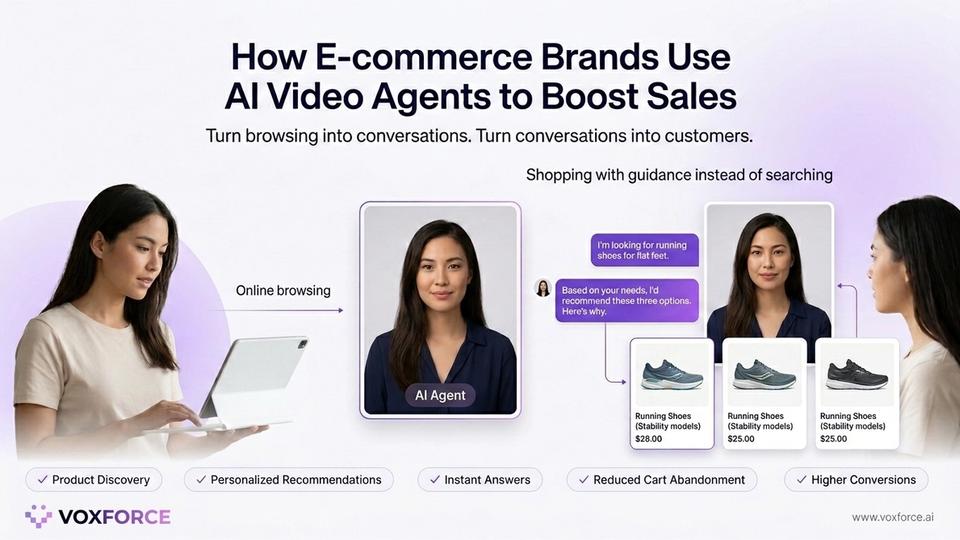
At VoxForce.ai, we believe AI video agents represent the next evolution of online shopping because they transform e-commerce from a browsing experience into a conversational one. Instead of forcing customers to navigate websites manually, AI-powered digital agents can guide, explain, recommend, and assist in real time through natural video interaction.
The shift is not simply technological. It is behavioral.
Why Traditional E-commerce Experiences Create Friction
Most online shopping journeys still rely on static interfaces.
Customers scroll through product pages, compare specifications manually, search for answers inside FAQs, and move between support tabs while trying to make decisions. Even with modern recommendation systems, the interaction remains largely self-directed.
This creates several problems.
First, uncertainty increases. Customers cannot physically inspect products, ask spontaneous questions easily, or receive personalized reassurance during decision-making.
Second, attention drops quickly. Modern users, particularly younger consumers, have little patience for fragmented information spread across multiple pages.
Third, support systems often interrupt momentum. A customer ready to purchase may abandon the journey entirely if resolving a question requires waiting for live support or reading lengthy documentation.
The issue is not only operational. It is structural.
Traditional e-commerce systems were designed around catalogs and search behavior. Modern consumers increasingly expect guided interaction instead.
That shift matters because customers today are overwhelmed by choice. The average online shopper does not necessarily want more options. They want faster confidence.
The Rise of Conversational Commerce
Consumer behavior is shifting away from static browsing toward conversational engagement.
People increasingly discover products through creators, live streams, short-form video, and recommendation-driven platforms rather than traditional keyword search behavior. Shopping is becoming more interactive, visual, and dialogue-driven.
This shift is particularly visible among Gen Z consumers, who are more comfortable with conversational interfaces and AI-assisted interaction than previous generations.
According to Salesforce research, one-third of consumers would rather purchase products through automated or digital systems than interact with human representatives. The same research found that 32% of Gen Z consumers are already comfortable with AI agents shopping for them.
This reflects a larger behavioral change.
Consumers are becoming less attached to navigating digital systems manually and more interested in experiences that reduce effort for them.
AI video agents are emerging as a response because they combine:
- conversational interaction
- visual communication
- personalized recommendations
- real-time support
- scalable engagement
The result feels significantly closer to interacting with a knowledgeable in-store assistant than navigating a traditional website.
How AI Video Agents Improve Product Discovery
One of the biggest challenges in e-commerce is helping customers find the right product quickly.
Traditional recommendation systems rely heavily on algorithms that surface products based on browsing history or purchasing patterns. While effective to some extent, these systems remain passive.
AI video avatars introduce active guidance into product discovery.
For example, a customer shopping for skincare products may feel overwhelmed by dozens of options with technical ingredient descriptions. Instead of manually comparing products, the customer can interact with a conversational video AI agent that asks questions about skin concerns, explains formulations conversationally, and recommends products dynamically based on user responses.
The interaction becomes guided rather than search-driven.
In fashion retail, AI video agents can help customers compare fits, styling options, and seasonal recommendations. A shopper uncertain about sizing for a specific jacket, for example, can ask follow-up questions conversationally instead of scanning return policies and sizing charts alone.
In electronics, AI sales assistants can explain technical differences between devices naturally rather than forcing users to interpret specification tables independently. A customer looking for a laptop for video editing may simply describe requirements conversationally and receive personalized recommendations instantly.
The goal is not simply answering questions. It is reducing decision friction.
This is important because too much choice often weakens purchasing confidence rather than improving it.
Why Video Creates Stronger Purchase Confidence
One reason physical retail still influences buying behavior is trust.
Customers feel more confident purchasing products when they can see demonstrations, ask questions, and receive immediate clarification. Static product pages struggle to replicate that experience.
Video changes the dynamic entirely.
Research suggests the human brain processes visual information significantly faster than text, which helps explain why video-driven product explanations feel easier to absorb than written descriptions alone.
AI video interaction introduces additional advantages:
- facial expression
- voice tone
- conversational pacing
- visual demonstration
- contextual explanation
These elements create a stronger perception of attentiveness and responsiveness during customer interaction.
For example, a customer considering an expensive appliance purchase may hesitate because installation requirements seem unclear. A conversational video AI agent can explain setup requirements step by step, answer follow-up questions naturally, and reduce uncertainty in real time.
Similarly, a beauty brand using AI video avatars can guide customers through product usage routines visually rather than relying entirely on static instructions. That interaction feels more reassuring because the customer experiences guidance rather than information overload.
The interaction feels more reassuring than scanning support documentation alone.
That reassurance directly impacts conversion behavior.
However, not every purchase requires conversational interaction. Commodity purchases may still favor speed and minimal engagement. But as products become more expensive, technical, customizable, or emotionally driven, guided AI interaction becomes significantly more valuable.
AI Video Agents Reduce Cart Abandonment
Cart abandonment is often driven by unresolved hesitation.
Customers leave because:
- product information feels incomplete
- comparison becomes overwhelming
- support is unavailable
- checkout creates confusion
- confidence drops during decision-making
Traditional support systems frequently fail because they introduce delay at the exact moment customers need clarity.
AI customer support automation changes that dynamic by providing immediate conversational assistance during high-intent moments.
For example:
- an AI video agent can explain shipping timelines instantly
- clarify return policies conversationally
- recommend complementary products
- answer compatibility questions in real time
- guide checkout completion interactively
This reduces friction without interrupting momentum.
Importantly, conversational video AI also keeps users engaged longer than static interfaces because interaction feels active rather than transactional.
That extended engagement window increases opportunities for conversion.
The Shift From Search-Based Commerce to Guided Commerce
One of the biggest changes AI video agents introduce is the movement from search-based commerce toward guided commerce.
Traditional e-commerce assumes customers know how to navigate toward decisions independently.
But modern consumers increasingly expect assistance throughout the process.
This mirrors broader changes happening across digital platforms. Recommendation engines already guide entertainment consumption, social discovery, and content engagement. Commerce is moving in the same direction.
Over time, online shopping may become less about manually browsing product grids and more about interacting with conversational AI systems that guide users toward decisions dynamically.
Instead of typing keywords into search bars, customers may increasingly describe needs conversationally:
- “I need running shoes for flat feet.”
- “Recommend a laptop for video editing under a specific budget.”
- “Help me choose skincare products for sensitive skin.”
AI video agents can transform those requests into interactive shopping conversations rather than static search results.
In the future, the traditional e-commerce homepage itself may gradually become less important than the conversational layer sitting above it. Product catalogs may remain in the background while AI-led interfaces become the primary way customers discover, compare, and purchase products.
The future of e-commerce may depend less on improving search and more on reducing the need for search altogether.
That fundamentally changes how customers experience digital commerce.
Why E-commerce Brands Are Investing in AI Video Interaction
The rise of AI video agents is driven by more than novelty.
E-commerce brands face growing pressure from:
- rising customer acquisition costs
- shorter attention spans
- increasing competition
- declining loyalty
- higher expectations for personalization
At the same time, scaling high-quality human support across millions of customers becomes economically difficult.
Historically, brands had to choose between scalability and personalization.
AI-powered digital agents are beginning to bridge that gap by allowing businesses to deliver conversational, personalized, always-available engagement at scale without increasing operational overhead proportionally.
This matters because younger consumers increasingly evaluate brands not only on pricing or product quality, but on how intuitive the interaction experience feels.
The customer experience itself is becoming part of the product.
Why VoxForce.ai Is Building the Future of Conversational Commerce
At VoxForce.ai, we believe the future of e-commerce will become increasingly conversational, visual, and AI-driven.
VoxForce.ai enables brands to deploy conversational video AI agents that combine:
- real-time interaction
- AI video avatars
- enterprise integrations
- personalized engagement
- conversational intelligence
These AI video agents can guide customers through product discovery, onboarding, support, and purchasing journeys while maintaining consistent brand communication at scale.
The objective is not simply automation. It is creating shopping experiences that feel more natural, responsive, and human-centered.
That shift matters because digital commerce is no longer competing only on convenience.
It is competing on interaction quality.
The Future of Online Shopping Will Feel More Conversational
Technology history shows that every major shift in digital behavior eventually reshapes interfaces.
Websites evolved from static information pages into interactive applications. Social platforms transformed communication into continuous engagement environments. AI is now reshaping commerce itself.
But the next generation of e-commerce experiences may no longer revolve around product pages customers browse independently.
Instead, shopping will increasingly become conversational, guided, and adaptive.
Customers will expect digital commerce experiences to:
- answer instantly
- adapt dynamically
- communicate visually
- guide decisions naturally
- reduce friction proactively
AI video agents represent the beginning of that transition.
And the brands that adopt conversational commerce early will not simply improve customer support or conversion rates. They will help redefine how online shopping itself works.