
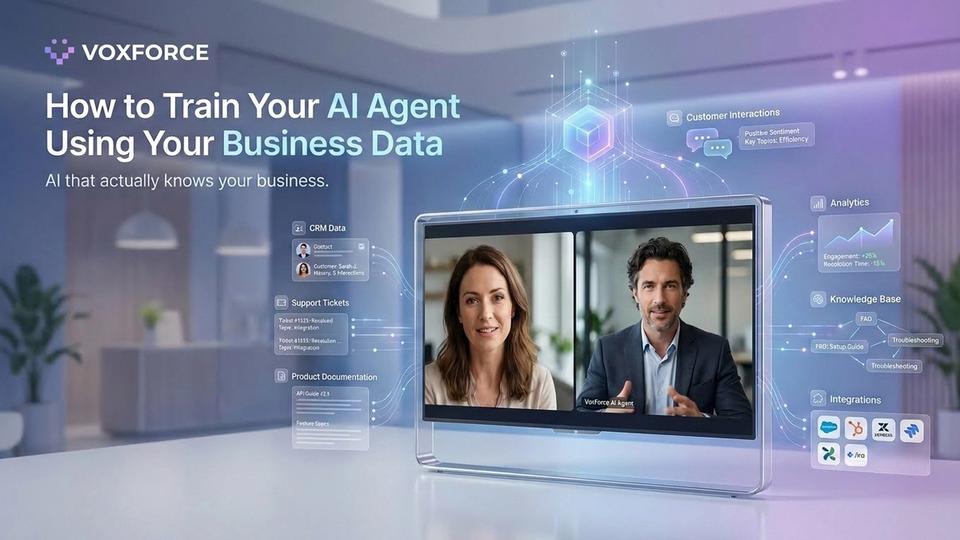
A Voxforce.AI Guide to Building AI Agents That Actually Know Your Business
Most AI chat-bots fail customers not because the technology is broken, but because the AI knows nothing about the business it is supposed to represent. It answers in generalities, misses product-specific nuances, and cannot resolve the exact issues customers bring to it. The result is an experience that frustrates rather than helps.
The solution is not a smarter generic AI. It is an AI agent trained on your specific business data — your products, your processes, your tone, and your customers' most common questions.
According to Salesforce, 67% of consumers are frustrated when customer service cannot resolve their issues instantly, and customers walk away from nearly one-third of all customer service interactions without getting what they need. These failures are not inevitable. They are the result of deploying AI that was never given the right information to do its job.
This guide explains how businesses can close that gap — using their own data to build AI agents that are genuinely useful, not just technically impressive.
Why Generic AI Falls Short
Off-the-shelf AI models are trained on vast amounts of general internet data. They can write emails, summarize documents, and answer broad questions reasonably well. But when a customer asks about a specific return policy, a product configuration, or a billing issue, a generic model has no reliable answer.
What businesses need is an AI agent trained on their internal knowledge — one that understands their offerings as well as a well-prepared human representative would. This requires a deliberate training process built around the right data sources.
The businesses winning with AI are not using the smartest general model. They are using models that know their business better than any individual employee could.
Step 1: Identify Your Core Business Data Sources
Before training begins, the first task is a data audit. Most companies have far more useful training material than they realize, distributed across systems that have never been connected.
The most valuable sources typically include:
Customer support ticket archives — real questions your customers ask, along with the resolutions that worked
Product documentation, spec sheets, and FAQs
Sales call transcripts and objection-handling notes
Internal knowledge bases and employee handbooks
Website content including pricing pages, about pages, and blog posts
CRM data reflecting common customer journeys and pain points
Not all data is equally valuable. Prioritize sources that reflect real customer interactions over internal documents written for internal audiences. Customer support tickets, in particular, are goldmines — they capture authentic language, edge cases, and resolution paths that generic AI would never encounter in training.
Step 2: Clean and Structure Your Data
Raw business data is rarely training-ready. Support tickets may include irrelevant metadata. Documentation may be outdated. Sales transcripts may contain filler language that adds noise without adding value.
Effective data preparation involves several steps:
- Remove outdated content that no longer reflects current products or policies
- Standardize formats so the AI can parse information consistently
- Tag data by topic, intent, and resolution type to improve retrieval accuracy
- Anonymize any customer-identifying information to protect privacy
- Prioritize high-quality resolved interactions over unresolved or escalated ones
The quality of your AI agent's responses will directly reflect the quality of the data it was trained on. Garbage in, garbage out applies here more than in almost any other technology context.
Step 3: Define Your Agent's Knowledge Boundaries
A critical design decision often overlooked at this stage is scope. What should your AI agent know, and equally important, what should it not attempt to answer?
Trying to make one agent answer everything creates a system that answers nothing well. Instead, define clear knowledge domains for each deployment context. A support agent should know troubleshooting workflows and return policies. A sales agent should know product benefits, pricing tiers, and common objections. An onboarding agent should know setup processes and feature walkthroughs.
54% of consumers say they do not care how they interact with a company, as long as their problems are fixed fast. (Salesforce) Speed and accuracy matter more than the format of the response.
Defining scope also determines how the agent handles out-of-scope queries. A well-trained agent should recognize when a question falls outside its knowledge boundary and route it to a human representative, rather than attempting a guess that erodes customer trust.
Step 4: Connect the Agent to Live Business Systems
Static training data captures what was true at the time of training. But businesses evolve. Products change, pricing updates, policies shift. An agent trained on a snapshot of your data will drift out of accuracy without a way to access current information.
This is why the most effective AI agents are not just trained on historical data — they are also connected to live enterprise systems. Integration with CRM platforms, product databases, help desk tools, and inventory systems allows the agent to pull real-time information at the moment of interaction.
The payoff for this investment is significant. According to Salesforce, over a third of consumers (34%) would work with an AI agent instead of a person specifically to avoid repeating themselves — a signal that customers are ready for AI that actually knows their account, their history, and their current situation.
Step 5: Test Against Real Customer Scenarios
Before deploying any AI agent, it must be tested against the types of questions and situations it will actually encounter. Synthetic test cases designed by internal teams tend to miss the edge cases, ambiguities, and unusual phrasings that real customers bring.
The most reliable testing approach uses historical customer interactions as a benchmark. Feed the agent real support tickets or chat transcripts, compare its responses to the resolutions that actually worked, and identify where it falls short.
Key metrics to track during testing include:
- Resolution accuracy: does the agent provide the correct answer or action?
- Containment rate: what percentage of interactions does the agent resolve without escalation?
- Confidence calibration: does the agent correctly recognize when it does not know the answer?
- Tone consistency: does the agent sound like your brand, not a generic AI system?
Step 6: Deploy, Monitor, and Continuously Improve
Training is not a one-time event. The most effective AI agents are maintained as living systems that improve over time based on real deployment data.
Post-deployment monitoring should track which questions lead to successful resolutions and which trigger escalations or agent uncertainty. Escalated conversations are particularly valuable — they reveal the gaps in your training data and point to exactly what the agent needs to learn next.
Setting up a regular retraining cadence — whether monthly, quarterly, or triggered by major product changes — ensures the agent stays accurate as the business evolves.
This continuous improvement loop is one reason that businesses deploying AI agents early are building durable advantages over those that wait. The longer an agent is in production, the more it learns, and the harder it becomes for competitors to replicate that accumulated knowledge.
The VoxForce.ai Advantage: Video AI That Knows Your Business
At VoxForce.ai, we have built our platform around a core insight: an AI agent is only as good as the business knowledge behind it. Technical capability without domain accuracy is a sophisticated way to disappoint customers.
VoxForce combines advanced conversational AI with real-time video generation to create AI agents that not only communicate naturally — with voice, facial expression, and human-like presence — but also draw on your specific business data to resolve customer issues accurately.
Our platform integrates with enterprise CRM systems, product databases, and support knowledge bases, enabling AI agents that adapt dynamically to each customer's context. Customers interact with an agent that knows their account, understands your product catalog, and can walk them through solutions step by step — visually, not just in text.
The impact of this approach is directly measurable. Salesforce research shows that 39% of consumers are already comfortable with AI agents scheduling appointments for them, and 37% are comfortable with AI agents creating more personalized content for them. The demand for capable, knowledgeable AI agents is here. The question is whether the AI agent you deploy can actually meet it.
VoxForce is not building another chatbot. We are building the infrastructure for AI agents that represent your business as accurately and compellingly as your best human representative would.
The Business Case for Training AI on Your Own Data
The return on investment for properly trained AI agents compounds over time. Initial deployment reduces the volume of repetitive support interactions that consume human agent capacity. As the AI agent improves, containment rates increase, average handle time decreases, and customer satisfaction scores rise.
The Salesforce data makes the customer appetite clear: one-third of consumers would already prefer to purchase products through AI agents rather than with a person. Among Gen Z, 32% are comfortable with AI agents handling shopping for them entirely. These are not hypothetical future preferences — they reflect where customer expectations are today.
Businesses that train AI agents on their specific data and deploy them through high-quality conversational interfaces are not just reducing costs. They are creating experiences that match how modern customers want to engage.
Getting Started
The path to a well-trained AI agent does not require starting over from scratch. Most businesses already have the raw material — in their support archives, their documentation, their sales transcripts, and their CRM systems. The work is in surfacing that knowledge, structuring it for AI consumption, and connecting it to a platform capable of delivering it through a genuinely human interaction.
Voxforce.AI provides the platform. The knowledge already exists in your business. Bringing the two together is what transforms a generic AI into an agent your customers will actually trust.
About Voxforce.AI
Voxforce.AI is the leading platform for conversational video AI agents. We help businesses deploy intelligent digital agents that communicate visually and draw on real business knowledge to resolve customer interactions accurately and at scale.