
The conversation around artificial intelligence has centred on one question.
Can AI think like humans?
Businesses have measured progress through increasingly sophisticated language models, higher reasoning capabilities, larger context windows, and more accurate responses. Every new breakthrough has been viewed as another step towards building more intelligent systems.
Yet something curious has happened along the way.
AI has become dramatically more capable, but customer interactions have not become dramatically more human.
Most businesses still ask customers to interact with AI in almost exactly the same way they did five or even ten years ago. Open a chat window. Type a question. Read a response. Type another question. Read another response.
The intelligence has evolved.
The interface has barely changed.
That distinction is becoming increasingly important because the next challenge in customer engagement is no longer about making AI smarter. It is about making communication feel natural.
At VoxForce.ai, we believe the next phase of enterprise AI will not be defined by better automation alone. It will be defined by Human AI, systems that combine intelligence with the communication patterns people instinctively understand. Businesses have already digitised information. The opportunity now is to humanise how that information is delivered.
Businesses Have Been Solving the Wrong Problem
Most discussions around AI focus on what happens inside the model.
Can it reason better?
Can it retrieve information more accurately?
Can it understand context?
Can it perform more complex tasks?
These are important questions, but they overlook something fundamental.
Customers never experience a language model.
They experience a conversation.
A customer does not finish interacting with an AI system and think about its reasoning architecture or model parameters. They remember something much simpler.
Did it understand what I meant?
Did it explain things clearly?
Did it help me make a decision?
Did the interaction feel effortless?
The quality of customer interaction has always depended as much on communication as it does on intelligence. Human conversations are effective not simply because people know the answers. They succeed because people know how to explain, reassure, adapt, and respond in ways that create confidence.
Businesses have invested heavily in improving machine intelligence while paying far less attention to improving the interface through which that intelligence is experienced.
That imbalance is beginning to define the next stage of digital transformation.
The Interface Has Become the Constraint
Every major technology shift eventually reaches a point where the technology itself stops being the differentiator.
The interface becomes the differentiator.
Computers became mainstream when graphical interfaces made computing accessible to ordinary users rather than specialists.
Smartphones changed digital behaviour because touch made interaction more intuitive than keyboards and styluses.
Streaming platforms transformed entertainment because instant access replaced physical ownership.
Artificial intelligence is approaching a similar transition.
The underlying models continue to improve at remarkable speed. Yet for many customers, interacting with AI still feels like operating software rather than having a conversation.
The limitation is no longer computational intelligence.
It is human communication.
The organisations that recognise this shift early will begin designing AI around how people naturally communicate rather than how software has traditionally operated.
Communication Has Never Been About Words Alone
Businesses often treat communication as the exchange of information.
Human beings experience communication very differently.
When someone explains a complex idea in person, we interpret far more than the words themselves. We notice tone, pacing, pauses, emphasis, facial expressions, eye contact, and the subtle signals that tell us whether someone understands our concerns.
These cues influence how we process information, particularly when decisions involve uncertainty.
Consider the difference between reading a paragraph explaining a financial product and having an experienced advisor walk you through the same decision. The facts may be identical, but the experience is fundamentally different because the communication adapts in real time.
Questions lead to clarification.
Hesitation leads to reassurance.
Confusion leads to another explanation.
That dynamic interaction is what businesses have struggled to recreate digitally.
Human AI begins to close that gap.
Instead of asking customers to interpret static information, it allows organisations to explain, guide, and respond through conversations that feel significantly closer to natural human interaction.
Why Text Is Becoming the New Digital Bottleneck
Text transformed the first generation of digital customer engagement.
It was searchable, scalable, inexpensive, and easy to deploy across websites and applications. Chatbots extended that model by making text interactive, allowing businesses to automate routine conversations at scale.
The limitation was never automation.
It was the medium itself.
Text works well when customers already know exactly what they need.
It becomes less effective when customers are uncertain, comparing alternatives, or trying to understand something unfamiliar.
Reading lengthy responses increases cognitive effort. Explaining complex situations through typing slows conversations. Important emotional cues disappear entirely.
As customer expectations evolve, businesses are beginning to recognise that improving text responses alone produces diminishing returns.
The next breakthrough is not generating better paragraphs.
It is creating better conversations.
Customers Evaluate Confidence, Not Technology
One of the biggest misconceptions surrounding AI adoption is that customers evaluate the sophistication of the technology they are using.
In reality, they evaluate outcomes.
Nobody chooses an organisation because it uses a larger language model.
Customers remember businesses that helped them understand a complex product, resolve a problem without friction, or make an important decision with confidence.
That distinction explains why organisations are increasingly shifting from text-based automation towards conversational experiences.
The objective is no longer to demonstrate technological capability.
It is to reduce uncertainty.
When AI communicates naturally, customers ask more questions, explore more scenarios, and continue conversations that would otherwise have ended prematurely. Businesses gain something far more valuable than automation.
They gain trust.
Human AI Is Redefining the Digital Front Door
For years, websites have been designed around navigation.
Customers selected menus, searched documentation, downloaded brochures, completed forms, and waited for someone to contact them.
That model assumes customers know where information exists.
Increasingly, they simply want to ask.
Instead of navigating through multiple pages, they want to describe their situation in their own words and receive guidance immediately.
Someone evaluating enterprise software wants to explain operational challenges rather than compare feature lists.
A patient wants to describe symptoms before exploring treatment pathways.
A prospective homebuyer wants to discuss budget, location, and lifestyle before reviewing dozens of floor plans.
These conversations are contextual from the very beginning.
The organisations creating the strongest customer experiences are redesigning digital engagement around conversation rather than navigation.
Human AI makes that possible.
How VoxForce.ai Is Building Human AI for Enterprise Communication
At VoxForce.ai, we believe businesses already possess the expertise their customers are looking for.
Sales teams understand customer concerns. Product specialists explain complex capabilities. Customer success managers know what drives adoption. Support teams solve recurring challenges. Industry experts interpret regulations, workflows, and implementation requirements every day.
The challenge is that this expertise remains distributed across people, documents, CRM platforms, knowledge bases, and internal systems.
Customers experience fragments of organisational knowledge instead of one continuous conversation.
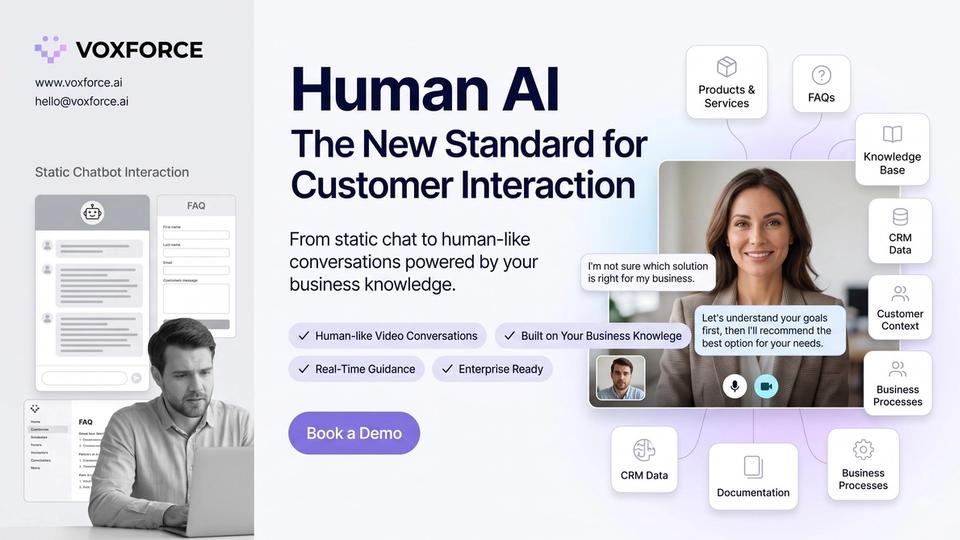
VoxForce acts as the intelligence layer that transforms enterprise knowledge into Human AI. Organisations can create AI-powered humans trained on products, services, company documentation, business processes, CRM data, and institutional expertise. These conversational AI agents communicate through real-time voice and video, answering questions, explaining concepts, guiding decisions, supporting onboarding, and helping customers move forward with confidence.
Rather than replacing human expertise, VoxForce makes that expertise continuously accessible across every customer touchpoint.
The result is not simply better automation.
It is a fundamentally better way for organisations to communicate.
The Future of Customer Interaction Will Feel Less Like Software and More Like Conversation
Every generation of technology changes the way people interact with machines.
Artificial intelligence is now reaching that point.
The next competitive advantage will not belong exclusively to businesses with the most advanced AI models. It will belong to organisations that communicate knowledge in the most human way. They will recognise that customers are not looking for another interface to operate or another chatbot to type into. They are looking for conversations that help them think more clearly, understand more quickly, and decide with greater confidence.
That is why Human AI represents something much larger than another technology category.
It signals a shift in how businesses communicate altogether.
The companies that lead the coming decade will not simply automate customer interactions. They will redesign them around the way people have always preferred to communicate, through conversation, context, and human connection. In that future, AI will not feel like software sitting between businesses and customers. It will become the communication layer through which knowledge, expertise, and trust are delivered at scale.
That is the standard Human AI is setting, and it is the future VoxForce.ai is building toward.