
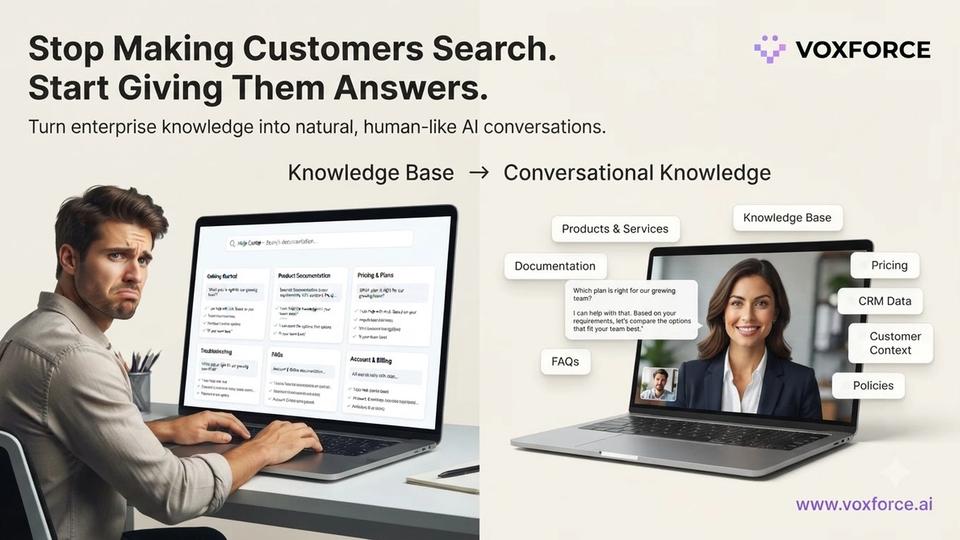
Enterprises have spent two decades building knowledge bases. Help centres, FAQ libraries, documentation portals, searchable article repositories. The investment has been real, and so has the ambition behind it: give customers a place to find answers on their own.
The results tell a different story. Customers still cannot find what they need quickly. Help centres get abandoned mid search. Support tickets get filed anyway, often by the same customer who just spent ten minutes looking through articles. Zendesk reports that 74 percent of customers find it frustrating to repeat their story to different agents or channels, a frustration that usually starts with an unsuccessful search.
The instinct inside most enterprises is to treat this as a content problem. Add more articles. Improve the search index. Rewrite the FAQ. That instinct is misplaced.
The problem is not the quality of the information. It is the format customers are being asked to use to get it. Knowledge bases require search. Customers want answers. That gap is the actual issue, and it will not close by publishing more documentation.
This distinction matters more than it sounds. A search-based system puts the burden of translation on the customer: turning a problem into the right keywords, then turning an article back into a solution. A conversational system removes that burden entirely. The rest of this article makes the case for why that shift is now both possible and necessary.
Customers Do Not Want Documentation, They Want Answers
A customer contacting support has already decided something is wrong or unclear. They are not browsing. They are trying to resolve a specific problem, as fast as possible.
A knowledge base asks that customer to do work the business should be doing instead:
- Guess the right search terms
- Scan multiple articles for relevance
- Interpret which parts apply to their situation
- Translate general documentation into a specific solution
Each of those steps is friction. Forrester research puts a number on how much customers already prefer to avoid contacting a human for this: 73 percent would rather use a company's website for help than pick up the phone. That preference is not an endorsement of search. It is a preference for speed and control, and search is simply the only self-service option most companies currently offer.
Search-based support was never designed to meet that preference well. It was designed to organise information, not to deliver it.
Traditional Knowledge Bases Were Built for Information Storage
Every structural decision behind a typical knowledge base reflects a storage goal, not a resolution goal:
- Categorisation, so articles can be filed under a topic
- Indexing, so a search engine can retrieve them
- Article management, so content can be created, versioned, and archived
- Taxonomy, so related topics can be grouped
These are good practices for organising a library. They are the wrong foundation for answering an individual customer's question, because a library assumes the visitor will do the work of finding the relevant shelf.
Static documentation also struggles to keep pace with how fast products, policies, and pricing change inside a modern enterprise. An article written six months ago may no longer reflect the current process. Research compiled from Salesforce's customer service surveys found that 62 percent of agents say self-service materials are not kept up to date, and 59 percent say the instructions that do exist are too complicated for customers to follow. The knowledge base is not failing because it lacks content. It is failing because the content decays faster than most organisations can maintain it.
This is a maintenance problem that scales badly. Every new product feature, pricing change, or policy update requires someone to notice, write, review, and publish a corresponding article, and to do so before customers start asking about it. Most support and knowledge management teams cannot keep pace with that cadence, especially in fast-moving enterprise software categories. The backlog is not a staffing failure. It is a structural mismatch between how quickly a business changes and how quickly a static library can be updated to reflect it.
Searching Creates Real Customer Effort, Not Just Delay
Customer effort has become one of the most predictive metrics in customer experience research, and search is one of its biggest sources.
The typical failure pattern looks like this. A customer searches using their own words, which rarely match the terminology in the documentation. They open several articles that look relevant, only to find conflicting or outdated guidance. They give up and contact support anyway, often more frustrated than if they had contacted support first.
Gartner's research on self-service found that 28 percent of customers would rather abandon the attempt to solve a problem altogether than reach out to an agent for help, which is not a self-service success story. It is a churn risk hiding inside a deflection metric. A separate industry compilation of Salesforce data found that self-service currently resolves only about 54 percent of customer issues, meaning nearly half of all self-service attempts end in failure or an escalation the knowledge base was supposed to prevent.
Every one of these failed searches carries a cost that rarely shows up on a support dashboard:
- Time lost by the customer
- A second contact through a more expensive channel
- Diminished trust in the brand's ability to help
- A support ticket that could have been avoided if the right answer had reached the customer directly
Deflection rate has been the wrong metric all along. Resolution is the metric that matters, and search-based self-service consistently under delivers on it.
Most enterprises are still measuring the wrong side of this equation. A deflection dashboard shows a search interaction as a success the moment a customer closes the article without clicking "contact support." It has no way to see that the same customer opened a support ticket an hour later, frustrated and no closer to an answer. Until resolution, not deflection, becomes the metric that governs self-service investment, the true cost of search-based support will stay hidden inside the numbers rather than visible in them.
AI-powered Human Agents Turn Knowledge into Conversation
The alternative is not a better search bar. It is removing search from the process entirely.
AI-powered Human Agents do not present a list of documents and ask the customer to interpret them. They understand the intent behind the question, retrieve the relevant enterprise knowledge in the background, and deliver a direct, personalised answer through natural conversation. Where a question is ambiguous, they ask a clarifying question first, the way a knowledgeable person would, rather than returning a generic list of possibly related articles.
This shift matters because it changes what the customer experiences:
- No guessing at search terms
- No comparing multiple articles for relevance
- No translating general documentation into a specific answer
- A conversation that adapts as the customer's situation becomes clearer
Conversational AI is becoming the new interface for enterprise knowledge, in the same way conversation has already replaced menus and forms in other parts of digital experience. The knowledge itself does not disappear. It simply stops being something the customer has to go looking for.
AI Video Agents Make Enterprise Knowledge Easier to Understand
Some explanations are genuinely difficult to deliver in text. A multi-step configuration process, a product comparison, a troubleshooting sequence with several branching outcomes. Documentation tries to solve this with screenshots and numbered lists, and customers still get lost partway through.
AI Video Agents close that gap by explaining knowledge the way a person would in front of a whiteboard or a screen share. They can:
- Walk through a complex product feature visually
- Demonstrate a workflow step by step
- Guide a troubleshooting sequence in real time
- Simplify onboarding for a new product or platform
- Reinforce product education with tone and pacing, not just text
Zendesk's research found that 76 percent of consumers would choose a company that let them move between text, images, and video within the same conversation, without starting over. That is a clear signal that customers already want support delivered through more than static text, and face-to-face AI interaction is the direct answer to that preference. It builds confidence in a way a wall of documentation cannot.
Enterprise Knowledge Becomes Dynamic, Not Static
A knowledge base is a snapshot. It reflects what someone wrote at a point in time, and it stays that way until someone remembers to update it.
AI-powered Human Agents work differently, because they draw on multiple live sources at the moment of the conversation, rather than a single static article:
- CRM records, for account and purchase history
- Enterprise documentation, for current policy and product detail
- Support history, for what the customer has already tried
- Product knowledge, for how features actually behave
- Policy updates, reflected as soon as they change
- Customer context, for tone, urgency, and prior sentiment
The result is a system that personalises every interaction rather than serving the same static article to every visitor who lands on it. Zendesk found that 83 percent of CX leaders now see memory-rich AI agents as the key to delivering personalisation that holds up across the full customer relationship. A knowledge base has no memory. A conversational system does, and that difference compounds with every interaction.
There is also a maintenance advantage that matters to anyone responsible for the knowledge itself. A conversational system that draws on live sources does not require a parallel effort to keep a separate article library synchronised with reality. The underlying systems of record stay current because they are already being maintained for other business reasons. The conversational layer simply reads from them directly, rather than depending on someone remembering to translate every change into a new help centre article.
From Knowledge Management to Knowledge Delivery
For years, competitive advantage in support was measured by the size and depth of a company's documentation. That measure is losing relevance.
The advantage now belongs to whoever delivers knowledge most effectively, not whoever has published the most of it. The business case for this shift is measurable across several dimensions:
- Lower support costs, since fewer failed self-service attempts convert into paid-channel contacts
- Faster resolution, since customers reach an answer without navigating multiple articles
- Higher self-service success, since the system interprets intent rather than requiring exact search terms
- Stronger first-contact resolution, since context and clarifying questions reduce back and forth
- Improved customer satisfaction, driven by lower effort rather than lower headcount alone
- Better employee productivity, since support teams spend less time answering questions a well-designed conversational system could resolve directly
Salesforce's State of Service: AI Agents Edition, based on more than three thousand service professionals surveyed globally, found that after deploying AI agents, the top improved metric organisations report is customer satisfaction, ahead of productivity, handle time, and retention. That ordering reflects exactly what a shift from search to conversation should produce: an experience customers notice, not just a cost saving.
This reframes how enterprise leaders should think about the knowledge management function itself. For years, the discipline was judged by completeness: how much of the product, policy, and process was documented, and how well it was organised. That standard made sense when documentation was the delivery mechanism. It makes less sense once delivery moves to conversation, because a large, well-organised library of content that customers still cannot use effectively is not actually doing its job. The more useful question for a knowledge management leader to ask now is not how much has been written, but how directly that knowledge reaches a customer at the moment they need it.
How VoxForce.ai Is Redefining Enterprise Knowledge Delivery
The organisations moving fastest on this shift are not trying to build a better knowledge base. They are replacing the need for one.
VoxForce.ai is one example of what that replacement looks like. Its AI Video Agents function as AI-powered Human Agents, combining Conversational AI, natural voice, and visual presence with enterprise knowledge and conversational memory, so a customer gets a direct, spoken answer instead of a list of articles to search through. The same underlying architecture extends into AI Customer Engagement and AI Sales Assistants, supporting Human AI Conversations across both support and commercial interactions, and applying Multimodal AI so customers can move between text, voice, and video without losing context.
The goal behind this approach is straightforward. Enterprise knowledge should reach the customer inside the conversation they are already having, rather than requiring a separate trip to a help centre. VoxForce's positioning reflects that shift directly, turning documentation that once sat behind a search bar into something a customer can simply ask about and receive an answer to.
Conclusion
Traditional knowledge bases solved an information problem. They organised documentation so it could, in theory, be found.
Modern enterprises now face a different problem, and it is a conversation problem. Customers no longer judge a business by how much documentation it has published. They judge it by how quickly and accurately they receive an answer that fits their specific situation.
AI-powered Human Agents, supported by AI Video Agents, represent the next stage of enterprise knowledge management. They replace static documentation with intelligent, conversational experiences that scale across every customer interaction, without asking the customer to do the work of finding the answer themselves.
The organisations that pull ahead will not be the ones with the largest help centres. They will be the ones that stop publishing information and start delivering knowledge, directly, inside every conversation a customer has.
That shift does not require abandoning the knowledge enterprises have already built. It requires changing how that knowledge reaches the customer, from something they have to find on their own to something a conversation brings to them automatically. The documentation was never the problem. The delivery model built around it was.