
Most organisations try to reduce sales cycles by improving sales execution. They retrain representatives, refine playbooks, or invest in forecasting tools that promise sharper pipeline visibility. Yet cycle times keep extending, even as sales teams grow more disciplined.
The reason is structural, not behavioural. The biggest delays in enterprise buying rarely happen inside the sales conversation. They happen before it, in the space now being reshaped by AI Video Agents and Conversational AI. By the time a prospect books a demo, weeks of research, internal debate, and unanswered questions have already shaped the outcome. Sales teams inherit whatever momentum, or hesitation, already exists rather than creating it.
This is the core misunderstanding behind most sales cycle initiatives: leaders assume they have a pipeline problem, when in fact they have a decision velocity problem.
1. The Hidden Economics of Long Sales Cycles
Sales cycles continue to lengthen despite better CRM systems, marketing automation, and analytics dashboards, because none of these tools address the actual source of delay: decision complexity. Enterprise purchases are no longer made by a single buyer. They move through buying committees, and each stakeholder brings a different threshold for confidence:
- Finance wants cost justification.
- Technical teams want architectural assurance.
- Compliance wants risk mitigation.
- Procurement wants competitive validation.
Each constituency introduces its own review cycle, and each cycle adds friction that sales coaching alone, or Conversational AI applied only at the point of sale rather than through AI-powered Human Agents earlier in the journey, cannot resolve.
This is why pricing is so rarely the true obstacle to a faster close. Uncertainty is. When a buying committee cannot align internally, the deal stalls not because the offer is unattractive, but because confidence has not yet accumulated across the group. Information overload compounds the problem: buyers now have more content and analyst commentary available than at any point in enterprise history, yet more content produces more hesitation rather than more clarity, because conflicting inputs are harder to reconcile than none at all.
2. Revenue Teams Are Optimising the Wrong Stage of the Funnel
Most revenue organisations invest heavily in the stages they can measure and control: follow-up cadences, CRM hygiene, forecasting accuracy, and sales coaching. These are legitimate priorities, but they optimise a portion of the funnel that is already relatively efficient.
The largest period of inactivity sits earlier, in the gap between a prospect's first visit to a website and the first meaningful conversation with a human seller. This is where AI Customer Engagement, powered by AI-powered Human Agents, should begin, and where revenue leakage actually starts.
During this window, a buyer forms an opinion with almost no organisational support, reading documentation and comparing vendors without Human AI Conversations or Conversational AI available to answer a specific question in real time. Every unanswered question either slows the decision or quietly disqualifies the vendor. Without AI Video Agents present at this stage, revenue leaders rarely measure this leakage, because it never shows up as a lost opportunity in the CRM. It simply never becomes one at all.
3. Buyers Don't Delay Purchases. They Delay Decisions.
This distinction, central to the case for AI Video Agents, is the most important insight in modern enterprise selling. Buyers are not waiting because they lack information. They are waiting because they lack confidence, and static content or one-way messaging rarely resolves that without genuine Human AI Conversations delivered through AI Video Agents using Multimodal AI.
The pattern repeats across every sector, just with a different point of hesitation:
- Enterprise SaaS - a buying committee fully understands the product yet still delays because no one feels equipped to defend the decision to leadership.
- Financial services - procurement recognises the value but hesitates without clear answers on data handling and regulatory alignment.
- Healthcare - stakeholders agree on outcomes but stall over integration specifics.
- Manufacturing - operational buyers want proof a new system will not disrupt existing workflows.
- Cybersecurity - evaluators understand the threat model well, yet still delay pending implementation detail.
In every one of these cases, the bottleneck is not desire. It is uncertainty that no one has resolved quickly enough, uncertainty that scripted Conversational AI alone cannot dissolve without genuine Human AI Conversations behind it. This reframes the entire sales cycle conversation. The goal is not to accelerate closing activity. It is to compress the distance between a buyer's first question and their first moment of confidence.
4. AI Video Agents Remove Friction Before Sales Begins
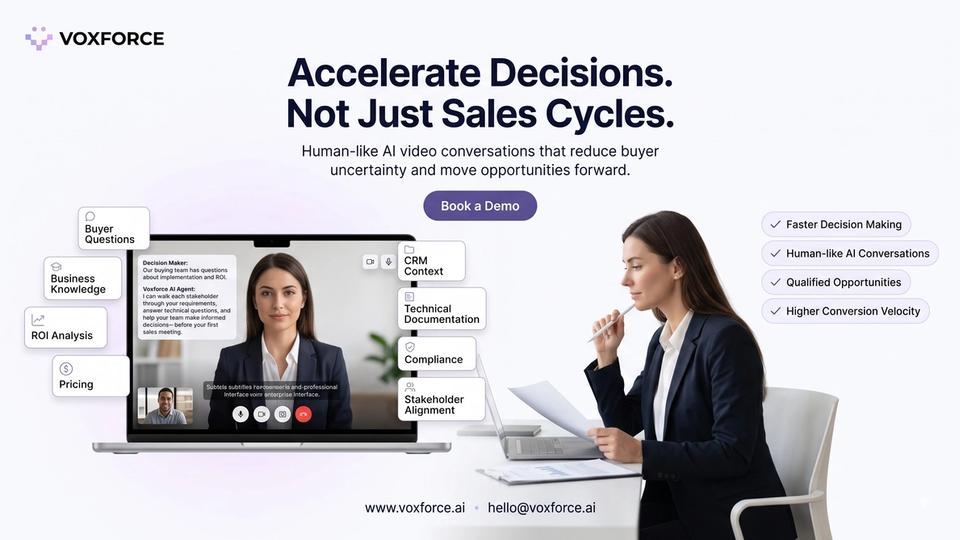
This is where AI Video Agents change the structure of enterprise engagement. Rather than functioning as another marketing tool, AI-powered Human Agents operate as an always-available, knowledgeable presence that meets a buyer at the exact moment a question arises, long before a sales representative is involved. Through Human AI Conversations delivered via Conversational Video AI, prospects can ask technical questions, request pricing clarification, and receive explanations tailored to their role within the buying committee, all through AI Video Agents built for enterprise complexity.
In a single interaction, AI-powered Human Agents can:
- Qualify intent and surface objections before they harden into disqualifiers.
- Engage multiple stakeholders across a single account through Multimodal AI.
- Recommend next steps based on where a buyer actually stands.
In practice, the AI Video Agent becomes the first meaningful business conversation a prospect has, well before any human seller enters, delivering AI Customer Engagement that feels personal rather than automated.
5. The Sales Funnel Is Becoming a Decision Acceleration Engine
The traditional sales funnel follows a linear sequence: website traffic generates a lead form, the form triggers a sales call, the call leads to qualification, followed by a product demo, a proposal, and finally a closed deal. This process assumes meaningful engagement cannot begin until a human salesperson becomes available. In today's buying environment, that assumption creates unnecessary delays and slows decision-making.
The traditional funnel looks like this:
- Traffic
- Lead Form
- Sales Call
- Qualification
- Demo
- Proposal
- Close
The decision acceleration model transforms the journey into:
- Traffic
- AI-powered Human Agent
- Instant Education
- Decision Support
- Intent Discovery
- Qualified Opportunity
- Sales Conversation → Close
A more effective approach treats the sales funnel as a decision acceleration engine rather than a lead management process. Instead of asking visitors to submit a form and wait for follow-up, businesses engage them instantly through an AI-powered Human Agent. Functioning as both an AI Video Agent and an AI Sales Assistant, it delivers Human AI Conversations powered by Conversational AI from the very first interaction. Prospects receive immediate education, personalized answers, and relevant information without waiting for a sales representative.
As the conversation progresses, the AI-powered Human Agent provides decision support by addressing stakeholder concerns, answering objections, and guiding buyers toward the right solution. Intent discovery happens naturally through conversation instead of rigid qualification forms, while continuous AI Customer Engagement helps buyers build confidence at every stage of the journey.
By the time an opportunity reaches the human sales team, much of the education, qualification, and consensus-building has already taken place. Sales teams can focus on high-value discussions and commercial negotiations instead of repeating introductory conversations. The result is a faster sales cycle, better-qualified opportunities, and a buying experience designed to accelerate decisions instead of creating friction.
6. Sales Teams Should Spend Less Time Explaining and More Time Advising
One of the most significant consequences of this model is what it removes from a seller's calendar. Conversational AI, delivered through capable AI Sales Assistants, absorbs the repetitive explanations that consume seller time: feature walkthroughs, onboarding logistics, and pricing fundamentals. AI Video Agents, delivered through Conversational Video AI, handle this layer with a consistency no team of humans could match at scale.
What remains for human sellers is the work that requires judgment:
- Business outcomes
- Return on investment
- Strategic fit
- Commercial terms
This is a fundamental shift in sales productivity. Sellers stop functioning as information dispensers and start functioning as advisors, engaging only once AI Sales Assistants and Human AI Conversations have already resolved the uncertainty that used to consume the earliest, least productive conversations.
7. How VoxForce.ai Is Building the Revenue Front Door
VoxForce.ai is not an AI avatar platform, and it is not a chatbot vendor. It is the intelligence layer that converts enterprise knowledge into Human AI Conversations, delivered through AI-powered Human Agents and AI Sales Assistants built for enterprise scale, expressed through Conversational Video AI. By combining Multimodal AI, Conversational Video AI, real-time voice, and deep CRM integration, VoxForce meets every prospect with a knowledgeable, always-available presence from the first moment of engagement.
This is the foundation of AI Customer Engagement built for enterprise complexity rather than simple support deflection. VoxForce's AI Video Agents and AI Sales Assistants draw on enterprise knowledge to deliver context-aware answers, qualify opportunities in real time, and hand off informed context to human sellers. VoxForce is establishing an entirely new category of AI Customer Engagement, one where Conversational AI, expressed through Multimodal AI and Conversational Video AI, becomes the front door through which every serious buying relationship begins.
Conclusion
The next generation of high-performing revenue organisations will not reduce sales cycles by asking salespeople to move faster. They will reduce them by ensuring buyers spend less time navigating uncertainty on their own. AI-powered Human Agents will become the first sales conversation every prospect has, letting human teams begin discussions with context, confidence, and qualified intent rather than basic discovery.
The organisations that embrace AI Video Agents and AI Sales Assistants early will not simply shorten their sales cycles. They will redefine how enterprise buying happens, replacing a pipeline problem with a decision velocity advantage, built on Human AI Conversations, Conversational AI, and AI Customer Engagement, that competitors relying on conventional funnels will struggle to match.