
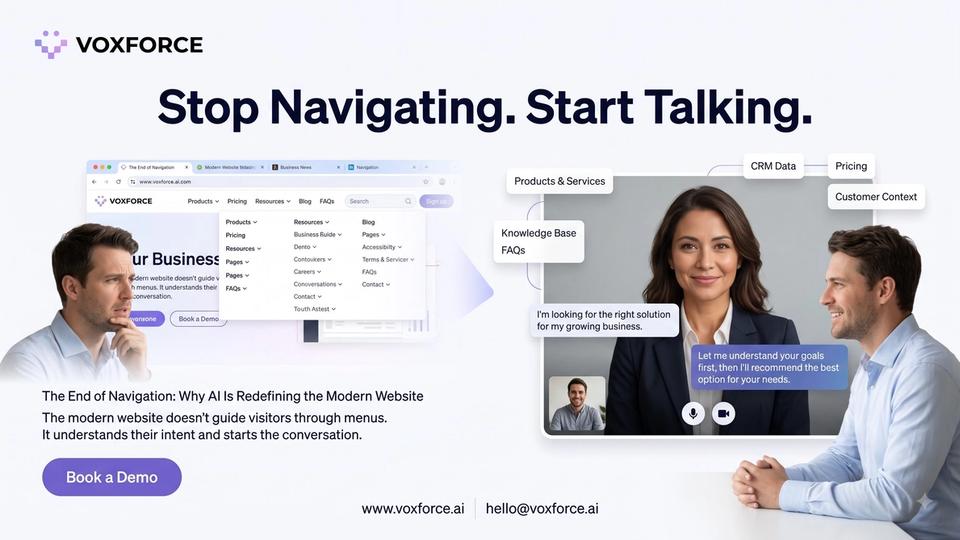
For almost three decades, businesses have measured the success of their websites using remarkably similar benchmarks. Faster loading speeds, better user interfaces, higher search rankings, improved conversion rates, and lower bounce rates became the indicators of digital maturity. Behind every redesign sat the same assumption that has shaped the internet since its earliest days. Customers would arrive with a question, navigate through pages, compare information, and eventually discover what they were looking for.
That assumption is beginning to disappear.
The biggest change taking place on the internet today is not another improvement in website design or user experience. It is the gradual disappearance of navigation as the primary way people interact with businesses online. Customers no longer want to understand a company's information architecture before finding answers. They expect businesses to understand what they are trying to achieve and respond accordingly.
This is a far more significant shift than replacing search bars with chat windows or adding AI to customer support. It changes the role of the website itself. Instead of functioning as a digital repository of information, the website is becoming an intelligent interface capable of understanding intent, guiding decisions, and holding conversations that evolve naturally as customer needs become clearer.
At VoxForce.ai, we believe this marks the beginning of a new era in digital engagement. The businesses that lead over the next decade will not necessarily have the largest websites or the most content. They will be the organisations whose knowledge is the easiest to access through conversation.
We Built Websites Around Company Logic, Not Customer Logic
Traditional websites mirror the way organisations operate internally. Products are grouped into categories, industries have dedicated pages, pricing lives under a separate menu, support sits in another section, and resources are organised into blogs, case studies, white papers, and documentation. From a business perspective, this structure is logical because it reflects departments, product portfolios, and organisational hierarchy.
Customers, however, rarely arrive thinking in the same way.
A visitor exploring a healthcare provider's website is not looking for a department page. They want to know whether a treatment is suitable for their condition. A procurement manager evaluating enterprise software is not interested in reading every feature page before asking whether the platform integrates with existing systems. A family searching for insurance is not comparing policy categories. They are trying to understand how they can protect their future.
Businesses organise information around what they sell. Customers organise their thinking around what they are trying to accomplish.
For years, website design has attempted to bridge this gap through better navigation, improved search functionality, and cleaner user interfaces. AI fundamentally changes the equation because customers no longer need to translate their objective into a company's menu structure. The website can begin with the customer's intent instead.
Every Click Represents Lost Context
Navigation has always been treated as a usability challenge. Businesses invest enormous effort in deciding where menus should sit, how many clicks customers should take, and which pages should appear first. Yet every additional click quietly transfers responsibility from the business to the customer.
Imagine someone evaluating a software platform. They begin on the homepage before moving to product pages, then implementation guides, pricing, integrations, customer stories, documentation, and finally the contact page. Each click represents another attempt to answer a question that the business already understands.
The customer is doing the work that the business should be doing.
Every navigation decision forces visitors to interpret the company's information architecture instead of simply explaining what they need.
Conversational AI reverses this relationship. Rather than expecting customers to understand how information is organised, businesses begin by understanding the customer. The conversation evolves around objectives, priorities, and context rather than menus and navigation paths.
That seemingly small change has profound implications because it removes friction from the earliest stages of digital engagement.
The Internet Does Not Have an Information Problem
Businesses continue to respond to customer questions in the same way they have for years. They publish more content.
More blogs.
More FAQs.
More landing pages.
More product videos.
More white papers.
More documentation.
The assumption is understandable. If every possible question has a corresponding webpage, customers should eventually find the answer.
The reality is very different.
Modern businesses are not constrained by a lack of information. They are constrained by the growing difficulty of making that information meaningful.
Consider a company evaluating customer engagement software. Product pages explain capabilities. Help centres describe every feature. Security documentation answers procurement requirements. Integration guides outline technical architecture. Customer stories demonstrate successful implementations.
Yet none of these resources answer the question that ultimately determines whether a purchase happens.
Will this work for my business?
That question depends on industry, existing technology, operational maturity, customer expectations, internal processes, and organisational priorities. No static webpage can anticipate every possible combination.
Conversation succeeds where documentation reaches its limit because it adapts continuously to context.
Search Was Never the Final Interface
Every major phase of the internet has been defined by a different way of finding information.
In the early years, people browsed directories because websites were too few to require sophisticated discovery. Search engines transformed that experience by allowing users to retrieve information instantly. Businesses then optimised websites around search, creating an entire industry built on visibility and discoverability.
AI introduces another transition.
Customers increasingly want answers rather than search results.
The difference may appear subtle, but it changes everything. Search retrieves documents. Conversations generate understanding.
When someone asks whether an enterprise platform can reduce onboarding time, they are not looking for a page containing those words. They are looking for an explanation that reflects their organisation, their challenges, and their objectives.
The future interface of the internet is therefore unlikely to be defined by better search.
It will be defined by better conversations.
Every Website Contains Two Businesses
Every organisation performs two very different functions.
The first creates value by building products, delivering services, solving problems, and serving customers.
The second explains that value through websites, marketing campaigns, documentation, customer support, product demonstrations, and sales conversations.
Historically, these two functions have remained separate because explanation depended heavily on people.
Sales teams explained products.
Support teams answered questions.
Implementation consultants guided customers.
Marketing created educational content.
AI changes this relationship by making explanation continuously available.
Instead of waiting for meetings or searching through documentation, customers can engage with an intelligent system that understands organisational knowledge and communicates it naturally. Information becomes dynamic rather than static, adapting as conversations evolve.
This does not replace human expertise.
It allows organisations to extend that expertise far beyond the limitations of time zones, office hours, and available headcount.
The Future Website Will Think Less Like Software and More Like a Colleague
One of the most interesting characteristics of traditional websites is that they remain passive regardless of who visits them. A first time visitor, an existing customer, a procurement leader, or a technical architect all receive essentially the same experience until they begin navigating different pages.
Intelligent websites behave differently.
They begin by understanding why someone has arrived before deciding how information should be presented. A returning customer asking about implementation receives a completely different conversation from a prospective buyer exploring products for the first time. A healthcare patient seeking treatment information engages differently from a hospital administrator evaluating technology partnerships.
The interface becomes adaptive rather than static because the conversation changes according to intent instead of remaining fixed around content.
This represents one of the most significant changes in digital communication since responsive design transformed websites for mobile devices. The next evolution is not making websites fit different screens. It is making them understand different people.
How VoxForce.ai Is Building the Next Generation of Digital Experiences
Every enterprise already possesses decades of expertise. Product managers understand why features were built. Sales engineers explain complex integrations every day. Customer success teams know what drives adoption. Support specialists resolve practical challenges. Compliance teams understand regulations, while implementation consultants know where customers typically struggle.
The problem is not that organisations lack knowledge.
The problem is that knowledge remains scattered across documents, CRMs, support systems, presentations, internal teams, and countless disconnected repositories.
At VoxForce.ai, we believe information alone does not create clarity. Conversation does.
VoxForce acts as the intelligence layer that transforms enterprise knowledge into real-time human conversations. Businesses can create AI-powered humans trained on their products, services, documentation, processes, and organisational expertise, allowing customers to engage naturally through voice, video, and conversation across every digital touchpoint.
Instead of asking visitors to navigate information, businesses can make knowledge instantly conversational.
That is fundamentally different from adding another chatbot to a website.
It is reimagining what the website itself can become.
The Next Competitive Advantage Will Be Conversation Architecture
The internet has spent thirty years perfecting the architecture of information. The next decade will focus on the architecture of conversation.
Businesses will still create content. They will still publish product pages, customer stories, documentation, and educational resources. But these assets will increasingly become the knowledge that powers intelligent conversations rather than destinations customers are expected to navigate independently.
The organisations that lead this transformation will not simply have better designed websites. They will have businesses that communicate more naturally, explain more clearly, and make expertise available the moment customers need it.
The website is not disappearing because websites have become obsolete. It is disappearing because navigation is no longer the most effective way to access business knowledge. As conversational AI reshapes digital engagement, the most valuable websites will no longer be measured by the number of pages they contain, but by the quality of the conversations they enable.
That is the future VoxForce.ai is building, where every website becomes an intelligent business interface, every interaction becomes conversational, and every visitor finds understanding instead of another menu.