
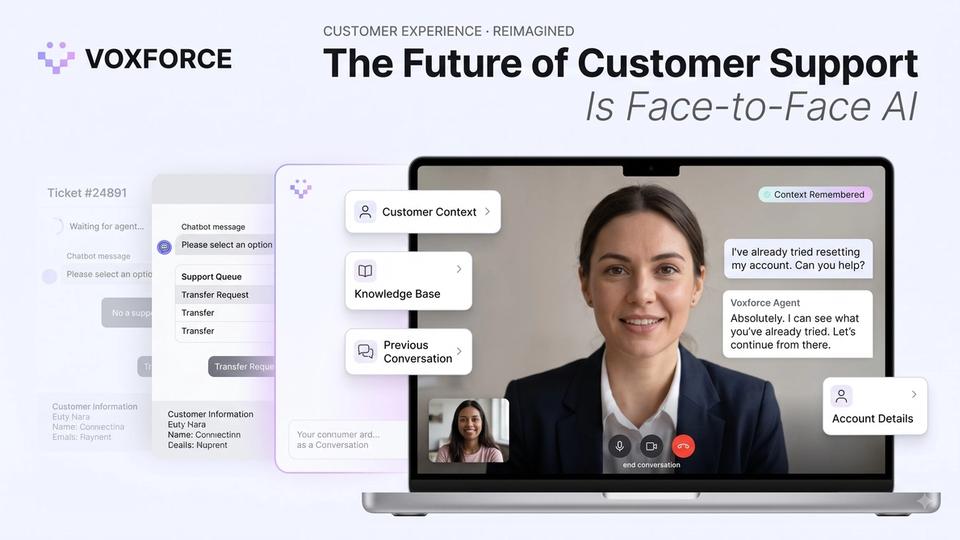
Enterprises have spent three decades and hundreds of billions of dollars building customer support infrastructure. Ticketing platforms. IVR trees. Live chat. Chatbots. Knowledge bases. Omnichannel routing engines. And yet the defining experience of contacting customer support in 2026 is still the same one customers have complained about for years: repeating yourself, waiting, and being passed between systems that do not remember you.
Zendesk's 2026 CX Trends research, drawn from more than 11,000 consumers and CX leaders across 22 countries, found that 83 percent of consumers still believe their customer experience should be meaningfully better than it is today. That is not a statistic about a broken industry. It is a statistic about an industry that has automated its old process without redesigning the experience underneath it.
Support became digital a long time ago. It has never become conversational. Customers still explain their problem to a bot, repeat it to a human, and repeat it again when they get transferred. Seventy-four percent of consumers say it is frustrating to tell their story over and over to different agents. The channels changed. The underlying architecture, built around queues and case records rather than relationships, did not.
This article argues that the next shift in customer support will not come from a better chatbot, a faster IVR, or a smarter routing algorithm. It will come from AI that can hold a face-to-face conversation: seeing, listening, remembering, and reasoning in real time, at the scale of an enterprise contact center. Call it face-to-face AI, or more precisely, an AI-powered human agent: a system that behaves less like software and more like the best representative a company has, available at enterprise scale. It is the point at which customer support stops being ticket management and starts being an actual conversation.
Customers Expect Conversations, Not Tickets
Every other digital relationship a customer has has become conversational. They ask a voice assistant a question and get an answer. They message a friend and get a reply in seconds, with full context of everything said before. They expect the same standard from the brands they pay.
Support has not kept pace. Zendesk's research shows 74 percent of customers now expect service to be available 24/7, and 88 percent expect faster response times than they did a year ago. Speed is only part of it. Eighty-five percent of CX leaders say customers will drop a brand over a single unresolved issue, which means the bar is not "respond quickly." It is "resolve correctly, the first time, without making the customer repeat the setup."
Context is the other half of the expectation. Eighty-three percent of CX leaders say memory-rich AI agents are the key to genuinely personalized customer journeys. Customers no longer separate "the chatbot experience" from "the human experience" in their heads. They judge the brand as a single entity, best served by an AI-powered human agent that should already know who they are, what they bought, and what they already tried.
This is the standard enterprises are being measured against, whether or not their support stack was designed for it: instant, continuous, personalized, and remembered. Most support infrastructure was designed for something else entirely.
Traditional Customer Support Was Built Around Queues
The ticketing system, the IVR, the chatbot, and the knowledge base were not built to optimize the customer's experience. They were built to optimize the organization's ability to process volume. That distinction explains almost everything about why support still feels transactional.
A ticketing system exists to prioritize, assign, and track resolution against an SLA. That is an operations tool, not a conversation. An IVR exists to route a caller to the correct queue with the fewest possible agent-minutes spent on triage. A chatbot, in its first-generation form, exists to deflect volume away from paid headcount. A knowledge base exists to let the customer solve the problem without involving a human at all.
Each of these was a rational response to cost pressure. Gartner's benchmark puts the cost of a self-service contact at roughly $1.84, versus roughly $13.50 for an agent-assisted interaction, a gap wide enough to explain most of the last decade's automation investment on its own. The economics were, and remain, real.
What none of these systems were built to do is hold a conversation that feels continuous across channels, remembers prior context, and adapts to the customer in front of it. That is why 88 percent of contact centers report using some form of AI, yet only 25 percent have fully integrated that automation into daily operations. Adoption has outpaced integration. Enterprises bought automation. Most have not yet redesigned the underlying experience.
Why Chatbots Plateaued
Text-based, rule-based chatbots solved a narrow problem well: deflecting simple, high-volume, low-ambiguity queries. Password resets, order status, store hours. Beyond that narrow band, they run into a hard ceiling.
The ceiling is structural, not cosmetic. A scripted chatbot has no persistent memory of the customer beyond the current session. It cannot interpret tone, frustration, or urgency. It cannot explain a complex decision, only restate a policy. And because it cannot do any of that, customers learn quickly that the fastest path to resolution is to type "agent" and wait.
The trust gap is documented, not anecdotal. Coworker AI's compilation of 2026 industry data found that 64 percent of consumers remain wary of AI in customer support, even as 64 percent of CX leaders are increasing AI investment. Those two numbers sitting side by side describe an industry investing faster than it is earning trust. Separately, NextPhone's 2026 compilation of vendor and analyst data notes that consumer preference still favors a human agent for 79 percent of interactions, even though 51 percent prefer a bot when speed is the priority, evidence that the objection to AI is rarely the automation itself. It is the flatness of the experience.
Gartner's own numbers illustrate the ceiling directly: only about 14 percent of customer service issues are fully resolved through self-service. Customers are not failing to find the self-service tools. They are finding tools that cannot actually reason through their specific problem.
None of this means generative AI failed. It means text-only, memoryless, faceless interaction has a natural resolution limit, and enterprises are running into it at scale.
Face-to-Face AI Changes the Dynamic
The missing ingredient is not more intelligence. It is presence. A written chatbot response and a spoken, face-to-face explanation of the same information land differently, because the customer is judging more than the content. They are judging tone, pacing, eye contact, and the sense that something is actually listening, not retrieving.
This is not a new insight about communication; it is an old one about trust that digital support has simply ignored. Video and voice carry signals that text cannot: hesitation, reassurance, emphasis on the part of the explanation that actually matters to this customer. An AI-powered human agent that combines conversational reasoning, natural voice, visual presence, persistent memory, and enterprise knowledge is not a chatbot with a face bolted on. It is a different category of interaction, because presence changes how the customer processes what they are being told.
This is also where the industry's own data points. Seventy-six percent of consumers say they would choose a company that let them move between text, images, and video in the same conversation thread without starting over. Customers are already telling researchers that multimodal, continuous conversation is the differentiator they want. Face-to-face AI is the logical endpoint of that preference, not a speculative leap beyond it.
The reasoning layer underneath matters as much as the video layer on top. Google Cloud–sourced benchmarking cited in industry compilations found that generative AI-powered agents reach roughly 92 percent accuracy in understanding customer intent, compared with 65 to 70 percent for keyword-based bots. Pair that reasoning accuracy with a natural voice and visual presence, and the resolution ceiling that has capped text-only chatbots starts to lift.
Customer Support Becomes Relationship Building
Once an AI-powered human agent can see, remember, and reason across sessions, the nature of the interaction changes. It stops being a single transaction and starts being one interaction in an ongoing relationship, which is precisely what CX leaders say customers are asking for.
In banking and insurance, that means an AI-powered support agent walking a customer through a claim or a disputed charge the way a trusted advisor would, with full account context already loaded rather than requested again. In healthcare, it means an AI-powered virtual agent guiding a patient through a benefits question or a pre-appointment intake with visible reassurance built into tone and pacing, not just accuracy of answer. In SaaS and telecom, it means onboarding that adapts in real time to what the customer is actually struggling with, rather than a fixed video tutorial. In retail and hospitality, it means a return, an upgrade, or a booking change handled with the same warmth a good in-store associate would bring, available at 2 a.m.
The common thread is not the industry. It is that each of these moments is high-stakes enough that customers want to feel understood, not just processed. Eighty-one percent of CX leaders say giving every employee the ability to surface answers instantly will transform decision-making inside their organizations. The same logic applies on the customer-facing side: an agent that already knows the history does not need to ask the customer to re-establish it.
The Economics of Face-to-Face AI
None of this matters to a CEO or CFO unless it shows up in the numbers, and the numbers behind AI-native support are now well documented enough to build a business case on.
On cost, Lorikeet's 2026 compilation of Gartner and market benchmarks puts self-service at roughly $1.84 per contact against $13.50 for agent-assisted service, with AI-native platforms now operating in the $1 to $3 range per resolution, achieving first-contact resolution of 55 to 70 percent with average handle times under three minutes. Separately, Gartner's contact-center projections estimate that conversational AI will reduce contact center labor costs by roughly $80 billion in 2026, on the basis that labor represents up to 95 percent of total contact center cost.
On availability, the case is structural rather than incremental: an AI agent does not have a shift schedule. Combined with 74 percent of customers already expecting 24/7 availability, round-the-clock coverage is shifting from a premium differentiator to a baseline expectation enterprise must meet at a sustainable cost.
On satisfaction, the more interesting finding is which metric moves first. Salesforce's 2026 State of Service: AI Agents Edition, based on 3,075 service professionals surveyed globally, found that after deploying AI agents, the number one improved KPI organizations report is customer satisfaction, ahead of rep productivity, average handle time, retention, and first-response time. Those ordering matters. It suggests the value of well-executed AI support is not primarily an efficiency story. It is an experience story that happens to also reduce cost.
Escalation behavior tells a similar story about quality, not just volume. Industry-compiled data attributed to Gartner indicates that companies using reasoning-capable AI agents see 45 percent fewer escalations to human agents than those relying on rule-based chatbots, which points to better first-contact resolution rather than simple deflection.
None of these figures are guaranteed outcomes. They describe what AI-native, well-integrated deployments are already achieving, against a backdrop where 88 percent of contact centers use some form of AI but only 25 percent have fully integrated it into daily operations. The economic case is real. It is also conditional on doing the integration work most organizations have not yet finished.
There is also a scalability argument that is easy to underweight. An AI-powered human agent does not need to be hired, trained, or retained market by market. The same level of product expertise that took years to build into a senior support team can be made available, consistently, to every customer, in every time zone, the moment it is deployed.
Why AI Will Augment Human Support Rather Than Replace It
The evidence does not support a fully automated future, and the more credible research is explicit about this. Gartner's own trend analysis anticipates a correction: by 2027, half of the organizations that had planned significant customer service workforce reductions are expected to abandon those plans, and separately, 95 percent of customer service leaders plan to retain human agents specifically to define AI's role rather than eliminate the function it plays.
There is a good structural reason for that. AI, including face-to-face AI, is well suited to repetitive queries, information retrieval, product guidance, routine troubleshooting, and structured processes with a clear correct answer. Data from AI-handled interactions bears this out: satisfaction scores are highest on structured intents such as password resets and refund status checks, and lowest on sentiment-heavy intents such as complaint handling, where variance and emotional nuance are highest.
That gap defines where humans still add irreplaceable value: complex negotiations, emotionally charged situations, genuine exceptions to policy, and relationship-level account management where judgment, not information retrieval, is the scarce resource. Salesforce's own longitudinal research found that 68 percent of customers say advances in AI make it even more important that companies remain trustworthy, which is really an argument for keeping humans visibly in control of the parts of support where trust is fragile.
The organizations getting this right are not choosing between AI and human agents. They are routing by intent: an AI-powered human agent handles volume and structure, humans handle exception and emotion, and face-to-face AI raises the floor of what the automated tier can competently do before a handoff is needed at all. That is a hybrid model, and it is likely to remain one for the foreseeable future, not because the technology cannot go further, but because trust in high-stakes moments is still, for now, a human currency.
How VoxForce.ai Is Building Face-to-Face AI Support
The shift toward face-to-face AI does not require enterprises to discard existing infrastructure. It requires a layer that can sit across a website or support environment and turn a static page or a text-based chat widget into an actual conversation: one that sees the visitor's context, speaks naturally, remembers what has already been discussed, and reasons over the company's own knowledge rather than a generic script.
That is the problem VoxForce.ai is built to solve. Its AI Video Agents function as an AI-powered human agent for the business: combining conversational AI, voice AI, and visual presence with memory and enterprise-specific knowledge, so a customer visiting a website or contacting support encounters something closer to a knowledgeable representative than a search box with a chat icon. The same underlying architecture extends to AI-driven customer engagement and sales assistance, where the goal is not automation for its own sake but a conversation that actually resolves what the customer came to resolve.
The design intent is additive rather than substitutive. VoxForce's positioning is not that AI Video Agents replace human support and sales teams. It is that they absorb the repetitive, structured volume, resolve it in real time, and hand off cleanly to a person when the situation calls for judgment, negotiation, or empathy that only a human can supply. For enterprises, that means an existing support and sales organization can extend its coverage and consistency without losing the human layer customers still want to reach for the moments that matter most.
Conclusion
The next competitive advantage in customer support will not come from resolving tickets faster. Ticket-based thinking is itself the constraint. It measures a transaction, not a relationship.
The organizations that pull ahead will be the ones that treat every customer interaction as a conversation worth having well: richer context carried across channels, problems addressed earlier because the AI actually understood the intent behind them, engagement that continues rather than resetting with each contact, and AI capable enough, and present enough, that customers are willing to talk to it the way they would talk to a competent person.
Face-to-face AI is the mechanism that makes this possible at enterprise scale. It does not replace the human relationship at the center of good customer experience. It extends that relationship to every customer, at every hour, in a form customers are already telling researchers they want. The support organizations built to manage queues will keep optimizing queues. The ones built to manage conversations will define the next decade of customer experience.