
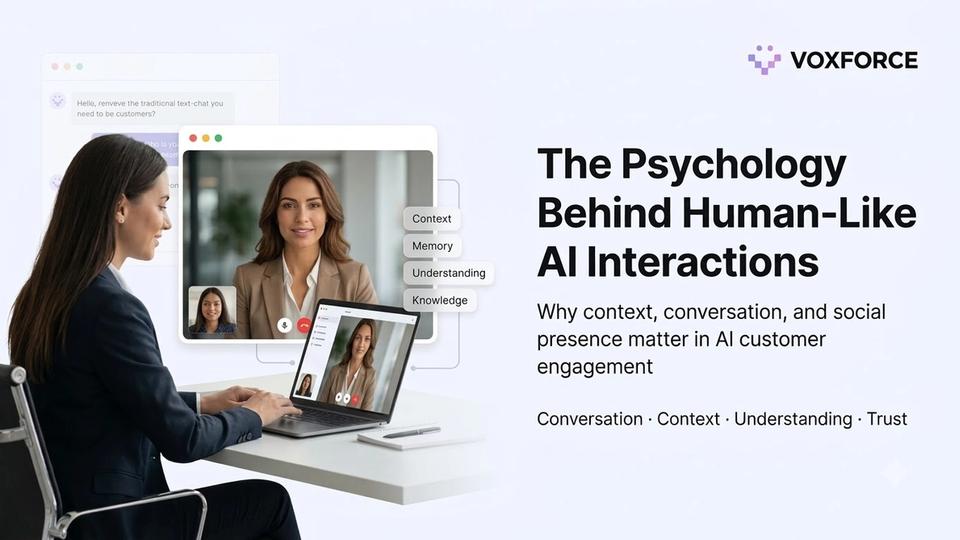
Chatbot abandonment remains high even in organisations that have invested heavily in AI. Customers open a chat window, type a question, and leave before getting an answer. This is usually read as a technology gap. It is more often a psychology gap.
Chief Customer Officers and Customer Success leaders spend their careers managing something conversational at its core: trust between a business and the people who depend on it. That makes this audience uniquely positioned to see what most AI rollouts miss. A chatbot can be technically capable and still fail, because customers are not evaluating it the way they evaluate a search engine or a form. They are evaluating it the way they evaluate a person.
AI-powered Human Agents, delivered through AI Video Agents, succeed where scripted chatbots fail for a specific reason. They are designed around how people naturally communicate, rather than asking people to adapt to how software is built. Understanding why that distinction matters requires a short detour into behavioural science, not just product design.
This matters more for retention than most technology evaluations account for. A customer who abandons a chatbot rarely files a complaint. They simply lose a small amount of confidence in the brand and move on, often without the business ever recording the interaction as a failure. Over enough touchpoints, that quiet erosion shows up in churn and lifetime value, long after the original conversation has been forgotten.
Humans Are Wired for Conversation
Conversation is the oldest interface humans have. Long before search engines or menus, people learned, negotiated, and built trust through dialogue. That history is not incidental. It shaped how the brain processes information.
Reading a form, scanning a menu, or interpreting a search result requires active translation. The brain has to convert an unfamiliar structure into meaning. A conversation does not require that translation step, because dialogue is the format the brain already expects.
This has a direct operational consequence. Traditional support tools ask the customer to do the cognitive work:
- Search for the right article
- Click through several menu layers
- Read documentation written for a general audience
- Fill in a form with fields that do not quite match their situation
Each of those steps adds friction that a natural conversation removes. Nielsen Norman Group's usability research on conversational interfaces has found that scripted systems struggle badly the moment a customer deviates from the expected script, forcing the customer back into search-like behaviour inside what was supposed to be a conversation. That failure point is exactly where trust breaks down, because the interaction stops behaving the way the customer's brain expects it to.
Behavioural researchers describe this as a difference in cognitive fluency, how easily the brain can process a given format of information. Dialogue is a high-fluency format because it mirrors how people already exchange information with each other. Menus, forms, and search results are lower-fluency formats, because they require the customer to learn and apply an unfamiliar structure before they can extract meaning. A conversation that behaves like an actual conversation, rather than a script wearing conversational language, keeps that fluency intact from the first message to the last.
Trust Begins Within Seconds
Customer Success leaders already know that first impressions carry disproportionate weight in a relationship. The same principle applies inside an AI interaction, often faster than most organisations account for.
Within the first exchanges, customers are evaluating:
- Confidence in the tone of the response
- Competence, based on whether the answer actually fits the question
- Clarity of the explanation
- Responsiveness, both in speed and relevance
- Empathy, particularly if the issue is stressful
- Consistency with what the customer already expects from the brand
A scripted chatbot tends to fail several of these tests simultaneously. Its first response is often generic, its tone rarely adjusts to context, and any deviation from the expected question exposes its limits immediately. An AI-powered Human Agent is built to pass this early evaluation, because it can hold tone, context, and relevance from the very first response, the way a knowledgeable person would rather than the way a script does.
Harvard Business Review's research on the AI trust gap found that 57 percent of people do not trust AI, with a further 22 percent neutral. That baseline makes the first impression even more consequential. There is little accumulated goodwill to draw on if the opening exchange feels mechanical.
Context Creates Confidence
Few things damage trust faster than being asked to repeat information already given. Zendesk's 2026 CX Trends research, based on more than 11,000 consumers and CX leaders globally, found that 74 percent of customers find it frustrating to tell their story again to a different agent or system.
That frustration is not really about efficiency. It signals to the customer that the business does not actually know them, which undermines confidence in everything that follows in the conversation.
AI-powered Human Agents address this by combining several layers of context at once:
- Conversational memory carried across sessions
- CRM integration, for account and history
- Prior customer interactions
- Enterprise knowledge relevant to the specific question
- Intent recognition, to understand what is actually being asked
Zendesk found that 83 percent of CX leaders now see memory-rich AI agents as the key to genuine personalisation. For a Customer Success leader, this reframes what personalisation actually means in an AI context. It is not a tone setting. It is whether the system remembers, and whether that memory visibly shapes the response the customer receives.
This distinction is worth sitting with, because many organisations already believe they have solved for context through their CRM alone. A CRM record is a store of facts. It only becomes context the moment it changes how a conversation actually unfolds, by shaping the first question asked or the explanation offered. Customers rarely notice a system that has their data. They notice, immediately, a system that behaves as though it does not.
AI Video Agents Add Social Presence
Behavioural research on human computer interaction describes a concept called social presence: the felt sense that another entity is actually there, engaged, and responsive. Text alone struggles to create this feeling. Voice and visual presence create it far more reliably.
Academic research on anthropomorphism and social presence in virtual assistants has found that perceived social presence increases both trust and the perceived quality of recommendations a system provides. That effect strengthens with dialogue length, meaning a longer, well-handled conversation builds more trust than a short, efficient one, provided the quality holds throughout.
AI Video Agents apply this directly to enterprise support. A visual, voice-led interaction can:
- Increase attention, since a face and voice command more focus than static text
- Improve comprehension of complex explanations
- Reassure the customer through tone and pacing during a stressful issue
- Build emotional connection that text alone rarely achieves
- Reduce the ambiguity that leads customers to misread a written response
This is not a claim that customers believe they are speaking with a human. It is a claim, supported by social presence research, that visual and vocal cues activate the same trust heuristics people use with other people, even when they know an AI system is on the other side of the conversation.
This point is worth stating carefully, because overstating it undermines the trust it is meant to build. The goal is not to disguise the AI as a person. Research on anthropomorphism in service contexts is consistent that customers respond positively to human-like cues precisely because they signal competence, warmth, and attentiveness, not because customers are being misled about what they are interacting with. Transparency about the nature of the system and psychological effectiveness of its design are not in tension. A well-designed AI Video Agent can be clearly identified as AI and still benefit fully from the trust cues that voice and visual presence provide.
Human-Like AI Reduces Cognitive Load
Cognitive load is the mental effort required to process information and make a decision. Every additional step a customer has to take, searching, comparing, interpreting, remembering, adds to that load, and higher cognitive load reliably reduces satisfaction and decision quality.
Traditional support systems accumulate this load quickly. A customer often has to:
- Search using terms they are not sure are correct
- Interpret whether an article actually applies to their situation
- Compare several possible answers for relevance
- Remember what they already tried before contacting support
- Decide, without much confidence, whether the information solves their problem
AI-powered Human Agents remove most of this by doing the retrieval and interpretation internally, then delivering a single, direct answer conversationally. The customer does not have to hold multiple possibilities in mind. They simply respond to what they are told, the same way they would in a conversation with a knowledgeable colleague.
For a Customer Success organisation, lower cognitive load has a compounding effect. It improves satisfaction with the immediate interaction, and it reduces the likelihood the customer disengages before reaching resolution, which is where most self-service abandonment actually originates.
Psychology Becomes a Competitive Advantage
Product parity has pushed more of the competitive battle into experience. When features and pricing converge across a category, the way a business makes customers feel becomes one of the few remaining differentiators.
Psychologically intelligent AI experiences influence several outcomes Customer Success leaders are directly accountable for:
- Trust, formed faster and held more consistently across interactions
- Engagement, since customers are more willing to continue a natural conversation than a scripted one
- Loyalty, built through consistent, low-effort experiences over time
- Retention, since fewer customers disengage out of frustration
- Conversion, in cases where support and commercial conversations overlap
- Overall satisfaction, driven by lower effort and higher perceived understanding
Salesforce's State of Service: AI Agents Edition, based on more than three thousand service professionals surveyed globally, found that after deploying AI agents, the top improved metric organisations report is customer satisfaction, ahead of productivity, handle time, and retention. That is a direct signal that psychologically sound AI design produces outcomes customers notice, not just efficiency gains behind the scenes.
This is a useful reframe for how Customer Success teams justify AI investment internally. The business case is often built around cost per interaction, which is real but incomplete. The stronger case, and the one that tends to hold up over a longer horizon, is that trust compounds. A customer who has three effortless, well-remembered conversations is measurably more likely to stay, expand, and advocate than one who has three inconsistent ones, regardless of how quickly each individual interaction was resolved.
AI-powered Human Agents Enhance Human Relationships
None of this argues for removing people from the customer relationship. It argues for using AI to protect the moments where human attention matters most.
AI-powered Human Agents are well suited to routine, structured interactions:
- Frequently asked questions
- Onboarding walkthroughs
- Product education
- Standard troubleshooting
- Account and policy guidance
Human teams remain essential for the interactions that depend on judgment rather than information:
- Complex problem solving
- Strategic account conversations
- Negotiations
- Emotionally difficult situations
- Long-term relationship management
For a Customer Success leader, this is the practical value of getting AI psychology right. When routine conversations feel effortless and trustworthy on their own, the human team is freed to spend its attention on the accounts and moments where empathy and judgment cannot be automated. AI becomes an extension of how the organisation communicates, not a replacement for the relationships it depends on.
How VoxForce.ai Applies Behavioural Intelligence to Enterprise AI
The organisations getting this right are not simply deploying a more advanced language model. They are designing for how people actually process trust, memory, and presence in conversation.
VoxForce.ai is one example of this approach applied at enterprise scale. Its AI Video Agents function as AI-powered Human Agents, combining Conversational AI, natural voice, and visual presence with enterprise knowledge and conversational memory, so each interaction carries the context and tone a customer expects from a knowledgeable person. The same architecture extends into AI Customer Engagement and AI Sales Assistants, supporting Human AI Conversations across both support and commercial interactions, and applying Multimodal AI so customers can move between text, voice, and video without losing continuity.
The underlying premise reflects the research this article has walked through. Enterprise AI performs best not when it is simply intelligent, but when it is designed around how people already communicate.
Conclusion
Enterprise AI will not ultimately be judged only by how intelligently it answers a question. It will be judged by how naturally people interact with it, and by whether that interaction leaves the customer more confident in the business than before it started.
Customers trust conversations that feel human because the human brain evolved around dialogue, relationships, and social interaction, not menus or search fields. AI-powered Human Agents, supported by AI Video Agents, create experiences that align with that wiring rather than working against it.
For Chief Customer Officers and Customer Success leaders, the next competitive advantage in AI Customer Engagement will not come from adding more automation. It will come from designing AI around human psychology, so customers experience less effort, more understanding, and a relationship they are willing to trust again.
That is a different mandate than most AI roadmaps are currently written around. Fewer organisations are asking whether their AI is fast enough or accurate enough than are asking whether it feels trustworthy to the person on the other end of the conversation. The answer to that question, more than any technical benchmark, is what will determine whether AI strengthens the customer relationship or quietly erodes it.