
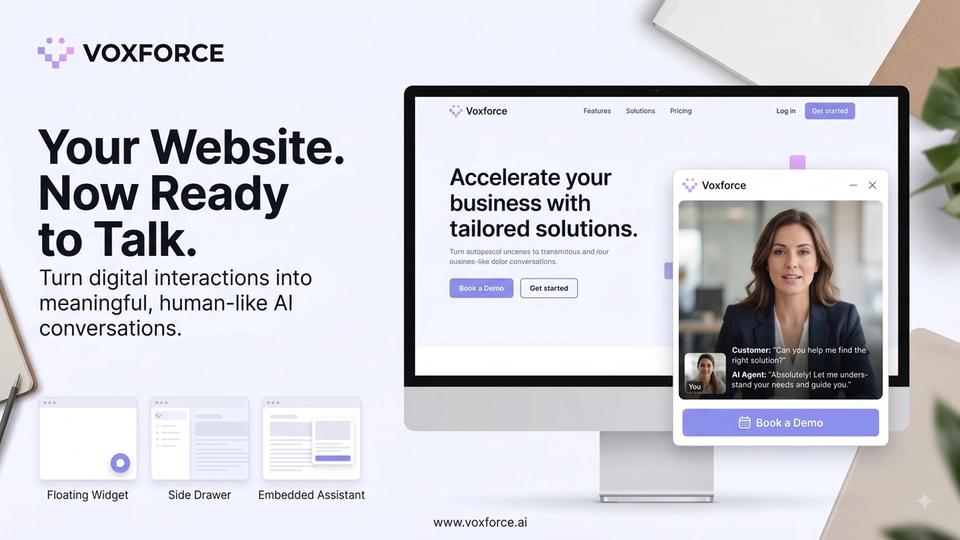
The Voxforce Widget enables businesses to deploy AI-powered Human Agents directly on websites, landing pages and digital platforms. Rather than functioning as a conventional chatbot that simply answers questions, the Widget provides a configurable customer-facing interface through which visitors can interact with an AI agent using different formats, personas, languages and engagement triggers. Businesses can determine where the Widget appears, which pages use it and how visitors initiate conversations, allowing Conversational AI to become part of the existing digital customer journey. The Widget can also serve as the entry point to broader Voxforce capabilities such as product and service presentation, lead capture, appointment booking, option selection, payment actions and human handoff.
Websites have become more sophisticated. Customer journeys have not
Businesses have spent years improving their digital presence. Websites now provide extensive product information, detailed service pages, pricing, resources, FAQs, customer stories, videos and multiple contact options. Search, analytics, personalisation and marketing automation have made digital channels considerably more capable than they were a decade ago.
Yet the underlying interaction model has changed much less.
A visitor arrives with a question or business need and is expected to navigate the organisation's digital structure to find the answer. If the relevant information is not immediately apparent, the customer searches again, moves between pages, opens another menu or submits a form. The business may have all the necessary information available, but the customer still has to assemble it.
This creates a growing gap between customer intent and digital response.
The problem becomes more pronounced as businesses offer more products, services, packages and use cases. A customer may understand the problem they are trying to solve without knowing the terminology the business uses to organise its website. A prospective buyer may want to know which product is appropriate without reading every product page. A customer may be ready to book a service but still have one question that prevents action.
Traditional website architecture assumes that the customer will navigate towards the answer. Conversational AI changes the assumption by allowing the customer to start with the question. That is where AI-powered Human Agents become increasingly relevant.
The next stage of digital experience is conversational
The evolution of digital experience has largely been about making information easier to access. Search made websites easier to navigate, responsive design made them accessible across devices, personalisation made experiences more relevant and analytics helped businesses understand customer behaviour.
The next development is more interactive.
Instead of simply presenting information, the digital experience can respond to customer intent. An AI-powered Human Agent can allow visitors to describe what they need in natural language, ask follow-up questions, receive information in context and, where the relevant capabilities are available, move towards an action.
This does not mean that websites become obsolete or that every interaction should be converted into a conversation. It means that the website gains another interface through which customers can engage with the business.
The distinction is important. A conventional chatbot is often treated as an additional support feature, usually represented by a small chat icon in the corner of the screen. A more sophisticated AI Customer Experience model considers the AI agent as part of the overall digital journey, with its location, behaviour and role designed around customer intent.
The emerging model is therefore less about adding AI to a website and more about making the website capable of interacting with the customer.
The Widget is the customer-facing layer for AI
The intelligence behind an AI agent is only useful when customers can access it at the point where they need assistance. The Voxforce Widget is designed to provide that customer-facing layer by allowing businesses to deploy AI agents directly on websites, landing pages and digital platforms.
This makes the Widget an important part of the overall AI Customer Engagement architecture. It connects the AI capability with the environment in which the customer is already making decisions, rather than requiring the customer to leave the website and enter a separate AI experience.
The feature supports multiple formats, including a circle live chatbot, rectangular live chatbot, side drawer assistant, full-page AI assistant and embedded section widget.
The significance of these options is not simply visual. Different digital journeys require different levels of conversational presence. A compact assistant may be appropriate for a content-led website where AI needs to remain available without dominating the page, while a side drawer may provide more space for a detailed conversation without taking the customer away from the underlying content. A full-page or embedded experience may be more appropriate when the conversation itself is central to the journey.
The Widget therefore allows businesses to consider where conversation belongs within the customer experience, rather than treating AI as a standard component that appears identically across every page.
The form of the AI interaction matters
The design of an AI-powered Human Agent is not limited to its technical capability. It also involves how the agent is presented to the customer.
Voxforce provides configuration options covering Widget position, colours, greeting messages, avatar and persona selection, language, trigger behaviour and page targeting.
These controls become particularly relevant when businesses use AI for different customer-facing roles. A sales AI agent may need to guide a prospective buyer through products or services, while a support-oriented agent may need to focus on resolving questions and escalating issues. A receptionist or appointment assistant may require another interaction style altogether. The Voxforce Persona Studio supports role-specific AI agents including sales, support, reception, product advisory and appointment assistance.
This creates an important distinction between generic AI and business-specific Human AI Conversations. The objective is not simply to make the AI sound natural. It is to make the interaction appropriate to the role the AI is expected to perform.
As AI becomes part of the customer-facing brand experience, businesses will increasingly need to consider the persona, language, visual identity and behaviour of their AI agents in the same way they consider other customer touchpoints.
Context is becoming as important as capability
One of the biggest risks with website AI is treating every visitor and every page in the same way.
A customer looking at a product page may want an explanation of features. Someone reviewing pricing may be trying to compare options or understand what is included. A visitor on a support page may have an existing issue that requires a different type of response. The customer's location within the website provides context about potential intent.
The Voxforce Widget includes page targeting and trigger behaviour, giving businesses control over where and how the AI interaction is introduced.
This capability supports a more contextual approach to AI Customer Experience. Instead of presenting the same AI interaction everywhere, businesses can determine which parts of the digital journey benefit most from conversational assistance and how that interaction should begin.
That distinction can influence the quality of the experience.
AI that appears at every stage without context can become another source of digital noise. AI that appears at the right moment, with the right role and the right information, can reduce friction.
The strategic principle is straightforward: AI should be available where it creates value, not simply where it can be deployed.
From conversation to action
The value of a conversational interface becomes more significant when it can help customers move beyond information.
The Voxforce Conversation UI Builder is designed to allow AI agents to display interactive elements during conversations, including registration forms, lead capture forms, appointment booking, product and service views, pricing cards, option selection, payment actions, confirmation screens and human handoff forms.
This changes the potential role of conversational AI within the website.
A customer could begin by asking a question, receive an explanation, view the relevant service or product, select an option and proceed towards a business action without having to navigate through multiple disconnected interfaces.
AI-assisted form filling extends this concept further by allowing the AI to collect information conversationally and populate permitted form fields, while requiring the customer to review and confirm the information before submission.
The underlying shift is from conversation as an endpoint to conversation as an interface for action.
For businesses, this could have implications across lead generation, appointment booking, product discovery, service enquiries and customer support. For customers, it can reduce the number of steps required to move from a question to an outcome.
The Widget is therefore not the entire conversational experience. It is the customer-facing entry point through which that broader experience can begin.
The website becomes an active participant in the customer journey
This creates a broader strategic question for digital leaders.
If a website is expected to do more than publish information, what should its role become?
The answer is unlikely to be a complete replacement of conventional interfaces. Websites will continue to need structured content, navigation, product pages, forms and transactional systems. The opportunity is to combine these elements with AI so that customers can choose the interaction model that best suits their needs.
A visitor who knows exactly what they want can continue to navigate directly.
A visitor who needs assistance can start a conversation.
A customer who needs to compare options can ask the AI for guidance.
A high-intent visitor can move from conversation to lead capture or booking.
A customer with a complex or sensitive issue can be transferred to a human team.
This creates a more flexible digital environment in which AI-powered Human Agents, rather than replacing the website, extend what the website can do.
The resulting customer journey can be represented as:
Content + Conversation + Context + Action + Human Support
Each component has a distinct role. Content provides information, conversation provides accessibility, context improves relevance, actions reduce friction and human support provides intervention where AI should not operate alone.
What digital leaders should consider before deploying an AI website assistant
The decision to introduce AI-powered Human Agents should begin with the customer journey rather than with the technology itself.
The first question is where customers experience friction. Businesses should identify pages, processes and interactions where visitors frequently require clarification, abandon forms, struggle to find information or fail to understand the next step.
The second question is what the AI should actually accomplish. The role may be answering questions, explaining products, guiding customers, capturing leads, booking appointments, supporting existing customers or directing complex cases to human teams. A clearly defined purpose is more valuable than simply placing AI everywhere.
The third question is what business knowledge the AI needs. Voxforce's Organization DNA is designed to provide AI agents with company information including products, services, pricing, FAQs, case studies, target audiences, brand tone, support processes, escalation rules and restricted topics.
The fourth question concerns boundaries. Customer-facing AI should know when an interaction requires human intervention. Voxforce includes Human Handoff for complex queries, pricing negotiation, complaints, sensitive medical, legal or financial matters, explicit requests for human support and situations where AI confidence is low.
The final question is measurement. AI Customer Engagement should be assessed against business outcomes rather than conversation volume alone. Voxforce's Pulse View includes measures such as conversations, conversation minutes, leads captured, completion rate, conversion rate and performance by persona and widget.
These considerations help shift the conversation from "Should the business use AI?" to the more useful question of "Where can AI improve the customer journey in a measurable and responsible way?"
What the Voxforce Widget represents
The Voxforce Widget is ultimately a deployment capability, but its strategic relevance is broader.
It provides businesses with a way to place AI-powered Human Agents directly within existing digital experiences while controlling the format, appearance, persona, language, triggers and page context of the interaction.
That matters because the next generation of digital customer experience will not be defined simply by how much information a website contains. It will increasingly be defined by how effectively the digital experience helps a customer understand that information, ask questions, make decisions and take the next appropriate action.
The shift is from a website that expects customers to navigate the business to an experience that can respond to the customer.
For digital leaders, that distinction is becoming increasingly important.
The future website is unlikely to be purely conversational, just as it will not remain purely navigational. It will combine structured information with Conversational AI, AI-powered Human Agents, contextual assistance and human expertise, creating a digital experience that is more responsive to what customers are actually trying to accomplish.
The Widget provides the interface through which that shift can begin.