
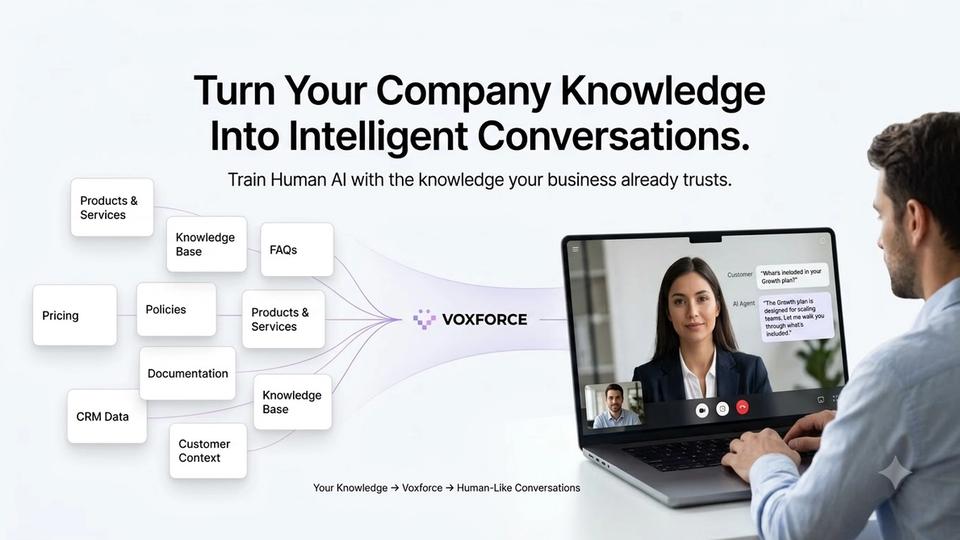
Every enterprise already holds an enormous amount of valuable knowledge. Product documentation, policy manuals, pricing rules, warranty terms, onboarding guides, resolved support tickets, internal wikis, years of institutional expertise. Most of it was never the problem.
The problem has always been access. Knowledge scattered across a dozen systems, written for internal readers, filed under inconsistent naming conventions, and updated at different speeds by different teams. Customers rarely fail because a business lacks the answer. They fail because the answer is buried somewhere the support process cannot reach fast enough.
AI-powered Human Agents change what is possible here, but only if they are trained on the right thing. A general purpose language model knows a great deal about the world. It knows almost nothing about a specific company's pricing tiers, warranty exceptions, or the exact phrasing customers expect from a policy explanation. For Knowledge Management Leaders and Heads of Customer Support, this is the real strategic question behind any AI deployment: not whether the AI is capable, but whether it has been given the enterprise knowledge required to be trustworthy.
This is a subtle but important reframe of how AI projects get scoped. Most enterprise AI initiatives are still evaluated as technology purchases, judged on model performance benchmarks and vendor comparisons. The organisations getting the strongest results treat AI deployment as a knowledge management initiative first, with the model selection as a secondary decision. The quality of the underlying knowledge sets the ceiling on how good the AI can ever be, regardless of which model sits on top of it.
Enterprise Knowledge Is Often Hidden, Not Missing
Ask most support leaders where the answer to a difficult customer question lives, and the honest response is usually "it depends who you ask." Institutional knowledge tends to exist in places that were never designed to work together:
- FAQs and help centre articles
- Product documentation and technical specifications
- CRM records and prior customer interactions
- Internal wikis and SOPs
- Training manuals for new hires
- Policy and compliance documents
- Previous support conversations and resolved tickets
Each of these repositories was built by a different team, for a different audience, at a different point in the company's history. A knowledge management function can spend years trying to unify them into a single searchable index and still fall short, because the fragmentation is organisational as much as technical.
This is precisely the gap an AI-powered Human Agent is positioned to close, provided it is connected to these sources rather than replacing them. The knowledge does not need to be rebuilt from scratch. It needs a layer capable of reading across all of it and delivering a single, coherent answer at the moment a customer asks.
This also reframes what a knowledge management function is actually for in an AI-enabled organisation. The historical mandate was curation: deciding what gets written, where it lives, and how it is categorised for a human reader browsing a help centre. The mandate now includes structuring that same knowledge so a retrieval system can find and apply it accurately, which is a related but distinct discipline. Content written well for a human skimming an article is not automatically written well for a system retrieving a precise answer under time pressure.
Generic AI Cannot Represent a Specific Business
Public large language models are trained on the open internet. That gives them broad, general knowledge, and almost no reliable knowledge about a specific company's pricing, implementation process, or support commitments.
Customers do not experience this distinction as a technical limitation. They experience it as a wrong answer, delivered with total confidence. Research on enterprise AI accuracy is blunt about how often this happens. Even strong general purpose models hallucinate a meaningful share of the time on specific factual queries, and Deloitte and Forrester research cited in industry benchmarking has found that AI-generated errors already cost businesses tens of billions of dollars globally each year through incorrect information reaching customers or internal teams.
For support and knowledge leaders, this raises the stakes on what "AI accuracy" actually means. A model that sounds fluent is not the same as a model that is correct. Customers expect precise answers on:
- Product specifications and compatibility
- Pricing and contract terms
- Warranty and refund conditions
- Compliance and regulatory requirements
- Support and service level commitments
None of that can come from general internet data. It has to come from the enterprise's own, verified knowledge base, retrieved and applied at the moment of the conversation.
Training AI-powered Human Agents With Company Knowledge
The mechanism that makes this possible is retrieval augmented generation, usually shortened to RAG. In practical terms, RAG means the AI does not answer purely from what it was originally trained on. Before generating a response, it retrieves the most relevant, current material from the enterprise's own knowledge sources, and grounds its answer in that material rather than in a guess.
AI-powered Human Agents built this way draw on several sources simultaneously:
- Enterprise documentation and product catalogues
- FAQs and help centre content
- CRM records and account history
- Support history and resolved tickets
- Internal knowledge repositories
- Policy and workflow documentation
Industry benchmarking on RAG implementation gives a sense of the scale of improvement this produces. Google Research findings cited in 2026 benchmark literature found that RAG can cut enterprise search hallucinations from roughly 27 percent to around 11 percent when implemented properly. Separate industry analysis puts well-implemented RAG architectures at reducing content errors by 30 to 60 percent compared with ungrounded models.
None of these figures suggest RAG eliminates the risk of an incorrect answer. They show why grounding AI in verified company knowledge is now treated as a prerequisite for enterprise deployment, not an optional refinement. An ungrounded model answering customer questions about pricing or compliance is not a productivity tool. It is a liability with a confident tone.
This is also why the framing matters for how support and knowledge teams evaluate vendors. A demo that answers general questions convincingly says very little about how the system will perform once it is grounded in a specific company's messy, real-world documentation. The harder and more revealing test is whether the system correctly declines to answer, or clearly flags uncertainty, when the retrieved knowledge does not actually cover the question being asked. A system that always sounds confident, even when it should not be, is the exact failure mode grounding is meant to prevent.
FAQs Become Intelligent Conversations
Static FAQ pages were built for a search-based world. A customer scans a list of questions, hopes one of them matches their situation closely enough, and interprets the answer themselves.
AI-powered Human Agents remove that interpretation step entirely. Rather than presenting a list of possibly relevant articles, they:
- Understand the actual intent behind the question, not just the keywords used
- Ask a clarifying question when the situation is ambiguous
- Tailor the response to the specific customer and context
- Explain complex topics in plain language rather than technical documentation phrasing
- Guide the customer through a multi-step process rather than pointing to a static article
This changes what an FAQ actually is. It stops being a page a customer has to browse and becomes a body of knowledge the AI draws on inside a live conversation. The content itself does not disappear. The interface customers use to reach it does.
AI Video Agents Make Knowledge Easier to Deliver
Some explanations do not translate well into text, no matter how well the underlying documentation is written. A multi-step configuration process, a product comparison, a troubleshooting sequence with several branching outcomes.
AI Video Agents close that gap by delivering knowledge the way a knowledgeable colleague would, face to face, rather than as a written article. They can support:
- Face-to-face explanations of policies or product details
- Visual product demonstrations
- Guided onboarding for new customers
- Step-by-step troubleshooting
- Interactive support that adapts as the customer's situation becomes clearer
Zendesk's 2026 CX Trends research, based on more than 11,000 consumers and CX leaders globally, found that 76 percent of consumers would choose a company that let them move between text, images, and video in the same conversation, without starting over. Customers already prefer multimodal knowledge delivery. The knowledge management challenge is making sure the underlying content is structured well enough to support it.
Enterprise Knowledge Must Continuously Learn
A knowledge base is only as trustworthy as its last update. Products change, policies get revised, regulations shift, and every one of those changes creates a window where static documentation and reality no longer match.
AI-powered Human Agents need to be built around continuous updates, not a one-time training exercise. The sources that should feed this ongoing process include:
- New product releases and specification changes
- Policy and pricing revisions
- Regulatory and compliance updates
- Customer feedback and satisfaction signals
- Resolved support cases, which often surface gaps in existing documentation
- Internal documentation updates as they happen
This is where knowledge management leadership becomes central to AI accuracy, rather than a downstream beneficiary of it. An AI system connected to stale documentation will confidently repeat outdated information at scale, faster than a single agent ever could manually. Continuous knowledge maintenance is not a nice-to-have layered on top of an AI deployment. It is the mechanism that keeps the deployment trustworthy over time.
Ownership of this process matters as much as the process itself. Many enterprises assume that once an AI system is connected to a knowledge source, maintenance becomes automatic. It does not. Someone still has to decide when a policy change is significant enough to require an update, verify that a product revision has actually propagated into the retrieval layer, and audit for gaps the AI is exposing through failed or uncertain answers. That responsibility sits naturally with a knowledge management function, and organisations that assign it clearly tend to see far fewer accuracy problems than those that treat AI knowledge as self-maintaining.
Better Knowledge Creates Better Customer Experiences
The business case for investing in enterprise knowledge quality, rather than treating it as a one-time documentation project, is measurable across several outcomes:
- Higher first-contact resolution, since the AI is answering from complete, current information
- Improved customer satisfaction, driven by fewer incorrect or incomplete answers
- Greater answer consistency across channels and agents
- Faster onboarding for both customers and new support staff
- Reduced support costs, as fewer queries require escalation
- Fewer escalations overall, since AI-handled interactions are grounded rather than guessed
- Stronger customer trust, built through consistent accuracy over time
- Improved employee productivity, since human agents spend less time correcting AI-generated errors or repeating information already documented
Salesforce's State of Service: AI Agents Edition, based on more than three thousand service professionals surveyed globally, found that after deploying AI agents, the top improved metric organisations report is customer satisfaction, ahead of productivity, handle time, and retention. That outcome depends directly on the quality of the knowledge behind the AI. A well-trained system with weak underlying knowledge will still produce a poor customer experience, regardless of how natural the conversation sounds.
How VoxForce.ai Turns Enterprise Knowledge Into Intelligent Conversations
The organisations getting the most value from conversational AI are not the ones with the most advanced language model. They are the ones that have done the harder work of connecting that model to accurate, current, well-structured enterprise knowledge.
VoxForce.ai is one example of what that looks like in practice. Its AI Video Agents function as AI-powered Human Agents, trained using enterprise documentation, FAQs, CRM data, policies, product information, and internal knowledge, so every conversation reflects what the organisation actually knows rather than what a general model assumes. The platform combines Conversational AI, natural voice, and visual presence with this grounded knowledge base, supporting Human AI Conversations across support and, where relevant, AI Sales Assistants for commercial interactions. The same architecture extends into AI Customer Engagement, applying Multimodal AI so customers can move between text, voice, and video without losing context.
For knowledge management leaders, the practical takeaway is that the platform is only as strong as the knowledge foundation supporting it. VoxForce's approach reflects that directly, treating enterprise knowledge as the input that determines whether the AI is trustworthy, not an afterthought bolted on once the conversational layer is built.
Conclusion
Enterprise AI is no longer defined primarily by the size or sophistication of its language model. Every serious enterprise vendor now has access to comparably capable models. What separates a trustworthy deployment from an unreliable one is the quality of the knowledge that model can access and apply.
Businesses already possess enormous intellectual capital, spread across documentation, support history, and institutional expertise built up over years. The competitive advantage does not come from creating more of it. It comes from making that knowledge instantly available, accurately and consistently, through AI-powered Human Agents.
The organisations that succeed at this will deliver faster, more accurate, and more personalised customer experiences, while turning static documentation into intelligent conversations powered by AI Video Agents. The knowledge was always there. The next competitive advantage belongs to whoever can put it to work in every customer conversation, not just in a help centre customers have to go find on their own.
For Knowledge Management Leaders, this is a mandate worth taking seriously well before the next AI procurement cycle begins. The quality of the underlying knowledge base, how current it is, how consistently it is structured, and how clearly ownership is assigned, will determine whether the eventual AI deployment earns customer trust or simply automates the same fragmented answers at greater speed.