
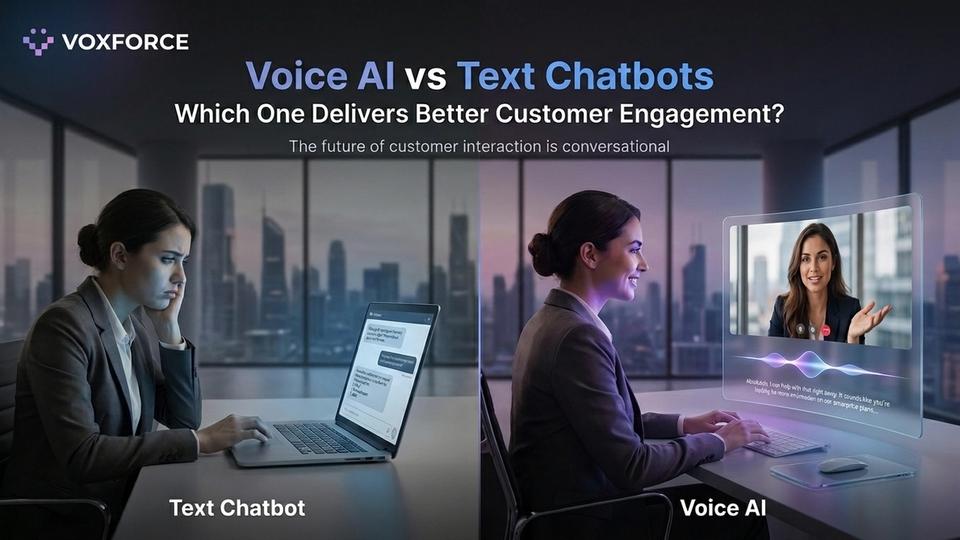
Customer expectations have never been higher. They want speed, empathy, accuracy, and relevance — all in a single interaction. Yet the technology most companies deploy to meet those expectations is still a text box sitting in the corner of a web page.
Text-based chatbots were a genuine leap forward when they arrived. They automated repetitive queries, extended support hours, and reduced operational overhead at scale. But a decade into their mainstream deployment, a fundamental question deserves a serious answer: are chatbots actually engaging customers, or are they simply filtering them?
At VoxForce.ai, we believe the data — and the direction of AI — points clearly toward voice as the dominant interface for customer engagement. This article examines why, and what that shift means for businesses that compete on customer experience.
The Engagement Gap in Text-Based Chatbots
The core problem with text chatbots is not intelligence. Modern language models are remarkably capable. The problem is the medium itself.
Human beings did not evolve to communicate primarily through typed text. We are wired for voice, tone, and rhythm. That is why reading a long chatbot response feels like work, while listening to a well-paced explanation feels natural. Humans speak approximately three times faster than they type, making voice interaction significantly more efficient for capturing and conveying information (Zhang et al., 2017 — SpeakWrite White Paper).
This cognitive mismatch has real commercial consequences. Customers who find a chatbot tedious to use are not simply mildly frustrated — they are customers at risk. According to Salesforce, 48% of customers have switched brands specifically because of poor customer service, while 94% say good service makes them more likely to purchase again. Text-only interfaces, however capable the AI behind them, put that loyalty at unnecessary risk.
What Voice AI Changes — and Why It Matters Now
Voice AI agents do not merely add audio to an existing chatbot experience. They change the interaction model entirely.
When a customer speaks to a voice AI agent, the conversation flows at a human pace. There is no typing lag, no parsing of bullet-pointed responses, no re-reading of a message that felt cold or ambiguous. The voice carries tone. It signals empathy, urgency, or reassurance — qualities that text struggles to convey without elaborate formatting that most users will not read.
This matters more today than at any previous point because customer expectations have risen sharply. Salesforce research found that 60% of service professionals say customer expectations have increased since before the pandemic, and 83% of customers expect to interact with someone immediately upon contact. Voice AI is the only scalable technology that can meet both requirements simultaneously — immediacy and a human-quality communication experience — without adding headcount.
The Personalization Problem Text Cannot Solve
Customers do not just want fast responses. They want to feel understood. Salesforce research reveals that 73% of customers expect companies to understand their unique needs and expectations, yet 56% say most companies still treat them like numbers.
This is where voice AI creates a structural advantage over text chatbots. A voice interface, by its nature, creates a more individualized experience. Speech patterns carry context. The way someone phrases a question — hesitant, frustrated, confident, confused — informs how an intelligent voice agent should respond. A text input field strips that context away entirely.
VoxForce.ai's conversational voice AI platform processes not just the words a customer uses but the intent and emotional register behind them. That enables responses calibrated to the individual, not just the query category. The result is an interaction that feels like speaking with a knowledgeable consultant rather than querying a database.
Resolution, Complexity, and the Cost of Getting It Wrong
One of the strongest arguments for deploying advanced AI in customer engagement is the potential for first-contact resolution. According to Zendesk's 2026 CX Trends Report, nearly 90% of CX trendsetters believe 80% of customer issues will be resolved without human intervention in the next few years.
But resolution rates depend on comprehension — and comprehension depends on the quality of the interaction. Complex problems are harder to explain in text and harder for customers to follow. A voice AI agent can walk a customer through a multi-step troubleshooting process the same way a skilled support representative would: verbally, with pauses for confirmation, with the ability to repeat or rephrase in real time.
The financial stakes of failure are equally clear. Research by 10x Banking found that global banks are losing one in five customers due to poor customer experience. In sectors where margins are thin and acquisition costs are high, a 20% customer loss attributable to a fixable interface problem is not a technology issue — it is a business emergency.
Voice AI vs Text Chatbots: A Direct Comparison
The comparison is not about which technology is more advanced in isolation. It is about which medium is more aligned with how people actually communicate. Voice wins that comparison at every point of contact.

Where VoxForce.ai Is Leading the Category
VoxForce.ai is defining what conversational voice AI looks like at enterprise scale. The platform combines real-time speech interaction, large language model reasoning, and enterprise data integrations to create AI agents that communicate the way customers expect — conversationally, intelligently, and in real time.
Unlike chatbot platforms that add a voice wrapper to an existing text-response architecture, VoxForce is built from the ground up for voice-first engagement. Agents are deployed across websites, applications, and digital touchpoints while maintaining consistent brand tone, knowledge accuracy, and response quality.
Critically, VoxForce agents are not scripted. They reason. They adapt to the direction of a conversation, handle follow-up questions without losing context, and escalate intelligently to human teams when a situation calls for it. That combination of reliability, flexibility, and natural communication is what separates voice AI leadership from voice AI experimentation.
The Strategic Imperative
Customer engagement has always been a competitive frontier. The companies that define the standard of interaction in any given era tend to hold it for a long time. Web-native companies set the standard for self-service. Mobile-first companies redefined accessibility. Now, voice-AI-first companies are setting the standard for conversational quality.
Text chatbots were the right tool for the last decade. They automated what needed to be automated and created the data infrastructure that modern AI systems now build on. But the interface layer has reached its ceiling. Customers have demonstrated — through switching rates, satisfaction scores, and rising expectations — that typing into a box is not how they want to engage with brands they trust.
Voice AI is not the future of customer engagement. It is the present. The question for every business invested in customer experience is not whether to make the transition — it is how quickly they can make it well.
VoxForce.ai exists to answer that question with infrastructure, intelligence, and a category-defining platform built for the way customers communicate today.