
Over the past decade, digital transformation has changed how mid-market companies operate. ERP systems have connected operations, CRM platforms have centralised customer data, and workflow automation has cut manual work. Leaders now make decisions on real-time intelligence rather than fragmented reports.
Yet one system every customer interacts with before speaking to an employee has barely changed: the corporate website. Most still function as digital brochures, presenting information and collecting enquiries, while the rest of the business has become intelligent.
This gap is getting expensive. Today's customer arrives after finishing most of their research independently, comparing competitors, reading reviews, and watching demos. They are no longer looking for information. They are trying to make a decision, and most websites were never built to support one.
The Website Was Built for Information. Customers Arrive Looking for Decisions.
The internet's original value was making information accessible. That advantage has eroded. AI can now retrieve answers from thousands of sources in seconds, so customers arrive already informed. What is scarce today is interpretation, the ability to answer "what does this mean for my situation?" rather than "where do I find the answer?"
Interpretation needs context, and context needs conversation, not a search bar. Real buyers rarely follow one journey. Some want technical depth, others want reassurance before committing budget. Most websites assume everyone follows the same path, which is precisely where they fall short.
The Next Competitive Advantage Is Better Interaction, Not Better Automation
Digital transformation has moved through two waves: efficiency (digitising records, connecting departments) and intelligence (analytics, predictive models, AI-driven decisions). Both improved the internal enterprise. Neither changed how customers experience it.
A connected enterprise does not automatically produce a connected customer experience. Businesses with sophisticated CRM platforms and deep knowledge repositories still leave customers navigating menus and contact forms, because the interface was built to publish information, not support decisions. The next wave of advantage belongs to organisations that rethink interaction itself, letting customers have conversations instead of running searches.
Multimodal AI Is Changing the Nature of Digital Interaction
Much of the AI conversation has focused on model benchmarks and reasoning quality. But human communication has never relied on words alone; tone, timing, and visual cues all shape how people build confidence in a decision.
This is why multimodal interaction is accelerating faster than text-only AI. Roughly half of consumers now say they prefer multimodal formats for engaging with brands, and research firm IDC expects 40% of AI models to blend multiple data modalities by 2026, extending well past the limits of single-mode chat. For businesses, that shift changes the website's role entirely. A traditional website delivers content. A multimodal one delivers guidance, adapting explanations in real time rather than expecting the visitor to already know what they're looking for.
That distinction matters most where purchases involve multiple stakeholders, long evaluation cycles, or real financial commitment; in those moments, customers need clarity and consultation, not more static content.
The Enterprise Already Knows the Answer. Customers Simply Cannot Access It
The common assumption is that businesses lack information. In reality, most possess deep institutional knowledge: sales teams know why prospects hesitate, support teams recognise recurring patterns documentation never captures, and customer success managers understand what drives long-term adoption.
The problem is access, not knowledge. Expertise remains scattered across CRMs, documentation, and individual employees, so customers only ever see fragments of it. That gap is becoming harder to justify. The AI customer service market itself reflects the shift already under way, with independent market estimates placing it at roughly $15 billion in 2026, growing toward the high double digits by the early 2030s as adoption moves from pilot to standard practice.
From Digital Infrastructure to Conversational Infrastructure
Enterprise technology has evolved in phases: digitising information, then connecting systems. Businesses assumed that once systems were connected, better customer experience would follow automatically. It didn't, because internal intelligence doesn't become external intelligence on its own.
Conversational infrastructure is the next layer. Instead of asking customers to navigate disconnected pages, it lets them interact directly with the organisation's knowledge, turning enterprise systems into a continuous dialogue rather than isolated software. For mid-market organisations running lean teams against increasingly complex product lines, this matters more than it does for large enterprises. Gartner's research on contact centre economics suggests AI-driven interaction could remove tens of billions of dollars in labour cost industry-wide by 2026, a signal of just how much manual bandwidth conversational infrastructure can free up.
Why This Matters More for Mid-Market CEOs Than Anyone Else
Large enterprises can dedicate separate teams to every stage of the customer journey. Mid-market companies rarely have that luxury. As the business grows, customer expectations rise faster than headcount can follow.
This creates a leadership question: keep scaling customer-facing teams at the pace of demand, or rethink how expertise is delivered? Independent research into AI-driven service economics reports average returns of roughly $3.50 for every dollar invested, with top performers seeing considerably more, and cost-per-interaction reductions of well over half in some deployments. The objective shifts from operational efficiency to organisational accessibility, freeing employees to focus on judgement and relationship-building while routine guidance becomes instantly available.
How VoxForce.ai Is Building the Next Enterprise Interface
At VoxForce.ai, we believe the future of customer engagement will not be defined by another chatbot. It will be defined by how naturally a business communicates its expertise.
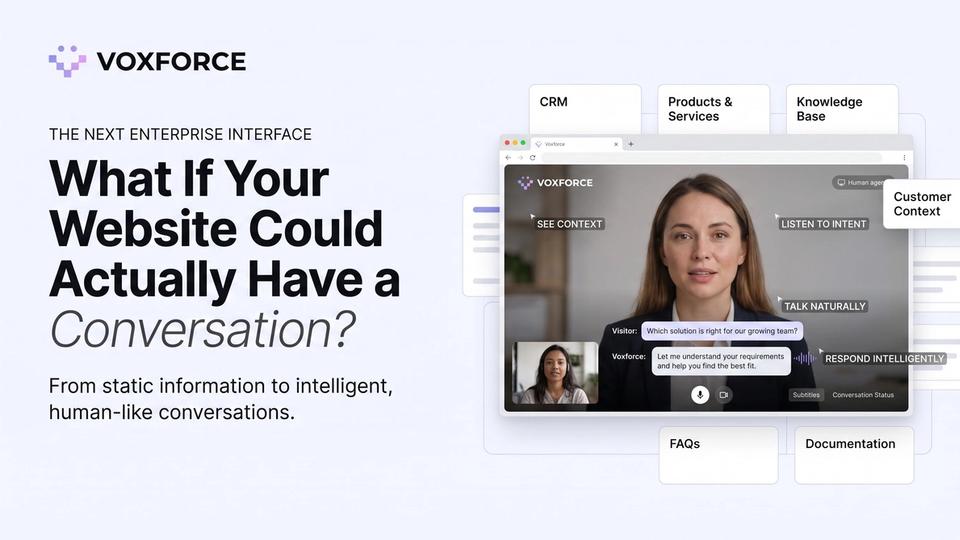
Every organisation holds institutional knowledge across product, sales, support, compliance, and CRM systems, yet customers experience only a fraction of it because traditional websites cannot turn that intelligence into conversation. VoxForce acts as the layer that connects these disconnected sources and turns them into Human AI conversations, combining conversational AI, AI video agents, multimodal interaction, and real-time voice and video into AI-powered human agents that explain products, guide decisions, qualify opportunities, and support onboarding across every touchpoint.
The Website Is Becoming the Enterprise's Most Valuable Conversation
The corporate website has long been treated as a marketing asset. It is becoming something more significant: the primary environment where customers test assumptions, seek reassurance, and make decisions.
The organisations that lead over the next decade won't be the ones with the largest technology budgets. They will be the ones that remove the most friction between what they know and what their customers need to know. Success will no longer be measured by page count or content volume, but by how effectively a website helps people decide, which is what happens when it can see context, listen for intent, and respond with genuine judgement.