
The next challenge in enterprise AI is not simply making AI more intelligent. It is making AI more relevant to the organisation it represents.
Businesses are moving rapidly from using AI as an internal productivity tool to deploying AI-powered Human Agents in customer-facing roles. These agents can answer questions, guide product discovery, support customers, assist sales teams and perform defined business actions. Yet a fundamental problem remains. A capable AI model does not automatically understand a particular company's products, pricing, policies, customer segments, brand voice or escalation processes.
That creates a distinction that will become increasingly important as enterprises expand their use of Conversational AI.
An AI model can understand language. An effective business AI agent must understand the business.
This is where the next generation of enterprise AI architecture is likely to move beyond model capability towards organisational knowledge.
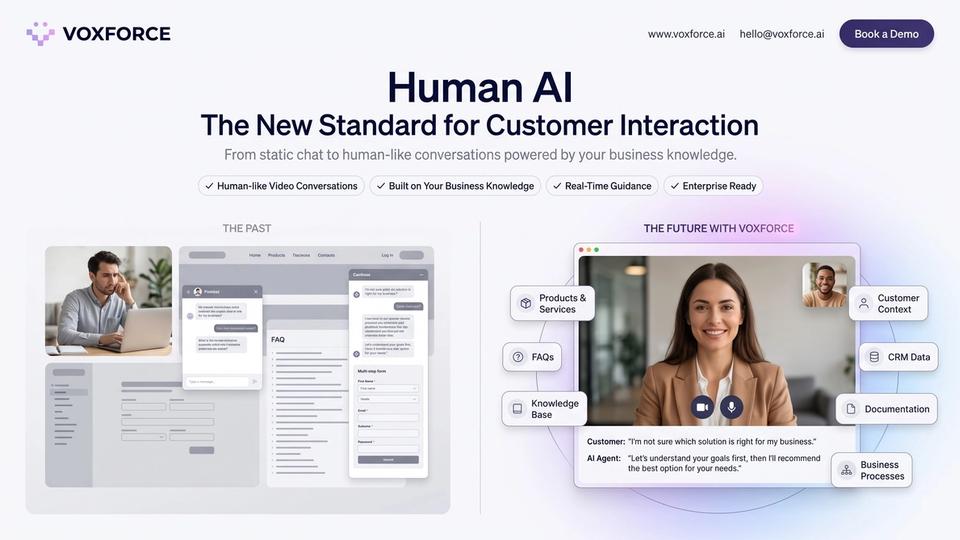
Voxforce's Organization DNA provides an example of this approach. Rather than treating business information as disconnected documents that an AI agent may or may not retrieve, the feature establishes a central knowledge layer covering the organisation and the information its AI agents need to operate within that business context.
The distinction matters because customer-facing AI is not simply answering questions.
It is representing an organisation.
Intelligence without context has limits
The rise of generative AI has changed expectations around what software can understand and produce. Modern AI systems can interpret natural language, summarise information, answer questions and generate responses across a wide range of subjects.
But enterprise deployment introduces another requirement.
The AI must know which information applies to this business.
Consider a customer asking an AI agent about a product. A generic model may understand the category and provide a plausible explanation. That does not mean the response reflects the company's actual product specifications, pricing, service terms or positioning.
A customer asking about a company's support process presents the same challenge. General knowledge about how customer support works is not sufficient. The AI needs to know how this organisation handles support.
The difference is between general intelligence and organisational intelligence.
For customer-facing applications, the latter becomes critical.
An AI-powered Human Agent that produces fluent but generic responses can create an experience that appears intelligent without necessarily being useful. Worse, it can create inconsistencies when customers receive information that does not correspond with the company's actual offerings or processes.
The objective therefore cannot simply be to make AI more conversational.
It must be to make the conversation business-specific.
The business knowledge layer is becoming a strategic requirement
Historically, organisations have stored knowledge across websites, product documents, FAQs, sales material, internal systems, support documentation and individual employee expertise.
Human employees learn how to combine this information through training and experience. They understand not only what the company offers, but also how it communicates, which customers it serves, what requires escalation and where the boundaries lie.
AI-powered Human Agents need an equivalent organisational context.
Voxforce Organization DNA is designed as a central knowledge layer containing information including the company overview, products, services, pricing, FAQs, case studies, target audience, brand tone, support processes, escalation rules and restricted topics.
This changes the role of business knowledge.
It is no longer simply reference material for employees.
It becomes part of the operating environment for the AI agents representing the organisation.
That has implications for how businesses should think about AI knowledge management.
The question is no longer only whether company information is documented. The question is whether that information is structured and maintained in a way that enables AI agents to use it consistently within customer interactions.
What an AI agent needs to know about a business
The knowledge required by a customer-facing AI agent extends well beyond a list of products.
At a minimum, the agent needs an understanding of several interconnected areas.
The organisation
The AI needs to understand what the company does, what it offers and how it positions itself.
Products and services
The agent needs accurate information about the products or services it is expected to discuss.
Pricing
Where pricing is part of the approved business knowledge, the AI needs access to the relevant information and the boundaries around how pricing should be communicated.
Customer questions
FAQs provide an important layer of operational knowledge because they reflect the questions customers repeatedly ask.
Audience
An AI interaction with a first-time prospect may require a different approach from an interaction with an existing customer or a highly informed buyer.
Brand tone
The AI represents the organisation through every interaction. Its communication style therefore becomes part of the customer experience.
Support and escalation
The AI needs to understand what it can handle independently and which situations require escalation.
Restricted topics
Knowing what not to say can be as important as knowing what to say.
Voxforce Organization DNA incorporates these categories into the business knowledge layer available to AI agents. This is an important shift in thinking. Enterprise AI needs both knowledge and boundaries.
From a knowledge base to business-aware AI
Traditional knowledge bases were primarily designed for humans.
An employee searches for a policy, reads a document or consults an internal resource. The employee then applies judgment to determine how that information should be used in a particular situation.
AI changes the relationship with organisational knowledge.
An AI-powered Human Agent can potentially use business knowledge during a live interaction, interpret a customer's question and provide a response within the organisation's defined context.
That means the knowledge layer becomes part of the customer experience itself.
This is particularly relevant as organisations move from simple chatbots towards more capable Human AI Conversations. The more responsibilities assigned to an AI agent, the more important its business context becomes.
An AI that only answers basic FAQs requires one level of knowledge.
An AI that advises customers about products requires more.
An AI that supports sales, handles service enquiries, captures leads or initiates business actions requires an even stronger understanding of the organisation and its operating boundaries.
The growth of AI capability therefore increases, rather than reduces, the importance of business knowledge.
Business knowledge also shapes the AI persona
Knowledge and personality are often treated as separate elements of AI design.
In practice, they are closely connected.
An AI agent may have the correct information but still communicate in a way that does not suit the organisation or its customer.
Voxforce addresses the role dimension through Persona Studio, which supports role-specific AI agents such as sales, support, reception, product advisory and appointment assistance. Persona settings include role, tone, greeting, language, response length, behaviour rules, escalation rules and do-not-say instructions.
This creates an important enterprise AI principle.
Knowledge tells the AI what the organisation knows. Persona helps determine how the AI represents that organisation.
Together, these layers move the experience beyond generic AI.
A sales agent needs to communicate differently from a support agent. A product advisor may need to explain options differently from a receptionist. An appointment assistant has a different objective from a customer service representative.
The underlying AI technology may be similar.
The business context is not.
Why generic AI can become a business risk
The attraction of general-purpose AI is its flexibility. It can discuss a broad range of subjects without requiring extensive configuration.
Customer-facing enterprise applications have a different risk profile.
A response can be fluent and still be wrong for the organisation.
An answer can be factually plausible and still conflict with company policy.
A recommendation can sound helpful and still be outside the role assigned to the AI.
A confident response can create greater customer frustration than an explicit escalation.
This makes business-aware AI an important consideration for organisations deploying AI agents at scale.
The issue is not whether AI can generate an answer.
The issue is whether the answer is appropriate for the business, the customer and the situation.
That is why knowledge, role definition, behavioural rules and escalation mechanisms need to be considered together rather than as separate AI features.
The new enterprise AI architecture
As businesses deploy more AI-powered Human Agents, a useful architecture is emerging.
Foundation model
Provides language and reasoning capabilities.
↓
Organization knowledge
Provides company-specific information.
↓
Persona and role
Defines how the AI operates within a particular business function.
↓
Interaction layer
Determines how customers communicate with the AI.
↓
Business actions
Allows the conversation to lead towards defined outcomes.
↓
Human escalation
Provides intervention when the situation requires human expertise.
The first two layers are particularly important because they determine whether the AI is operating as a generic assistant or as a representative of a specific organisation.
Voxforce's Organization DNA sits within this broader model by providing the business context used by its AI agents.
This also explains why simply connecting a general-purpose AI model to a website is unlikely to represent the complete enterprise AI strategy.
The interface is visible to the customer.
The knowledge architecture determines what sits behind that interface.
Five questions leaders should ask before deploying customer-facing AI
Does the AI know what the business actually sells?
Product and service knowledge should be current, structured and relevant to the agent's role.
Does the AI know who it is speaking to?
Customer context and target audience should influence how the interaction is designed.
Does the AI know how the organisation communicates?
Brand tone is not simply a marketing consideration when AI becomes a customer-facing representative.
Does the AI know its boundaries?
Restricted topics, behavioural rules and escalation requirements need to be defined before deployment.
Can the knowledge be maintained as the business changes?
Products, pricing, policies, services and customer processes evolve. An AI knowledge layer therefore needs to be treated as an operating asset rather than a one-time configuration exercise.
These questions shift the discussion from AI implementation to AI readiness.
The strategic value of business-aware AI
The long-term value of AI-powered Human Agents will depend partly on how well they fit into the businesses they represent.
Model capability will continue to evolve. AI will become faster, more conversational and increasingly capable of handling complex interactions.
That makes organisational knowledge even more important.
When AI becomes more capable, businesses will entrust it with more responsibilities. More responsibilities require clearer knowledge, stronger boundaries and more precise role definitions.
Organization DNA represents one approach to this problem by establishing a structured business knowledge layer for AI agents.
The larger strategic shift is from asking whether AI is intelligent enough to asking whether AI is informed enough to represent the organisation.
That is a different standard.
And for businesses deploying AI directly into customer interactions, it is likely to become the more important one.
The next generation of AI will need to know the organisation
The first phase of enterprise AI focused heavily on what AI models could do.
The next phase will focus increasingly on what AI can do within the context of a particular organisation.
That requires more than language capability. It requires business knowledge, role definition, communication standards, operating boundaries and a clear understanding of when AI should act and when it should escalate.
The AI agent of the future will not simply answer a customer's question.
It will need to answer it as a representative of the business.
That distinction is at the heart of the move from generic conversational AI towards AI-powered Human Agents.
The organisations that approach this shift strategically will not treat their business knowledge as background documentation. They will treat it as part of the infrastructure that makes their AI useful, consistent and capable of representing the business in the first place.