
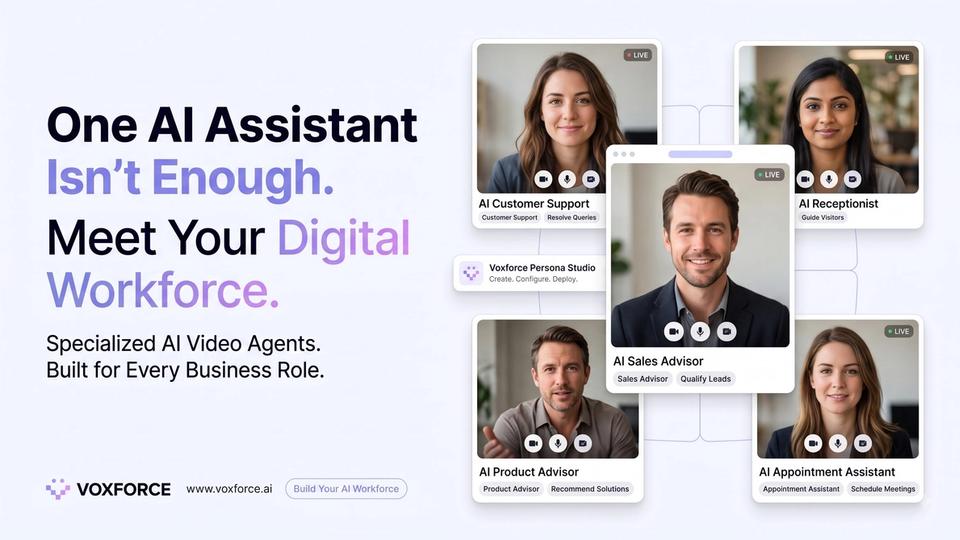
The idea of a single AI assistant capable of answering every customer question is attractive because it appears simple. One interface, one agent and one point of access could theoretically cover sales, support, product information, appointments and general enquiries.
Enterprise operations seldom work that way. A sales representative does not approach a customer in the same way as a support specialist. A receptionist has a different objective from a product advisor. An appointment assistant does not need to behave like a customer service representative. Each role operates within a different set of responsibilities, conversations and outcomes.
The same principle is beginning to apply to AI-powered Human Agents.
As businesses move beyond basic chatbots and deploy AI across customer-facing functions, the more relevant question is no longer whether one AI can perform multiple tasks. It is whether one AI should be expected to represent multiple business roles in the same way.
This distinction is at the centre of the emerging model of role-specific AI agents.
Voxforce Persona Studio provides a practical example of this approach by enabling businesses to create and manage different AI personas around specific functions, including sales, support, reception, product advisory and appointment assistance.
The underlying shift is significant.
The future of enterprise AI may look less like one universal assistant and more like a digital workforce of specialised AI roles.
The problem with the universal AI assistant
The appeal of a general-purpose assistant comes from its flexibility.
A single AI interface can potentially answer questions across multiple subjects. For an organisation beginning its AI journey, this can seem like the most efficient model. Deploy one assistant, connect it to business knowledge and allow customers to ask whatever they need.
But flexibility can also create ambiguity.
A customer approaching a business for support has a different expectation from a customer exploring a product. Someone looking to schedule an appointment has a different objective from someone negotiating a commercial proposal.
If the same AI persona handles all of these interactions, the business has to determine how that agent should behave when the objectives conflict.
Should it sound like a salesperson or a service representative?
Should it prioritise conversion or resolution?
Should it recommend products or simply provide information?
Should it encourage the customer to book, purchase, contact support or speak to a human?
These are not simply questions of tone.
They are questions of role.
And role determines behaviour.
AI personas bring role into the architecture
A persona is often treated as a cosmetic layer of AI, something that determines whether an agent sounds formal, friendly or conversational.
For enterprise applications, that definition is too narrow.
A business persona can define what the AI is expected to do, how it communicates, what it should avoid and when it should escalate.
Voxforce Persona Studio includes configuration for persona name, role, tone, greeting, closing message, language, response length, behaviour rules, escalation rules and do-not-say instructions.
That makes the persona part of the operating model rather than simply the personality of the interface.
A sales AI agent can be designed around sales conversations.
A support AI agent can be designed around customer assistance.
An AI receptionist can focus on initial enquiries and directing customers.
An AI product advisor can help customers understand products or services.
An AI appointment assistant can be structured around scheduling and related interactions.
The underlying technology can remain AI.
The business role changes.
Different business functions require different AI behaviour
Consider a customer visiting a website to understand whether a particular product meets a specific requirement.
A product advisor needs to help the customer evaluate suitability. The conversation may involve explaining features, comparing options or answering questions about the product.
Now consider a customer who has already purchased and needs assistance.
The objective changes. The AI should focus on resolving the customer's issue, identifying the relevant information and determining whether escalation is necessary.
A sales conversation presents another set of priorities. The AI may need to identify intent, understand requirements and help the prospect move towards a commercial outcome.
An appointment assistant operates differently again. The primary objective is not product education or support resolution, but helping the customer move through an appointment-related process.
These interactions may take place on the same website.
They do not represent the same customer journey.
This is why role-specific AI agents can become more important as organisations expand their AI deployments.
The challenge is no longer simply making AI capable of more tasks.
It is making AI appropriately specialised for the task it is performing.
The AI workforce is likely to become more specialised
The traditional workforce is organised around roles because specialisation creates accountability.
Sales owns sales outcomes.
Customer service owns support interactions.
Reception manages initial access.
Product specialists understand specific offerings.
Appointment teams manage scheduling.
The emergence of AI agents for business does not necessarily remove this organisational logic. Instead, it can extend it into digital environments.
A business could have several AI agents operating within the same customer ecosystem, each with a defined role and purpose.
This creates the possibility of an AI workforce in which agents are specialised rather than universal.
The distinction is important because specialisation can make AI deployment easier to govern.
If an agent has a clearly defined role, the business can define:
- what the agent is responsible for;
- what information it should use;
- how it should communicate;
- what actions it can support;
- which subjects fall outside its role;
- when it should escalate.
This makes the AI agent easier to design around a business outcome.
Persona is becoming part of customer experience
The role of an AI persona extends beyond internal configuration.
Customers experience the persona through every interaction.
The language used by an AI sales agent influences how the brand's sales function is perceived. The tone of a support agent affects the customer's experience during a potentially frustrating situation. The behaviour of a product advisor influences how the customer evaluates the business's expertise.
As AI becomes increasingly visible in customer journeys, AI Customer Experience will therefore depend not only on what the agent knows but also on how the agent behaves.
This creates a new brand consideration.
Businesses have traditionally managed brand voice across advertising, websites, customer service scripts and sales communication. AI agents add another layer to that ecosystem.
The organisation now needs to determine how its digital representatives should communicate.
Persona configuration becomes part of that process.
One AI model does not mean one AI role
There is an important distinction between the underlying AI technology and the agent that customers interact with.
Multiple AI personas do not necessarily mean multiple unrelated AI systems.
The same underlying AI capabilities can support different specialised agents when each is configured with a defined role, behaviour and business context.
This allows businesses to think in terms of AI orchestration rather than AI duplication.
The objective is not to create unnecessary complexity by deploying a separate AI system for every possible task.
It is to create clearly defined AI roles where different customer journeys genuinely require different behaviours.
That distinction will become increasingly important as organisations move from experimentation to enterprise-scale AI deployment.
Specialisation also creates clearer boundaries
One of the most important benefits of role-specific AI is the ability to establish boundaries.
A generic assistant may be expected to answer almost anything.
A role-specific AI agent can operate within a defined scope.
A product advisor can focus on product-related questions.
A support agent can focus on service issues.
A sales agent can focus on customer requirements and commercial conversations.
An appointment assistant can focus on scheduling-related interactions.
Voxforce Persona Studio includes behaviour rules, escalation rules and do-not-say instructions as part of persona configuration.
This is particularly relevant to responsible AI.
The more clearly an AI agent's role is defined, the easier it becomes to determine when that agent should answer, when it should redirect and when it should escalate.
Specialisation therefore serves two purposes.
It can improve the relevance of the interaction while also providing a clearer operating boundary.
The business case for a portfolio of AI agents
For enterprise leaders, the decision to deploy multiple AI agents should not be driven by the number of available functions.
It should be driven by customer and business needs.
A useful starting point is to identify where different customer journeys have fundamentally different objectives.
Sales
The objective is to understand customer intent and support movement towards a commercial outcome.
Support
The objective is to resolve customer issues efficiently while identifying cases requiring human intervention.
Product advisory
The objective is to help customers understand offerings and make informed choices.
Reception
The objective is to provide an initial point of interaction and direct customers appropriately.
Appointment assistance
The objective is to help customers navigate appointment-related interactions.
Voxforce specifically identifies these types of roles within Persona Studio.
The strategic value lies in aligning the AI role with the business process rather than forcing every process into the same conversational model.
Five questions leaders should ask before creating an AI persona
1. What business outcome is this agent responsible for?
A persona should exist for a reason. The role needs a defined objective rather than simply a different name or voice.
2. What should the agent be allowed to do?
The business should establish the responsibilities and boundaries of the role before deployment.
3. How should the agent communicate?
Tone, language, response length and greeting style should reflect the function and customer context.
4. What should trigger escalation?
A role is defined partly by what falls outside its responsibility. Escalation rules therefore need to be established alongside the persona.
5. What should the agent never say or do?
Do-not-say instructions and behavioural rules provide a mechanism for defining boundaries around the interaction. Voxforce includes these settings within Persona Studio.
These questions move persona design from a branding exercise to an AI operating model.
The emergence of the digital workforce
The conversation around AI and employment often focuses on whether AI will replace people.
A more immediate development may be different. Businesses may begin building digital workforces alongside human workforces, with AI agents assigned to specific roles that complement existing teams.
The AI sales agent does not have to become the entire sales organisation. The AI support agent does not have to replace the customer service team. The AI receptionist does not have to eliminate human interaction.
Instead, each can become a specialised layer within a broader operating model, handling defined interactions while humans focus on cases requiring judgment, expertise, negotiation or empathy.
This is where the concept of AI-powered Human Agents becomes more useful than the conventional idea of an AI chatbot.
The objective is not simply to automate conversation.
It is to create AI agents capable of performing defined roles within a business.
The next challenge is orchestration
Once organisations begin deploying multiple AI personas, another challenge emerges.
How should these agents work together?
A customer may begin with a receptionist-style interaction, move towards product advice and eventually require sales support. Another customer may begin with product discovery and later require human customer service.
This means the future of enterprise AI will involve not only specialised agents but also the ability to determine which agent should handle which interaction and when another agent or human should take over.
The persona therefore becomes one component of a larger AI architecture.
The organisation's knowledge provides context.
The persona defines the role.
The conversational interface provides access.
The business workflow determines the next action.
Human escalation provides a route when AI should no longer operate independently.
This creates a more structured approach to Human AI Conversations.
One assistant is simple. A digital workforce is strategic.
The attraction of a universal AI assistant is understandable. It appears easier to deploy, easier to explain and easier to manage.
But enterprise complexity does not disappear because the interface is unified.
Different business functions have different objectives, responsibilities, customer expectations and boundaries.
The more capable AI becomes, the more important these distinctions may become.
Voxforce Persona Studio reflects this approach by enabling businesses to create role-specific AI agents across functions such as sales, support, reception, product advisory and appointment assistance, with controls over role, tone, language, behaviour and escalation.
The larger shift is therefore not simply from chatbots to more sophisticated AI.
It is from one-size-fits-all AI to specialised AI roles.
The organisations that approach this strategically will not ask how many tasks one AI agent can perform.
They will ask a more fundamental question:
Which roles should AI perform, what should each role be responsible for, and how should those roles work alongside people?
That is the beginning of a digital workforce.