
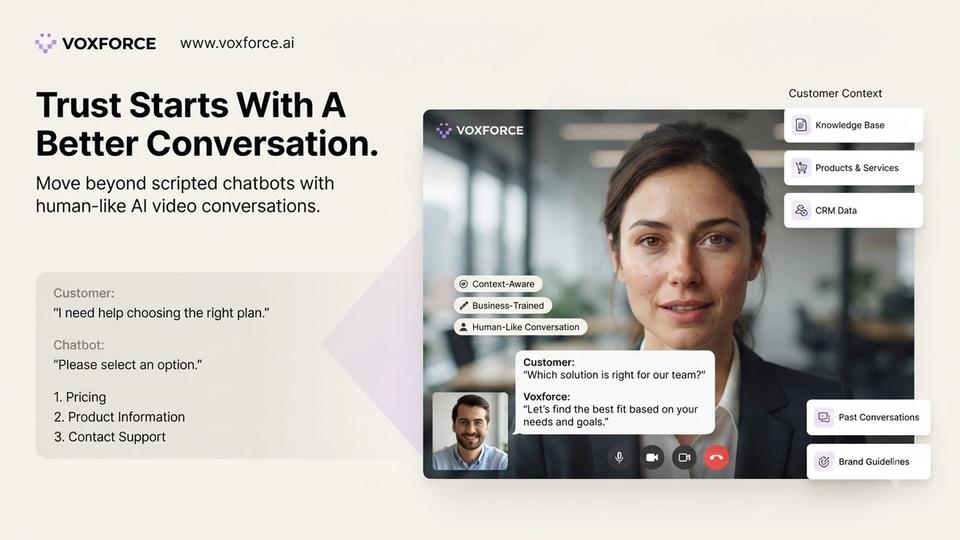
Most enterprises have already automated their customer conversations. Chatbots sit on nearly every support page and pricing page in the enterprise software market. Despite that, customer satisfaction with automated interactions has stayed stubbornly flat, and the reason is not a shortage of automation. It is a shortage of trust.
For a CIO or enterprise technology buyer, this reframes the evaluation question. The relevant metric for a conversational AI deployment is not how many queries the system can deflect. It is whether the architecture behind that deployment produces an interaction customers are actually willing to rely on. That distinction determines whether an investment shows up as adoption or as abandonment six months after go-live.
Harvard Business Review's research on the AI trust gap found that 57 percent of people do not trust AI, with another 22 percent neutral. That is the baseline a technology buyer is deploying into. It means trust is not a byproduct of good automation. It has to be engineered into the system from the architecture up, and it is the design decision that separates a chatbot deployment that gets used from one that gets routed around.
This article makes the case that the next generation of customer engagement, delivered through AI-powered Human Agents communicating via AI Video Agents, is a different technical category from rule-based chatbots, not an incremental upgrade to them. For a buyer evaluating this category, understanding why trust breaks down in legacy chatbot architecture, and what a trust-preserving architecture actually requires, is the real due diligence question.
That question is becoming harder to defer. Gartner's 2026 CIO and Technology Executive Survey found that 84 percent of CIOs expect their organization to increase GenAI funding this year, which means most enterprises are already committing further budget to conversational AI whether or not the current deployment is earning customer trust. The cost of getting the architecture wrong compounds with every dollar spent on top of it.
Customers Judge the System Before They Judge the Resolution
Customers form a judgment about whether to trust a support interaction within the first exchange, well before the issue is resolved. Responsiveness, clarity, and apparent competence are evaluated immediately, and that early judgment shapes how the rest of the interaction, and the relationship, is read.
This matters for a technology buyer because it changes where reliability has to be built in. A system that resolves 90 percent of queries correctly but fails visibly and awkwardly in the first ten seconds of a session will be judged on the failure, not the aggregate accuracy. Deloitte's research on customer-centric companies found they are 60 percent more profitable than peers that are not, a gap that starts accumulating from the very first interaction a customer has with a brand's support system, not from the eventual resolution.
For enterprise buyers, this is an architecture requirement, not a UX preference. The system's first response, whether it is a chatbot's opening line or an AI Video Agent's greeting, has to already carry context: who the customer is, what they likely need, and enough confidence in tone to signal competence. Bolting that onto a legacy IVR or scripted chatbot after the fact rarely works, because the underlying system was not built to hold that context at the point of first contact.
Why Traditional Chatbots Lose Confidence, Not Just Patience
The common failure modes of rule-based chatbots are well documented: scripted responses that miss the actual question, repeated requests for information the customer already provided, an inability to explain anything outside a fixed decision tree, and dead ends that force an escalation the system should have anticipated.
The business risk in these failures is often mischaracterized. Enterprises tend to log this as customer frustration, a service quality metric. It is better understood as an erosion of institutional trust. Zendesk's 2026 CX Trends research, based on more than 11,000 consumers and CX leaders across 22 countries, found that 74 percent of customers are frustrated by having to repeat their story to different agents or systems, and that 85 percent of CX leaders say a single unresolved issue is enough to lose a customer entirely. A chatbot that fails once does not just fail to answer a question. It signals to the customer that the business behind it does not actually know them.
This has direct implications for how enterprise technology buyers should evaluate legacy conversational AI investments already in production. A chatbot with high containment rates but declining CSAT is not an underperforming success. It is evidence that automation and trust are being measured as though they were the same metric, when they are not. Gartner's own benchmarking underscores the scale of the gap: only about 14 percent of customer service issues are fully resolved through self-service today, meaning the majority of automated interactions are quietly failing the trust test even when they technically stay within scope.
Trust Comes From Conversations That Behave Like People, Not Scripts
The psychological basis for trust in a conversation is fairly consistent across contexts: people trust interactions that demonstrate understanding, carry memory forward, stay contextually aware, offer relevant rather than generic suggestions, and maintain a natural conversational flow rather than a rigid decision tree.
A rule-based chatbot structurally cannot deliver most of these qualities, because its architecture is built around matching input to a predefined response, not around reasoning about the customer in front of it. An AI-powered Human Agent is built differently. It combines natural language understanding, persistent memory, and enterprise knowledge, so the system is reasoning about intent and context rather than pattern-matching to a script. That is the architectural difference a technology buyer should be evaluating, not just the presence of a large language model somewhere in the stack.
The accuracy gap between these two approaches is measurable, not theoretical. Google Cloud–sourced benchmarking cited in industry research found generative AI-powered agents reach roughly 92 percent accuracy in understanding customer intent, against 65 to 70 percent for keyword-based bots. That is a 20 to 25 point gap in the system's basic ability to understand what the customer is actually asking, before any conversation about tone, empathy, or personalization even begins.
AI Video Agents Add a Layer of Trust Text Cannot
Text alone can convey information. It struggles to convey confidence, reassurance, or the sense that something is actually listening. AI Video Agents close that gap by adding a visual and vocal presence that carries the same signals a knowledgeable person would: appropriate pacing, tone that matches the seriousness of the issue, and visual context where a spoken or diagrammed explanation is clearer than a paragraph of text.
Zendesk's research found that 76 percent of consumers would choose a company that let them move between text, images, and video in the same conversation, without restarting. That is a direct, stated preference for multimodal conversation, and it is the preference Conversational Video AI is built to satisfy.
For a technology buyer, the practical implication is that video is not a cosmetic layer added on top of an existing chatbot. It is a distinct input and output channel that has to be engineered into the conversational architecture from the start, including how the system maintains conversational state across a switch from text to voice to video within a single session. Systems retrofitted with a video front end but no underlying architecture for carrying that context across modalities tend to reproduce the same trust failures as the chatbots they replaced, just with a friendlier interface.
Personalization Is a Data Architecture Problem Before It Is a Trust Outcome
Long-term trust depends on the system remembering the customer: prior conversations, product usage, service history, and business context, carried forward consistently rather than reconstructed from scratch at each contact.
This is where the evaluation shifts most clearly toward a CIO's actual domain. Personalization at this depth is not a feature of the conversational layer. It is a function of how well the AI agent is integrated with CRM data, product usage telemetry, and prior interaction history, and whether that integration is real time or batch. Zendesk found that 83 percent of CX leaders now say memory-rich AI agents are the key to delivering personalization that holds up across the customer journey. That memory has to be architected, not assumed. A conversational AI layer sitting on top of fragmented, poorly integrated systems of record will produce the same repetitive, context-blind interactions customers already distrust, regardless of how natural the language model sounds.
This is also where governance intersects with trust. Fewer than a quarter of organizations report having a mature governance model for the agentic systems they are already deploying, according to industry-compiled benchmarking. An AI-powered Human Agent that carries customer memory across sessions is also a system handling sensitive customer data continuously, which means the trust question for a technology buyer includes data governance and access control, not just conversational quality. Gartner's own AI TRiSM framework, built around trust, risk, and security management for AI systems, exists precisely because customer-facing AI agents now sit close enough to core systems of record that governance has become a deployment prerequisite, not a follow-on project.
Human-Like AI Improves Measurable Enterprise Outcomes
The business case for trust-preserving conversational AI is not just a customer experience argument. It shows up directly in the metrics enterprise technology buyers are already accountable for.
Salesforce's State of Service: AI Agents Edition, based on 3,075 service professionals surveyed globally, found that after deploying AI agents, the top improved KPI organizations report is customer satisfaction, ahead of agent productivity, average handle time, retention, and first-response time. Separately, Gartner's cost benchmarking shows AI-native platforms now operating in the $1 to $3 range per resolution, against roughly $13.50 for a traditional agent-assisted contact, while achieving first-contact resolution rates of 55 to 70 percent. Industry-compiled data attributed to Gartner also indicates that companies using reasoning-capable AI agents see 45 percent fewer escalations to human agents than those relying on rule-based chatbots, a direct signal of higher resolution quality rather than simple deflection.
These figures matter to a technology buyer because they describe outcomes conditional on integration quality. Only about 25 percent of contact centers that report using AI have fully integrated that automation into daily operations, according to industry benchmarking. The gap between the adoption figure and the integration figure is where most of the ROI is either captured or lost. A trust-preserving, well-integrated AI-powered Human Agent produces the outcomes above. A conversational layer bolted onto disconnected systems tends to reproduce chatbot-era results under a more sophisticated label.
AI-powered Human Agents Strengthen Human Teams, Not Replace Them
None of this argues for removing people from the support or sales organization. It argues for using AI to protect the trust budget of the human team, by keeping AI in the interactions it is well suited to handle.
AI-powered Human Agents are well positioned for FAQs, onboarding, product guidance, routine account assistance, and structured troubleshooting, where the correct answer is knowable and the interaction benefits from consistency and speed. Human teams remain essential for complex problem solving, negotiations, escalations, emotionally charged conversations, and strategic account relationships, where judgment and empathy are the scarce resource.
Gartner's own trend research anticipates that many of the workforce-reduction plans built around AI adoption will not survive contact with reality: a substantial share of organizations that expected significant headcount cuts are projected to reverse those plans, and the large majority of service leaders intend to keep human agents specifically to define where AI's role begins and ends. For a technology buyer, this is the argument for an architecture that supports clean, context-preserving handoff between AI and human agents, rather than one designed around full automation as the end state. Trust is easier to maintain when a customer can tell that the system knows when to bring in a person, and does so without forcing the customer to re-explain anything.
How VoxForce.ai Is Building Trusted AI Conversations
The organizations approaching this correctly are evaluating conversational AI as infrastructure, not as a chatbot upgrade. VoxForce.ai is one example of what that infrastructure looks like in the category of AI-powered Human Agents.
The platform's AI Video Agents combine Conversational AI, natural voice, and visual presence with memory and enterprise-specific knowledge, so the system is reasoning about the customer in front of it rather than matching keywords to a script. That architecture supports Human AI Conversations that carry context across text, voice, and video within a single session, which is the technical requirement behind the multimodal experience customers say they want. The same underlying system extends into AI Customer Engagement and AI Sales Assistants, applying Multimodal AI consistently across both support and commercial interactions.
For an enterprise technology buyer, the relevant evaluation criteria are the ones this article has walked through: how the system carries memory and integrates with existing systems of record, how it hands off cleanly to a human agent when judgment is required, and what governance and data controls sit underneath the conversational layer. VoxForce's positioning reflects those requirements directly, aiming to give enterprises a trusted, human-like conversational layer rather than a faster chatbot.
Conclusion
Customer trust has become the most valuable competitive advantage in customer experience, and it is not created by automation volume. It is created by architecture: memory, context, governance, and a conversational presence that behaves like a knowledgeable person rather than a script.
Traditional chatbots automated conversations. AI-powered Human Agents humanize them. For CIOs and enterprise technology buyers, the practical conclusion is that the next conversational AI investment should be evaluated on whether it can preserve trust across the full customer journey, not on how many interactions it can deflect. The future of AI Customer Engagement will not be defined by how many conversations AI can automate. It will be defined by how many conversations customers genuinely trust.