
Every organisation has someone customers ask for by name.
Sometimes it is the salesperson who can explain a complex solution without making it sound complicated. Sometimes it is the customer success manager who remembers every account and anticipates problems before they arise. In other businesses, it is the support executive who can resolve an issue in minutes that others struggle with for hours. These people rarely become the face of the company because of their designation. They become indispensable because customers trust their judgement.
As businesses grow, that trust becomes increasingly difficult to scale.
A company may expand into new markets, launch additional products, serve thousands of customers, and invest heavily in technology, yet customers continue searching for the same thing. They want someone who understands their situation, answers questions clearly, and helps them make the right decision. The challenge is that the organisation's most knowledgeable people can only participate in one conversation at a time.
This has quietly become one of the biggest operational constraints facing modern businesses. Companies have learned how to scale products, infrastructure, and digital channels with remarkable efficiency. They still struggle to scale expertise.
That is why the idea of an AI front desk is gaining importance. It is not because businesses need another chatbot or a digital receptionist available around the clock. They need a way to make the judgement, knowledge, and communication skills of their best people available whenever a customer, partner, employee, or prospect needs guidance.
At VoxForce.ai, we believe the AI front desk represents a new category of enterprise communication. It is the intelligence layer that transforms organisational knowledge into real-time human conversations, allowing businesses to make expertise available at scale rather than limiting it to the availability of individuals.
Businesses Have Digitised Operations. They Have Not Digitised Expertise.
Over the past decade, organisations have invested heavily in technology that improves operational efficiency. Customer relationship management platforms organise sales data. Enterprise systems manage operations. Knowledge bases document processes. Support software tracks customer issues, while collaboration platforms connect distributed teams.
These systems have transformed how businesses store and manage information.
What they have not transformed is how businesses communicate that knowledge.
Consider a financial services company. Product information may exist inside internal documentation, regulatory guidelines, CRM records, training material, and years of experience accumulated by relationship managers. Everything the organisation knows is technically available. Yet when a customer asks a specific question, the answer often depends on finding the right person rather than the right system.
The same challenge exists across industries. Hospitals rely on experienced coordinators to guide patients. Software companies depend on solutions engineers to explain complex implementations. Real estate developers rely on experienced sales consultants to help buyers compare projects. Universities depend on admissions counsellors to answer hundreds of questions during enrolment.
Information has already been digitised.
Expertise has not.
Every Growing Business Eventually Encounters the Same Bottleneck
Growth creates a paradox.
As organisations become larger, access to expertise often becomes more difficult.
More products mean more specialised knowledge. More customers create more questions. New geographies introduce different regulations, languages, and expectations. Additional employees require more training, while larger support teams make consistency increasingly difficult to maintain.
Ironically, the organisations that invest the most in growth often become the ones where customers spend more time searching for the right person to speak with.
Businesses usually respond by hiring more people.
While necessary, this approach has practical limits. Recruiting experienced specialists takes time. Training new employees takes even longer. Maintaining consistency across hundreds of customer interactions becomes increasingly complex as organisations expand.
The challenge is no longer simply finding talent.
It is ensuring that institutional expertise grows as quickly as the business itself.
The Invisible Cost of Waiting
Most organisations measure response times.
Very few measure the cost of waiting.
A customer who submits an enquiry on Friday evening may receive a response on Monday morning. A prospect exploring enterprise software might leave a website because implementation questions remain unanswered. A patient researching treatment options could schedule an appointment elsewhere after failing to receive timely guidance. A prospective homebuyer may simply move to another developer that responds faster.
These losses rarely appear in business reports because they happen quietly.
No complaint is filed.
No escalation occurs.
The customer simply disappears.
Businesses often assume these decisions are driven by pricing, competition, or product quality.
In many cases, they are driven by unresolved uncertainty.
One unanswered question can delay a purchase by weeks or end a customer relationship before it begins.
Customers Are Not Looking for Information. They Are Looking for Judgement.
One of the biggest misconceptions surrounding customer engagement is that businesses need to provide more information.
Most organisations already provide an overwhelming amount of it.
Websites contain product pages, FAQs, brochures, comparison charts, documentation, videos, case studies, and resource libraries. Customers can usually find almost any fact they are looking for.
Yet they still reach out to people.
Why?
Because decisions require judgement, not information.
A prospective customer does not simply want to know every feature of a software platform. They want to know whether it suits their business. Someone comparing insurance policies wants to understand which plan best fits their family's needs. A patient wants reassurance that a recommended treatment is appropriate for their condition.
The most valuable employee in any organisation rarely succeeds because they know more facts than everyone else.
They succeed because they know how to apply those facts to individual situations.
That ability to interpret, explain, recommend, and reassure is what businesses have historically struggled to scale.
The AI Front Desk Is Becoming the First Point of Intelligence
Traditionally, the front desk represented the beginning of every customer relationship.
Visitors arrived, explained why they were there, and were guided towards the right person.
Digital businesses need the same capability.
Not another search bar.
Not another menu.
Not another chatbot that simply retrieves predefined answers.
They need an intelligent front desk that understands intent before directing the conversation.
Imagine visiting a healthcare provider's website. Instead of searching through departments and treatment pages, a patient explains their symptoms and receives guidance on relevant specialists, treatment options, appointment availability, and next steps.
A business evaluating enterprise software begins by describing operational challenges rather than navigating feature pages. The conversation immediately adapts around integrations, implementation timelines, pricing models, and deployment approaches relevant to that organisation.
The interface changes from navigation to conversation.
That shift fundamentally improves how customers experience businesses.
From Organisational Knowledge to Organisational Intelligence
Every company already possesses extraordinary expertise.
Sales teams understand customer objections.
Support specialists know recurring challenges.
Product managers explain why features exist.
Customer success teams understand adoption.
Operations teams know internal processes.
Leadership understands strategy.
The challenge is that this knowledge remains distributed across people, documents, CRM systems, support centres, training platforms, and internal repositories.
Customers experience fragments of this expertise across multiple interactions instead of one continuous conversation.
The next generation of digital businesses will not simply organise knowledge more efficiently.
They will make it conversational.
How VoxForce.ai Is Building the AI Front Desk
At VoxForce.ai, we believe the future of customer engagement is not about replacing people. It is about making the expertise of your best people available wherever conversations begin.
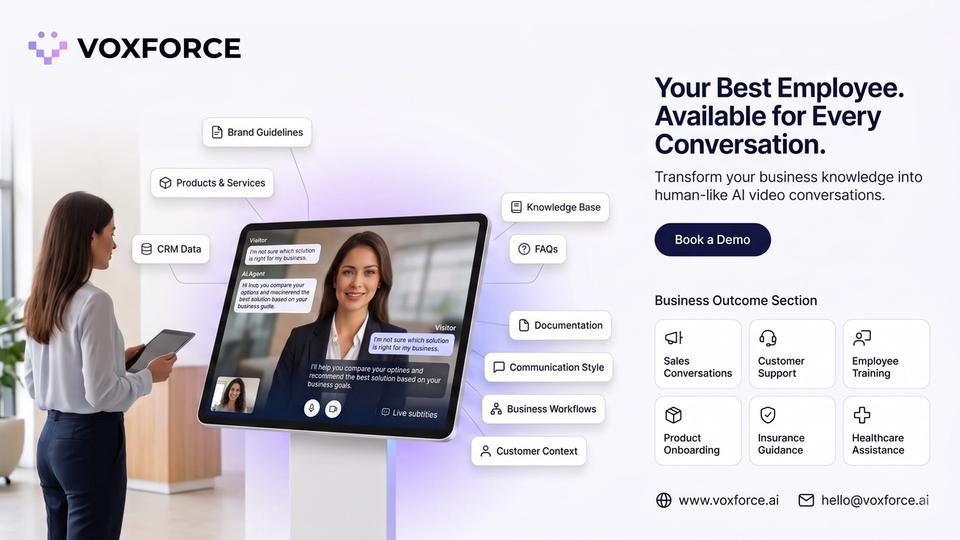
VoxForce acts as the intelligence layer that transforms enterprise knowledge into real-time human conversations. Businesses can create AI-powered humans trained on products, services, documentation, workflows, CRM data, support resources, compliance frameworks, and institutional expertise. These AI agents can explain complex offerings, qualify prospects, support customers, guide onboarding, answer questions, and help people make informed decisions through natural voice and video conversations.
Unlike traditional chatbots that retrieve information, VoxForce enables organisations to create AI-powered humans that understand context, adapt conversations, and communicate with the clarity and confidence customers typically expect from experienced employees.
The result is not simply better automation.
It is a business where expertise becomes continuously accessible.
The Best Employee in Your Company Should Not Be Your Biggest Constraint
Every successful organisation eventually discovers the same truth.
Its greatest competitive advantage is rarely its technology, processes, or products alone.
It is the collective knowledge of its people.
The challenge is that knowledge has historically remained tied to individual availability. As businesses grow, the gap between what the organisation knows and what customers can actually access continues to widen.
The AI front desk changes that equation.
It ensures that organisational expertise is no longer limited by working hours, geography, or individual capacity. Instead, every customer, employee, partner, or prospect can begin a conversation with an intelligent representative that communicates with the consistency, judgement, and contextual understanding of the organisation itself.
The businesses that lead the coming decade will not necessarily have the largest customer support teams or the most sales representatives. They will be the organisations that make the expertise of their best people available in every interaction, across every channel, at any moment.
That is what an AI front desk ultimately represents. It is not another automation tool sitting at the edge of the customer journey. It is the digital equivalent of having your most trusted employee ready for every conversation, every day, and for every customer.