
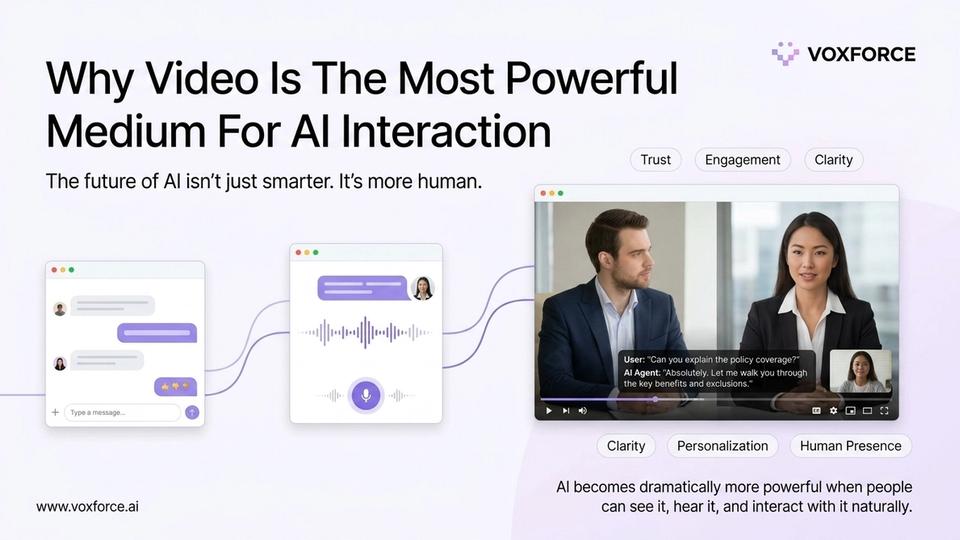
For decades, digital interaction has been built around text.
Users typed commands into search engines, navigated websites through menus, and later began interacting with chatbots through text-based interfaces. Even today, most AI systems still rely on the same interaction model. A user asks a question in a chat window, and the AI responds with written text.
The intelligence behind these systems has advanced dramatically. The interface has not.
That gap is becoming increasingly visible.
The future of AI interaction may not depend entirely on making AI smarter. Large language models are already capable of generating sophisticated responses. The real shift now lies in how humans communicate with AI systems. And increasingly, video is emerging as the most powerful interface for that interaction.
At VoxForce.ai, we believe AI interaction is evolving from simple information exchange toward something far more immersive: simulated presence. AI video agents combine conversational intelligence, voice interaction, and lifelike visual communication to create experiences that feel more natural, intuitive, and human-centered than text-based systems ever could.
This is not simply an upgrade to chatbots. It is a redesign of digital communication itself.
The Real Limitation of Chatbots Was Never Intelligence
Most conversations around AI customer engagement focus on the quality of the underlying model. Businesses ask whether AI can understand context better, provide more accurate responses, or automate workflows more effectively.
But the deeper limitation of traditional chatbots was always the communication medium itself.
Text is efficient for transactional exchanges, but it performs poorly when interactions require trust, explanation, reassurance, or sustained engagement.
Consider a customer trying to understand a complex insurance policy online. A chatbot may provide technically accurate answers, but the user still needs to read dense explanations, interpret terminology, and mentally reconstruct meaning from text alone. The experience feels effortful.
Now compare that to a conversational video AI agent explaining the same policy verbally while guiding the customer through key coverage points naturally and conversationally. The interaction feels clearer, more attentive, and easier to follow.
The intelligence may be identical in both systems. The experience is not.
This is because communication is not only about words. Human understanding depends heavily on tone, pacing, facial expression, emphasis, and visual context. Text removes nearly all of those signals.
Video restores them.
At the same time, businesses are discovering that improving AI performance alone does not solve customer frustration. Many AI systems still struggle with nuanced, multi-turn interactions because intelligence without intuitive communication creates friction rather than clarity. The next evolution of AI customer engagement depends not only on what AI can say, but how naturally users can engage with it.
Human Communication Was Built Around Presence, Not Text
For most of human history, communication relied on face-to-face interaction. People evolved to interpret facial movement, eye contact, vocal tone, and conversational timing instinctively.
These signals shape trust and attention long before words are consciously analyzed.
This is one reason video communication feels fundamentally different from text interaction. Humans naturally associate faces with responsiveness and intent. Even when users know they are interacting with AI video avatars, voice and visual presence create a perception of engagement that text interfaces cannot replicate.
The result is psychological as much as technological.
Text requires cognitive translation. Users must read information, interpret tone, and reconstruct meaning mentally. Video reduces that cognitive load because expression, pacing, and emphasis are delivered automatically.
Research suggests the human brain processes visual information up to 60,000 times faster than text, while nearly 90% of the information transmitted to the brain is visual. These behavioral patterns help explain why conversational video AI feels significantly more intuitive than static chatbot interactions.
This matters enormously in digital environments where attention spans are shrinking and users expect frictionless experiences.
The rise of short-form video across social platforms already reflects this broader behavioral shift. People increasingly prefer watching explanations over reading them because video aligns more closely with how the brain naturally processes information.
Conversational AI interfaces are beginning to evolve in the same direction.
Why Video AI Creates Better Customer Experiences
The strongest advantage of AI video interaction is not novelty. It is communication efficiency.
Video combines multiple layers of information delivery simultaneously:
- spoken language
- visual guidance
- emotional signaling
- conversational pacing
- facial expression
- tonal emphasis
No text-based interface can deliver all of these elements together.
This changes how users absorb information and respond emotionally during interactions.
For example, a first-time homebuyer navigating loan eligibility is far more likely to stay engaged when an AI video agent explains repayment structures conversationally rather than forcing the customer to interpret dense banking terminology alone.
In SaaS onboarding, customers often abandon setup processes because support documentation feels overwhelming. A conversational video AI agent can walk users through product configuration step by step in real time, reducing confusion during one of the highest-risk stages of customer drop-off.
In healthcare, patients are more likely to engage with spoken guidance delivered visually than long written instructions filled with technical language. In e-commerce, conversational video AI can answer objections, explain products dynamically, and guide customers through purchasing decisions in ways static FAQs cannot.
The interaction shifts from passive reading to guided conversation.
That distinction matters because modern customer experience increasingly depends on reducing friction.
The Economics Behind the Shift to AI Video Agents
The rise of conversational video AI is not driven only by user preference. It is also driven by business economics.
Historically, companies faced a difficult trade-off between personalization and scalability.
Human interaction created trust and depth but was expensive to scale. Automation created efficiency but often reduced customer satisfaction because interactions felt impersonal and rigid.
AI video agents are the first major attempt to bridge both simultaneously.
Businesses can now deliver conversational, personalized engagement at internet scale without increasing support and sales headcount proportionally.
This matters because customer expectations have changed dramatically.
According to Salesforce research, 67% of consumers become frustrated when customer service cannot resolve issues instantly. At the same time, 54% of consumers say they do not care how they interact with a company as long as their problem is solved quickly.
This reflects a broader behavioral shift.
Customers are becoming less attached to whether interaction is human-led and more focused on whether it feels effective, responsive, and convenient.
Video AI communication addresses all three.
However, not every interaction requires video. Simple transactional requests may still be faster through text interfaces. But as soon as communication involves trust, onboarding, persuasion, explanation, or reassurance, visual interaction becomes significantly more effective.
That is where conversational video AI creates its greatest advantage.
From Transactional Automation to Simulated Presence
Traditional chatbots automate tasks. AI video agents simulate conversational presence.
That difference represents the next major evolution in AI interaction.
In a traditional chatbot flow:
- the user types a question
- the AI returns written text
- the user scans the response
- clarification requires more typing
- engagement often drops quickly
In a conversational video AI flow:
- the user speaks naturally
- the AI responds conversationally
- explanations feel guided rather than static
- follow-up questions happen fluidly
- the interaction feels active and responsive
The technology no longer feels like a software tool. It begins to feel like communication.
This transition mirrors earlier interface shifts in computing history. Command lines evolved into graphical interfaces because visual interaction reduced complexity. Mobile apps replaced many desktop workflows because touch-based interaction felt more intuitive.
AI is now entering a similar transition from text interfaces toward conversational video environments.
Over the next several years, websites themselves may evolve from static navigation systems into conversational environments where AI video agents become the primary layer for product discovery, onboarding, support, and decision-making.
Search bars, FAQ pages, and long support menus may gradually become secondary interfaces as conversational AI becomes capable of guiding users directly through workflows and choices in real time.
Why Video Will Define the Future of AI Interaction
The future of AI will not be shaped only by model intelligence. It will be shaped by interface design.
Businesses often assume the next breakthrough in AI customer engagement will come from larger models or better automation. But the more important opportunity may lie in making AI feel easier and more natural to communicate with.
This is why conversational video AI matters so deeply.
It transforms AI from a tool users operate into an experience users engage with.
At VoxForce.ai, we believe the companies that define the next era of AI will not simply build smarter systems. They will redesign communication itself.
VoxForce.ai is helping shape this category through AI video avatars, conversational intelligence, enterprise integrations, and scalable infrastructure that enables organizations to deploy AI-powered digital agents across customer touchpoints.
The objective is not to imitate humans superficially. It is to create communication systems that align more closely with how humans naturally interact.
That is where the future of AI is heading.
The Next Interface Layer Has Already Arrived
Technology history follows a recognizable pattern. Every major computing shift introduces a new interface that changes how humans interact with machines.
Graphical interfaces transformed personal computing. Mobile interfaces transformed internet access. Conversational AI is now reshaping digital communication.
But the next stage of that evolution will not look like text chat.
It will look increasingly visual, conversational, and presence-driven.
AI video agents represent the beginning of that transition.
And the companies shaping the next decade of AI will not simply be those building more powerful models. They will be the ones redefining how humans communicate with intelligent systems altogether.